

I’m back from holiday, rested, and slowly but surely getting back into writing mode.
First, some belated self-promotion. An opinion piece and a podcast interview came out while I was away:
In my monthly piece in The Information, I wrote about The Question Plaguing Connected TV: Who’s Watching?
“Decoding the Streaming Wars”, a fun discussion with Amobee’s SVP of Marketing, Pam Zucker and GM Head of Growth, Valerie Bischak (Amobee is a Cross-Channel Video Advertising Platform, the interview is ~40 mins, you can watch the full interview here and you can watch a short excerpt on LinkedIn here).
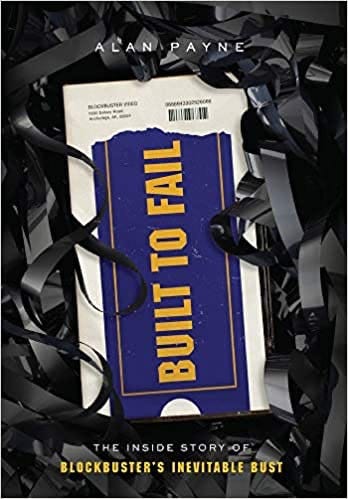
While on holiday I started reading “Built to Fail: The Inside Story of Blockbuster's Inevitable Bust” about the former VHS and DVD rental retail behemoth.
It was written by former Blockbuster executive Alan Payne, and it was recommended to me by a friend for being “fantastic on data, analytics, fat tail vs long tail, and knowing your customers”. I’m now halfway through it and a point Payne makes early and consistently has stuck with me. Blockbuster’s “lack of curiosity about what went on in the stores, as well as competitors’ stores, left gaping holes in its understanding of the business”.
He adds “If you rented from Blockbuster, they knew almost as much about you as your banker. They knew every customer’s gender, age, address, and every movie they ever rented—hundreds of millions of them.”
Payne details and highlights how that “lack of curiosity” was a top-down, cultural and organizational problem core to the DNA of Blockbuster and its management team under its original owner Wayne Huizenga. The metric of growth of total stores was prioritized over all other metrics, including in-store revenues, gross margins and cash flow. The scale of that missed opportunity is now reflected in Netflix’s 220MM+ subscribers.
If we rewrite that statement as “the metric of growth of total content spend was prioritized over all other metrics, including revenues and cash flow”, it reads an awful lot like Wall Street’s recent criticisms of legacy media streaming strategies.
It could be argued legacy media’s “lack of curiosity” about its consumers in streaming has been two-fold:
What its consumers want (personalization) and,
Who is watching advertising on those services (ad targeting).
This “lack of curiosity” may reflect a top-down, cultural and organizational problem that every legacy media streamer is its own “walled content garden, blocking out or strictly limiting access to competitors’ content”.
Blockbuster’s challenges with data
Payne describes Blockbuster as: “The company that had all the data could never seem to understand what customers wanted before someone else figured it out first.” Blockbuster simply never built out the store level or centralized databases to improve its business, and more importantly, better understand its consumer.
Payne repeatedly highlights how management under sequential owners Wayne Huizenga and Sumner Redstone’s Viacom simply did not care to do so, and that became the cultural and operational default mindset at the company.
That even played out when Netflix emerged as a competitor in the early oughts. In 2004 Blockbuster launched its own “Netflix-in-a-store” model called Movie Pass in response:
Netflix was passionate about understanding what all their subscribers were renting, and they used this data to create intensely loyal customers. In stark contrast, Blockbuster’s first response to Netflix did not have a reporting system that could show franchisees what Movie Pass customers were renting and, as a result, they couldn’t understand its effect on sales or rental behavior.
Without this understanding Movie Pass failed, and the rest is Netflix’s history.
1. Personalization
Netflix, Hulu and HBO Max may be the only services offering personalization (all say they do, but it’s not frequently discussed).
Consumers want more personalization in streaming, as reported in a previous Accenture study - Streaming’s next act. I highlighted the study in Consumers & CTV Advertisers vs. Publisher "Walled Gardens": “A majority of consumers globally said they’d like to be able to take their profile from one service to another to better personalize content (56%); and they’d be happy to let a video-on-demand service know more about them to make recommendations more relevant to them (51%).”
But because legacy media companies are "walled gardens", audiences are locked into particular services, and therefore publishers are unable to understand consumer preferences holistically.
Accenture highlighted the impact of this problem both on publisher data and their recommendation engines:
Many algorithms generate recommendations based on an incomplete viewing history—and those recommendations can be wildly off base. Furthermore, the reliance on the algorithm to pitch consumers shows doesn’t allow consumers to tune the model, except through actual show selection.
So, “walled gardens” may be to blame for a “lack of curiosity” in streaming reflected in a lack of solutions for in-app personalization of recommendations.
2. Advertising
“Walled gardens” also impact advertising: the data publishers intend to sell to advertisers from “walled gardens” is limited by incomplete viewing histories and/or subscale offerings. Advertisers and media buyers are forced to build their own models of consumers across “walled gardens”, and that results in a whole new set of problems - including the “walled gardens” of Smart TV manufacturers and Over-the-Top (OTT) streaming devices (NOTE: I dove into this problem in The Question Plaguing Connected TV: Who’s Watching?).
As I wrote in Consumers & CTV Advertisers vs. Publisher "Walled Gardens", market demand for better consumer data from publishers is only going to grow:
As the growth of e-commerce sales continues to outpace U.S. retail sales, the data needs of both 200 “retail-cartel” advertisers and 10MM e-commerce advertisers are going to drive the evolution of linear and CTV advertising. All will increasingly rely on publishers to supply better data on consumers to improve the reach, segmentation, variability, and complexity of their marketing. But not all publishers will not be able to meet that evolving demand.
As former GroupM chief digital officer Rob Norman has argued, advertisers and premium publishers (including TV networks) struggle to negotiate the intersection of old (more content-driven) and new (more data-driven) advertising models. His argument is that first-party data these publishers have is sizable but insufficient:
Right now, premium publishers have plenty of first-party data, but they also need other kinds of data. First-party data from their advertising customers is another piece of the puzzle but also zero party data. This is data that comes from consumers based on questions they’re asked directly rather than inferred and behavioural data.
Instead of solving this problem, premium publishers and many advertisers have defaulted to a “co-dependent relationship” where neither solves the problem of consumer data. This is best reflected in the linear market lingering around $68B in total spend in the U.S. between 2017 and 2025, despite accelerating cord-cutting trends reducing the total number of linear households.
So, "walled gardens" may also be to blame for the “lack of curiosity” of legacy media streamers in better understanding their consumers for advertisers. But, unlike Blockbuster’s blind pursuit of growth defined by "a singular focus" on growing total stores only, they reflect how legacy media companies must avoid cannibalizing a near-guaranteed market of $68B in annual linear ad spend.
The culprit: “walled gardens”
What we’re seeing in legacy media streaming seems to be a new iteration of what we saw with Blockbuster: “The company that had all the data could never seem to understand what customers wanted before someone else figured it out first.” Although now, I might update it to say, “The legacy media companies do not seem to have all the data to understand what consumers want to watch, or what they want to buy, or who in the household is actually seeing their ads”.
One obvious culprit is “walled gardens”. On the one hand, “walled gardens” are the value proposition of streaming services to the marketplace. Moreover, it’s the value proposition at Upfronts that says, effectively, “we have aggregated audiences at scale that others cannot”.
On the other hand, “walled gardens” reflect inherent top-down, cultural and organizational problem constraints to better understanding consumers who increasingly want to be understood better by streamers and by advertisers (more relevant ads and less repetition).
“Walled gardens” ultimately reflect $68B “stuck in a limbo of both inelastic demand for linear and declining size from competition”- as I argued in $68B in Linear Ad Spend & Netflix, It's Early Days for CDPs in Media. As long as that limbo exists, the comparison of legacy media streaming efforts to Blockbuster’s path to failure will be an imperfect but fair one.