In my recent essays about YouTube creator monetization, I’ve cited that only 4.4% of YouTube’s 67 million creators monetize their content. I tested this figure and related power law calculations using Google’s Gemini platform—and it delivered contradictory data worth examining, particularly because the responses “come straight from the horse’s mouth”.
What I found raises questions about AI as both a feedback mechanism and curator. Normally this essay would be titled “Reader Feedback” but here it is “AI feedback”. That shift reveals something important about how information gets verified when AI tools curate and/or replace human sources.
1. The $100 Billion Payout (Since 2021)
Gemini reports that YouTube has paid out over $100 billion to creators, artists, and media companies since 2021, with payouts accelerating from $70 billion (2021-2024) to $100 billion by late 2025.
It added two caveats that undermine this as evidence of creator success.
First, that $100 billion also includes artists (music royalties) and media companies (like Disney, Netflix, or sports leagues), implying the payouts to creators from that $100 billion are substantially smaller.
Second, the acceleration is driven by YouTube Shorts monetization and Connected TV viewership, not improvements in creator economics. It is worth asking: If $100 billion is being paid out but 93% of creators still can’t monetize, where is that money going? The data suggests extreme concentration—major media companies and top creators capturing the majority while the bottom 93% see nothing. Gemini does not tell us more.
2. The Partner Program (YPP) vs. Total Creators
Gemini cited an article in SQ Magazine claiming the YouTube Partner Program now supports over 5 million creators out of “roughly 69 million people who identify as ‘creators’ on YouTube”—or about 7% to 8%.
This data still supports my thesis: 92-93% of creators still cannot monetize. Gemini’s explanation reveals why: “The remaining 60+ million creators are either hobbyists, haven’t met the 1,000-subscriber/4,000-watch-hour threshold, or are in countries where YPP isn’t available.”
However, I cannot verify these numbers. SQ Magazine provides no sources, and Gemini offers no direct YouTube or Google citations.
3. The “Creator Middle Class”
Gemini pushed back on my analysis of YouTube’s “top-heavy” power law distribution, citing “recently released data” that channels earning $100,000+ per year grew 45% year-over-year, “specifically among those whose content is watched on TV screens.” It sourced this to The San Antonio Observer, a publication I am unfamiliar with as a YouTube data resource and one of many to cover YouTube’s 20th anniversary “Made on YouTube” event.
Again, Gemini reinforced the power law problem, and did not refute it. If earnings concentrate among creators whose content performs on Connected TV—the fastest-growing viewing surface—that reinforces my point about “Power laws within power laws.” Algorithmic advantage compounds for winners while the bottom 93% remain shut out. A 45% increase in six-figure earners fails to address the 64 million creators earning nothing.
It also pointed out that YouTube is pushing “Fan Funding” (Memberships, Super Chats, and YouTube Shopping) to help smaller creators monetize without relying solely on ad revenue. Past data cited from eMarketer made that point, but Gemini cited a post from a site called “Buzzincontent”.
Gemini added in a footnote that the “barrier to entry” for the YouTube Partner Program was actually lowered in 2023/2024 to allow creators with 500 subscribers to access fan funding, though they still need 1,000 subscribers to get a share of ad revenue. Rather than cite Google, it cited a website called VidIQ with which I am also not familiar.
The Problem: AI Feedback vs. Search Feedback
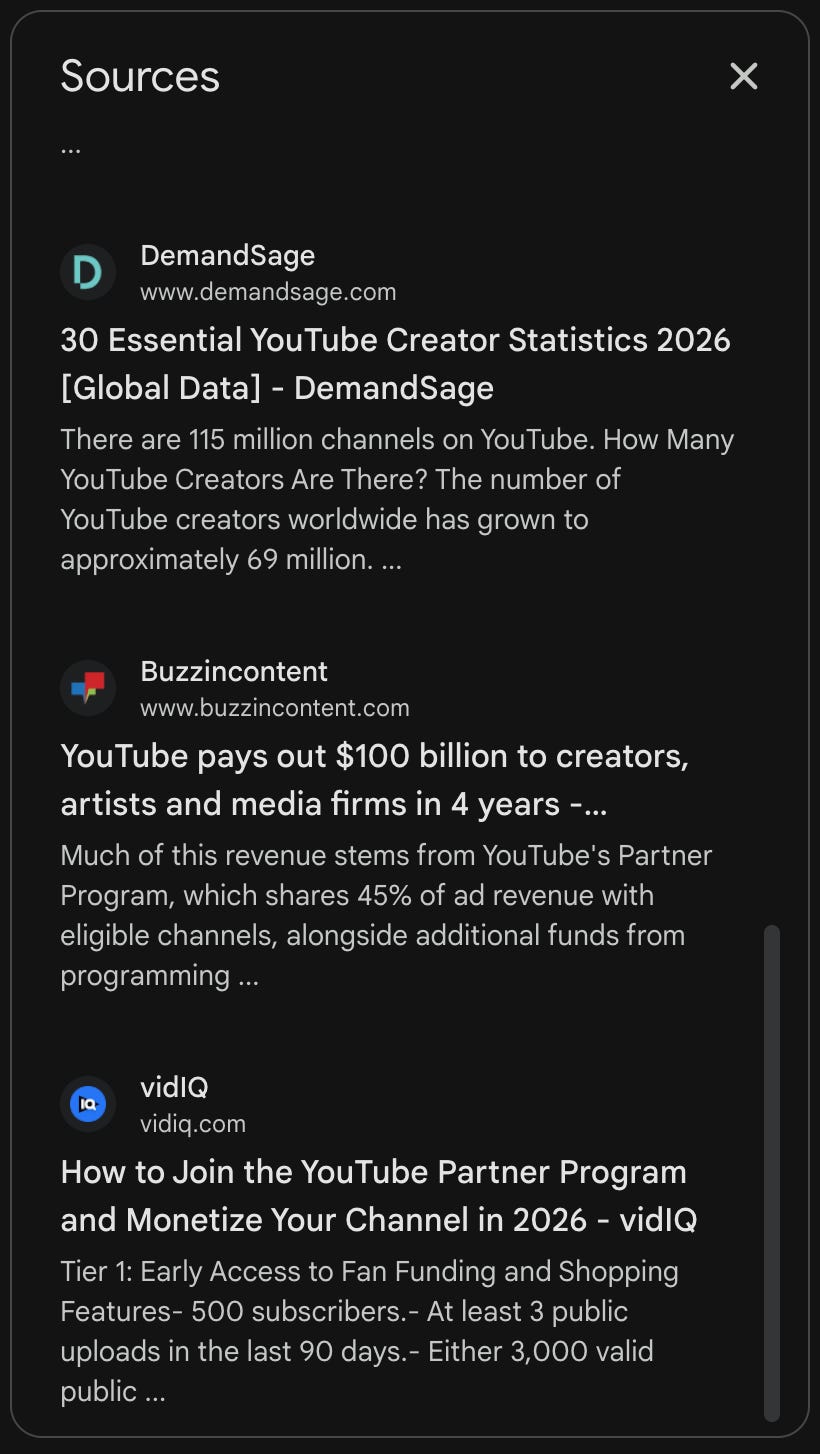
Across all three data points, Gemini cited third-party blogs and unfamiliar publications—including SQ Magazine, The San Antonio Observer, Buzzincontent, VidIQ—instead of YouTube’s official creator resources or Google’s own data releases.
Google Search has established itself as a reliable narrator, instantly surfacing links to YouTube’s official blog or a press release in its first 10 results. Gemini sent me to third-party interpretations in its footnotes—even when discussing Google’s own platform.
When Gemini is citing data for YouTube, the sources should be from Google or YouTube itself. These citations are not. Sources from Google and YouTube are not readily available in Gemini or easy to discover via a Google search. So the citations raise questions and Gemini seems unreliable as a source of independently verifiable information.
This makes Gemini an “unreliable narrator“—a narrator whose credibility is compromised. It positions itself as authoritative (”straight from the horse’s mouth”) while citing unverified third parties. It presents data that appears designed to rebut criticism without providing first-party evidence. And it frames statistics that actually reinforce power law concentration (45% growth among $100K+ earners) as evidence against it.
A Curation Problem
Gemini’s obvious problem is that it has obvious shortcomings as a curator.
The irony is that, if we believe Samir Chaudry of the YouTube creator duo Colin & Samir, curation and not attention will be the scarce resource going forward. He framed it in a recent LinkedIn post as “an abundance crisis in the creator economy“ which is happening within the context of both the supply of and demand for “good creators and good content” having never been higher.
I am not familiar enough with SQ Magazine, Buzzincontent or The San Antonio Observer to tell you if they are “good creators and good content”. If they are, Gemini has done me a service. If they are not, Gemini has done me a disservice. It has done that anyway by not sourcing Google sources.
Gemini appears to struggle with an abundance of sources and opts for smaller, third-party sources over first-party sources. In that sense it is not different from its human users.
Is that why these three publications were recommended? No. My guess is Google needs better optics so that it does not appear as “the grim reaper” of small publications.
That said, this has obvious implications for storytellers. Chaudry is saying storytelling, alone, is no longer enough. He argues that, “in a world where everyone is big, just being big isn’t that special.” For this reason, “Viewership and reach won’t be the differentiators of the abundance era, narrative and brand will be.”
I do not buy that the three publications above have narrative and brand. I do buy that Chaudry is a well-informed visionary in the creator market.
The question that this Gemini exercise raises is, if not Gemini or other AI platforms, then who will be the best curators of storytelling (and first-party data)?
Chaudry does not say. The answer to his question seems to be the opportunity.