

Reminder #1: as you can see above, I have rebranded this newsletter to The Medium. It's the same newsletter focused on three to four key trends per quarter, but it is now oriented a bit more narrowly.
And, as you may have figured out, the new branding is a nod to Marshall McLuhan's "The medium is the message" and my focus on the moving pieces of media's evolution from wholesale to retail models.
PARQOR will remain the primary corporate brand, and I will be building out membership services under that brand. Watch this space!
Reminder #2: This mailing is going out on a Tuesday because of the holiday weekend.
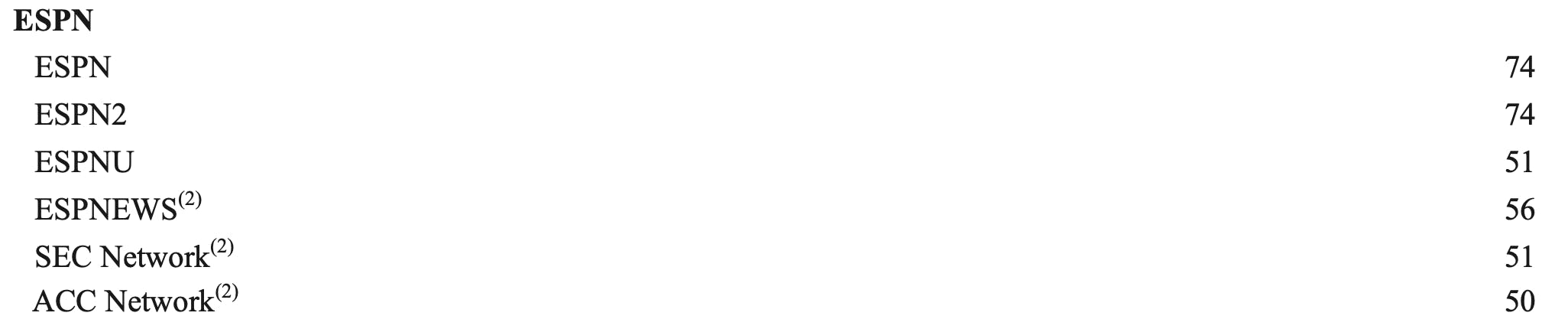
Note on: A reader pointed out to me that in Monday's mailing, I forgot to mention that ESPN is not the only channel Disney distributes under the ESPN brand. There are five additional channels, as you can see below in a screengrab from Disney's most recent 10-K filing, all of which also command premium prices.
The endlessly quotable Warner Bros. Discovery CEO David Zaslav offered two new quotes that got media attention at the recent SVB MoffettNathanson Technology, Media and Telecom Conference.
The first was a pro argument for bundles: “For me, it seems very clear that if we were to package this great product that we have with others, if we were to wake up tomorrow and in each market, if we're the #1, 2 or 3 product, if we were marketed with 2 or 3 for a specific price, it would be great for consumers.”
Second, he offered data suggesting HBO Max is a hit-driven streamer: “What are people watching? And we could see that 5 shows or 90% of what people are watching on HBO Max. And if we put it to 20 shows, it's 98% of what people are watching.”
No one seems to have yet pointed out that these statements fundamentally contradict: if consumers only consume a handful of shows, then in the long run, won’t they value those shows more than a bundle of apps?
It is worth considering this contradiction in light of last month’s essay, "It's about the free money... and it's about the free money.” That essay argued:
The TV and movie industries — as we understand them today — are the product of “free money”. That source of capital is steadily disappearing as cord-cutting accelerates and movie distribution evolves towards streaming.
Nature abhors a vacuum, but it is now unclear what will replace “free money”.
The contradiction offers us a rare insight into how executives are thinking about the question: what will a post-”free money” business model in media look like?
Key Takeaway
If Warner Bros. Discovery can't solve for its consumer database, it will not be able to unlock new sources of "free money". It seems like an unfair challenge given how complex the consumer database space has become, but what other solution is out there?
Total words: 1,700
Total time reading: 7 minutes
Churn
Zaslav told the conference attendees that “the biggest problem with all the streaming services is churn”. As a longtime linear executive, he has historically benefited from the low churn rates of the wholesale model, which until the early 2010s or so was 1%.
Recent data from analytics firm Antenna shows that HBO Max churn was at 4.94% in September 2022, but jumped to around 7% in January 2023, and has held steady since. Zaslav’s pitch was that both an expanded library of content and the relaunched, rebranded Max app will help to reduce churn.
There is nothing new about a media executive openly worrying about streaming churn. Even Netflix executives have done so on recent calls. But, in terms of “free money”, Zaslav has two problems with churn: first, accelerated cord-cutting is creating higher churn rates than linear. Meaning, the 1% churn rate is gone. Continued linear penetration to 60 million pay TV households (and 74 million including virtual cable networks) has been his bet on “free money”, to date. But, in Q1 2023 that churn has gone up to 4% quarterly, or 16% annually. There is exponentially less and less “free money” available for his business.
Second, streaming is not a “free money” business model. It seemed to be when interest rates were near zero and billions of dollars of debt could be easily taken on with the expectation that streaming would drive similar returns to linear. But given its high average churn rate (~6% in September 2022, according to Antenna) it is not producing monthly guaranteed revenues like a bundle of cable channels produces. [Note: that linear “free money” is key to Warner Bros. Discovery’s free cash flow, which it needs to pay down the “free money” its predecessor AT&T took on in debt over the past decade.]
Antenna data on the Disney+ bundle suggests Zaslav and his team may be right that a bundle will be a solution to churn. As of September 2022, the Disney+ bundle helped to reduce churn for ESPN+ by as much as 60%, Hulu’s churn by as much as 50% and Disney+’s churn by 25%. So, bundling Discovery+ content with HBO Max within Max should also reduce churn, though not by much: as of September 2022 Discovery+ was at 5.7% churn, or 19% less than HBO Max’s March 2023 churn rate.
Content > app
But, Zaslav seems to be ignoring the lesson that AMC Networks Executive Chair James Dolan has been sharing with investors: the direct-to-consumer business model requires a “culture change” in legacy media businesses away from the longstanding wholesale model—which isolates the producer from the consumer—and toward “understanding the customer and serving them well.”
The Antenna data also shows that if Warner Bros. Discovery understood his customers, they do not *need* any of those apps like they did a cable box: the Disney+ bundle had a 3.2% churn rate in September 2022, or over 3x the linear model’s churn. In other words, the consumer has needs and a streaming app sometimes but does not always meet them.
When five shows make up 90% of viewing on HBO Max and 20 shows make up 98% of viewing, consumers are telling Warner Bros. Discovery that they do not require as much content from the company as executives may assume they do.
A streaming application may be only as good as its content, and therefore the content is more important than the app, but only when the consumers want the content. There is an open question of what the consumer's need for an app is when they do not need its content. The available churn rates for other apps tell this story — most above 5% as of September 2022 — except for Netflix which has the lowest churn rate in the marketplace at around 3%.
It is important to note that these data points reinforce why Netflix spends $17 billion on content annually: it added 891 Netflix Originals series and movies in 2022, or over 74 titles per month or 2.5 titles per day. Netflix’s intent with its spend is not to have consumers watch 74 new titles per month, but rather, as it tells investors: “The internet allows us to offer a wide variety, and to have our user interface quickly learn and make recommendations based upon individual users' tastes.” The data also reinforces why Netflix has pivoted into adding both gaming and ad-supported business models in its app and within less than two years.
Also, in “free money” terms, zero interest rate policies allowed Netflix to raise billions in cheap debt to fund content that was fed into its user interface recommendation algorithms. In turn, a “flywheel” emerged — a consistent supply of content led to more data on consumer preferences which led to content recommendations keeping users from churning out. Netflix defines content as more important than the app, and personalized recommendations help to solve for "when" the consumers "want" the content.
An end to eight year CLVs
In this light, Zaslav seems to be openly wrestling with the question: In a post-”free money” world, what should be a media company's value proposition when outside of the moments when they want its content?
In other words, “free money” is a problem of consumer lifetime value (CLV), and Zaslav is openly worrying whether a media company can create CLV in 2023. The CLV metric informs a business what the average customer is worth to a business over the course of the relationship. It is a simple equation: the customer value per month times the average customer lifespan. In a retail model like streaming where this greater churn, customer value is the average monthly fee times total number of monthly subscriptions over the period.
The beauty of the linear model is that the CLV was seemingly infinite (100 months or eight years and more). That was the “free money”. Zaslav believes the obstacle to streaming replacing this lost “free money” is the improving the apps and bundling:
“Imagine you were back 30 years ago and you wanted to watch CBS and you had to download and buy something. And then you want them to watch ABC, had to download and buy something. You wanted to watch MTV. It's not a good consumer experience. So a lot of that is going to change, I believe, over the next couple of years. And we're going to try and push toward that change because we have a lot of great content.”
Disney CEO Robert Iger seems to agree with him: Iger announced on the FY Q2 2023 earnings call that Hulu will be available as a tile within Disney+ later this year. Hulu originals and FX content will be on Disney+ and the Hulu app. Content may not solve for CLV, alone, but optimizing the value proposition of content across distribution channels is an important step (and, notably, Iger seems to be moving from Hulu’s personalized user interface which would put him closer to Netflix’s model than Max’s).
Consumer data
So, the real questions lurking in Zaslav’s quotes are: What are the retail models that create CLV when “free money” no longer does, and how does a company build them?
I touched upon this question last week in “Consumer Data May Be Too Complex for Media's DTC Models”:
what we are witnessing in real-time are media companies trying to build and evolve for their own consumer databases. At the same, the advertisers who buy from them are also building and evolving their own consumer databases in response to anti-tracking.
These dynamics do not necessarily make it harder for media companies to build and launch direct-to-consumer products and lines of business. But, it reads like it makes it harder to build broader ecosystems beyond a single service or handful of services.
Rephrase that last sentence with “beyond a single streaming service or bundle of streaming services” and it becomes Zaslav’s point. What consumers want from a streaming service is proving to be narrower than what Warner Bros. Discovery had assumed (but not its WarnerMedia predecessors).
That said, the consumer data lens suggests Zaslav may be framing the problem incorrectly. Not just in terms of a problem with streaming as a business, but whether his challenge in creating CLV and “free money” may be more accurately framed as a consumer database problem.
If Warner Bros. Discovery can't solve for its consumer database, it will not be able to unlock new sources of "free money". It seems like an unfair challenge given how complex the consumer database space has become, but what other solution is out there?