

PARQOR is the handbook every media and technology executive needs to navigate the seismic shifts underway in the media business. Through in-depth analysis from a network of senior media and tech leaders, Andrew Rosen cuts through what's happening, highlights what it means and suggests where you should go next.
In Q4 2022, PARQOR will be focusing on four trends: this essay is on the theme, "Hollywood’s future lies in the creator economy, what happens next?”
Two weeks ago I attended the first-ever PromptTopia. It was hosted at the offices of Union Square Ventures, and it offered “a day of presentations and conversation exploring what’s happening when you have an interface shift into the creative possibilities of audio, speech, art and video in the AI space.”
The focus of that day was the user experience of the “prompt” - entering text into an Artificial Intelligence (AI) engine text box which looks like any search box on any website, and the AI system generates audio, speech, art or video based on that text. It was all built on stable diffusion or DALL-E, which are AI engines primarily used to generate detailed images conditioned on text descriptions.
We saw demos for nine different engines and use cases. We ended with Holosheet, where “you input a prompt and the AIs generate story, visuals and a title”. In other words, write a story idea like “The wizard approached the abyss" and the AI generates a storyboard that looks like the one below.
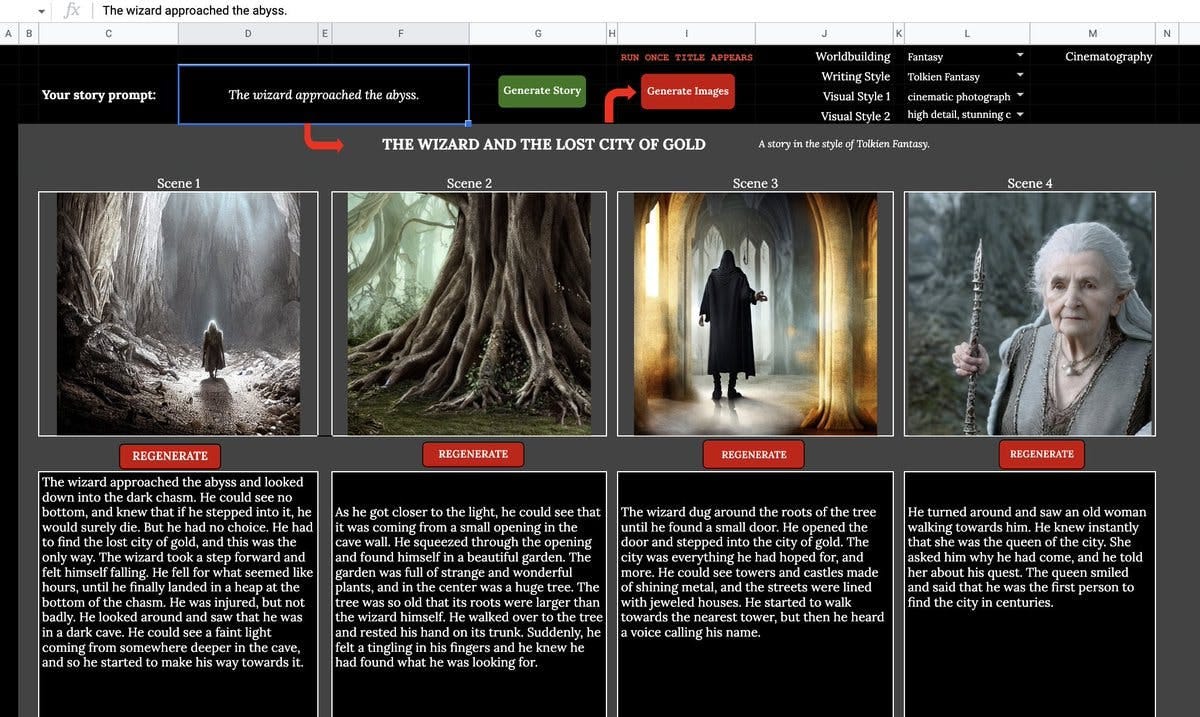
In this moment, Holosheet looks like an AI companion to screenwriting, basically an AI tool like Grammarly but for a niche group of writers.
The technology is rapidly evolving, and the use cases are rapidly expanding. There are plenty of essays being written and to be written on the topic.
The challenge is where to begin from PARQOR’s perspective. I think the best starting point is the text prompt itself. Because it hits on “The Netflix Paradox”, “'The Office' Paradox” or “The YouTube Paradox” that I wrote about in August, and which I wrote about again last week: the “walled garden” model is unusually vulnerable to the power of third-party platforms like YouTube to find more audiences with the same content.
So what will happen when third-party platforms powered by AI can deliver video and photo interpretations of owned and original content?
Key Takeaway
However AI, stable diffusion and DALL-E end up transforming video, the best business models for AI-generated video content may still end up being creator economy business models.
Total words: 1,000
Total time reading: 4 minutes
I think the most helpful example is the one that “The Office” writer and actor B.J. Novak delivered on the Recode Media podcast, after host Peter Kafka asked him whether the show felt “less popular” since it left Netflix. Novak answered: “I thought it would feel less popular, but the weird thing is, when I ask teenagers who say ‘We love “The Office!”’—I say, ‘Do you watch it on Peacock?’ And more often I hear, ‘No, we watch it on YouTube.’ People will watch highlight reels of it and consider that the show.” He said a teenager at a children’s hospital recognized him not from the show but from the “you rolling your eyes” meme.
Put in terms of a text prompt, audiences enter a text prompt like “the office ryan” into YouTube to discover “The Office” content, and the search box autofills text like “the office ryan started the fire” or “the office ryan and kelly”. Users won’t find full episodes and they don’t care. That’s not their intent. Shorter form content is more immediately available, for free, and therefore has more value than a paid subscription. The textbox autofill is a form of AI that is algorithmically recommending content based on the most popular searches on the site.
Entering the AI Rabbit Hole
I have been using Nightcafe AI Art Generator for learning how AI works. I’ve used it for testing visuals of ideas I’ve had a novel, and tonight I tested it with the text prompts “ryan from the office rolling his eyes” with Nightcafe’s Stable Diffusion engine with “B&W Portrait” as the style. Below is what it delivered.
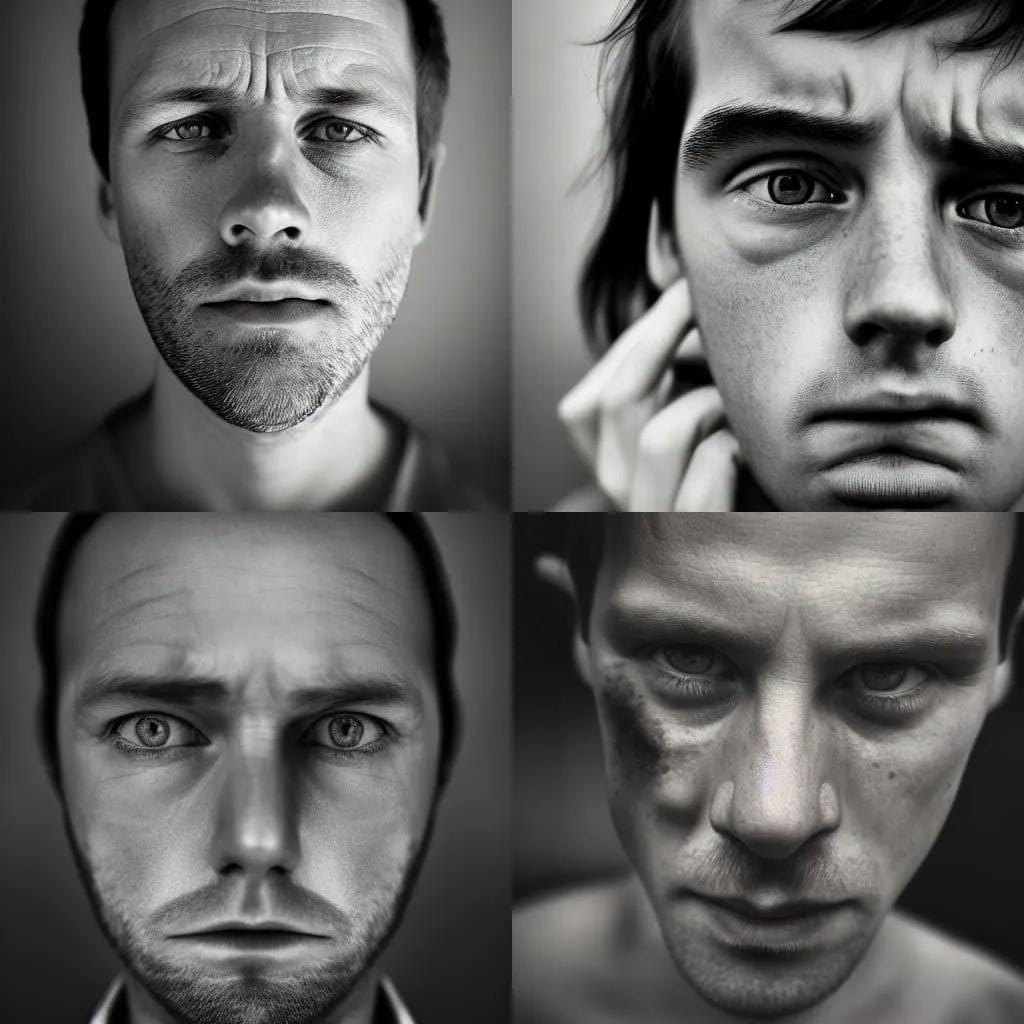
I tried the same settings again but with “the office ryan” as the text prompt. This is what it produced:
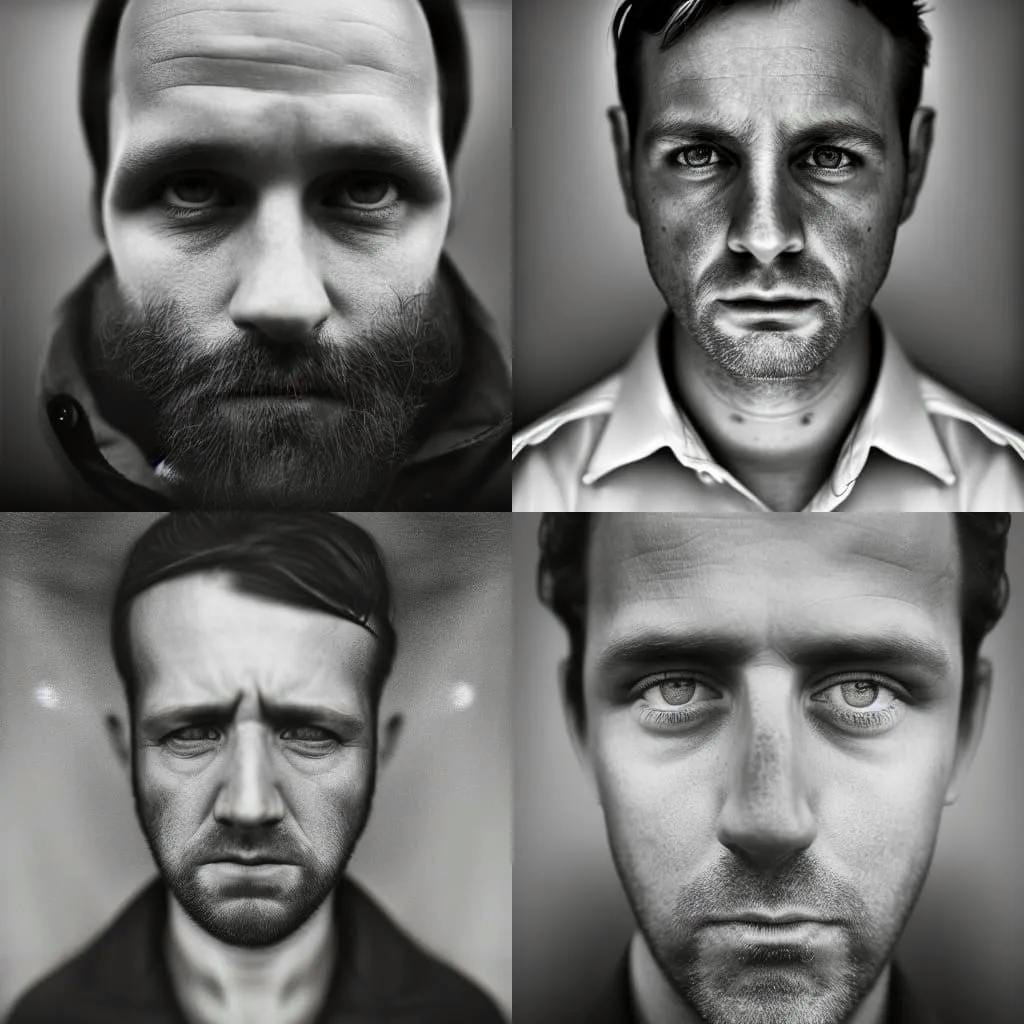
Then I tried “the office ryan” text prompt with the DALL-E 2 AI System which also can generate realistic images and art from a description in natural language, and it produced this.
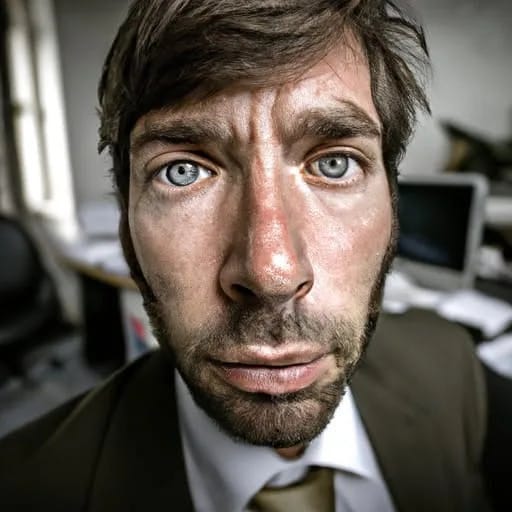
None of these look like BJ Novak, who looks like this:
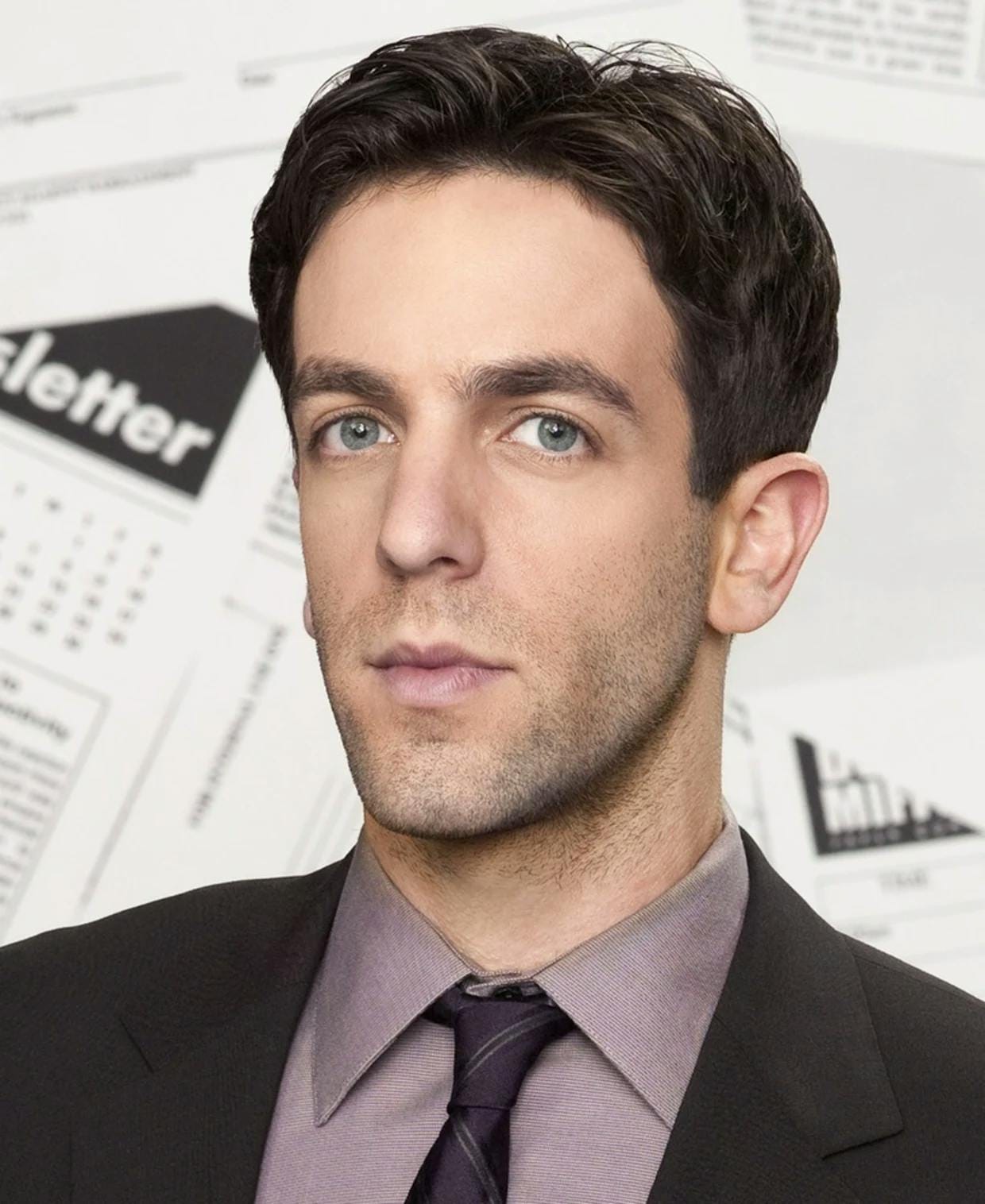
So the value proposition of NightCafe, though amazing, doesn’t map the same way to fan intent as a suggestion in a search box that autofills text related to scenes from “The Office”. The obvious takeaway is AI is not anywhere near meeting the needs of fans of “The Office” the same way YouTube or even Google search do now.
What takes us down the rabbit hole?
Kevin Pereira, a content creator who has been toying with AI video creation, offered an interesting insight on this point at Promptopia. He has been pursuing something similar to what the South Park creators “Sassy Justice with Fred Sassy” series, where actor Peter Serafinowicz did an imitation of Donald Trump and deep fake technology mapped Trump’s face to his (there’s a fun Mark Zuckerberg bit and Michael Caine bit in there, too).
He predicted dead celebrities will be "revived" by AI generative technology, and that old TV game shows like Hollywood Squares would be the optimal format. That doesn’t get us closer to an outcome for something like “The Office”. But it’s a signal that if “The Office” is currently valued more in pieces outside of Peacock than in whole episodes within it, then with AI audiences will value “The Office” more as a framework than respecting the sanctity of the IP and the whole episodes. Because if users can create their own clips now, it's not a huge leap for fans of “The Office” to recast the clips with their own celebrities, living or dead, in the future.
That reads amazing, but there are two questions presented by both walled gardens and “The Netflix Paradox”, “'The Office' Paradox” or “The YouTube Paradox” as to what will be valuable to audiences:
Is recasting "The Office" with dead celebrities a need for audiences that they'll pay for?
If they want this content for free, instead, how will video content be monetized?
Let’s say there are 20 cast members, and AI enables them to be replaced by any celebrity in history… the permutations are endless. But who is that valuable to? There is absolutely no way to tell right now..
The only clear answer we have right now is whenever they do figure this out, the businesses best positioned to host all that content, to target different content to fans of those celebrities with an algorithm, and to monetize it are Netflix, YouTube or TikTok. Because all that content will need algorithms to map different celebrities and different clips to the audiences who are most likely to watch them.
In other words, there is a compelling argument – though early and incomplete – that the future business models for videos produced by AI engines like stable diffusion and DALL-E are going to look a lot like the creator economy.
Must-Read Monday AM Articles
* Getty Images CEO says firms racing to sell AI art could be stepping into illegal territory
* Shutterstock will start selling AI-generated stock imagery with help from OpenAI
* Slow Ventures General Partner Sam Lessin argued on Twitter “Why you should be ‘default out’ on investing in ‘Generative AI’ companies for the next few years.”
The Vibe Shift
* N/A
The 200 vs. The 10 Million
* N/A
Aggregator 2.0 & Bundles
* Amazon just announced a new update for Fire TV which will add deep integration with the company’s Luna game streaming service and its TV platform. 9to5Google argues “it’s exactly the sort of thing Google should have done with Stadia too.”
* A good recap of Disney CEO Bob Chapek’s talk at The Wall Street Journal’s Tech Live conference about the objective of “we can give you a better experience in the park, because we know what your preferences are in terms of viewing and a better experience on Disney+ because we know what your affinities are”. ($ - paywalled)
Sports & Streaming
* Verizon announced that NBA League Pass, a premium direct-to-consumer service for live games, and NBA TV, a service offering 24/7 NBA content are now available through +play
* The NBA has told RSNs that they have to send game announcers to every away game this season, a significant difference from last season when the pandemic caused the league to give RSNs more leeway in how they produce road games.
Creator Economy, Platforms & Transparency
* Snapchat has once again lowered the total amount it's paying to creators who use its short-video feature Spotlight. ($ - paywalled)
* Spotter - “like a VC for YouTubers” - is proving there’s a growing space where startups are investing in creators before they take off.
* Live shopping has yet to break through in the West. But some predict that’s about to change. ($ - paywalled)
* Axios had an overview of Jimmy Donaldson’s aka MrBeast’s empire as he seeks to raise $150MM at a $1.5B valuation
Original Content & “Genre Wars”
* NFL Films is building its 'version of the Marvel universe' with a push into movies, dozens of TV projects, and partnerships with athletes from Tom Brady to Ronda Rousey ($ - paywalled)
AVOD & Connected TV Marketplace
* Amazon and Google have struck a deal that allows Amazon to work with manufacturers like TCL, which also makes Android TVs and phones.
* LG found 80% of consumers use ad-supported models of CTV, with 67% preferring those models over subscription-based CTV services.
* Marketers may be under-using some types of connected TV (CTV) platforms and content genres, according to a new survey commissioned by mobile marketing analytics and attribution platform AppsFlyer (free - registration required)
* Krishan Bhatia, president and chief business officer at NBCUniversal Advertising and Partnerships, insisted to Next TV that real solutions to issues in CTV and streaming advertising exist today.
Other
* N/A