

PARQOR is the handbook every media and technology executive needs to navigate the seismic shifts underway in the media business. Through in-depth analysis from a network of senior media and tech leaders, Andrew Rosen cuts through what's happening, highlights what it means and suggests where you should go next.
In Q4 2022, PARQOR will be focusing on four trends: this essay is on the theme, "Media companies have consumer credit cards on file. What happens next?”
I am now about halfway through “It's Not TV: The Spectacular Rise, Revolution, and Future of HBO” by Bloomberg reporter Felix Gillette and The New York Times reporter John Koblin.
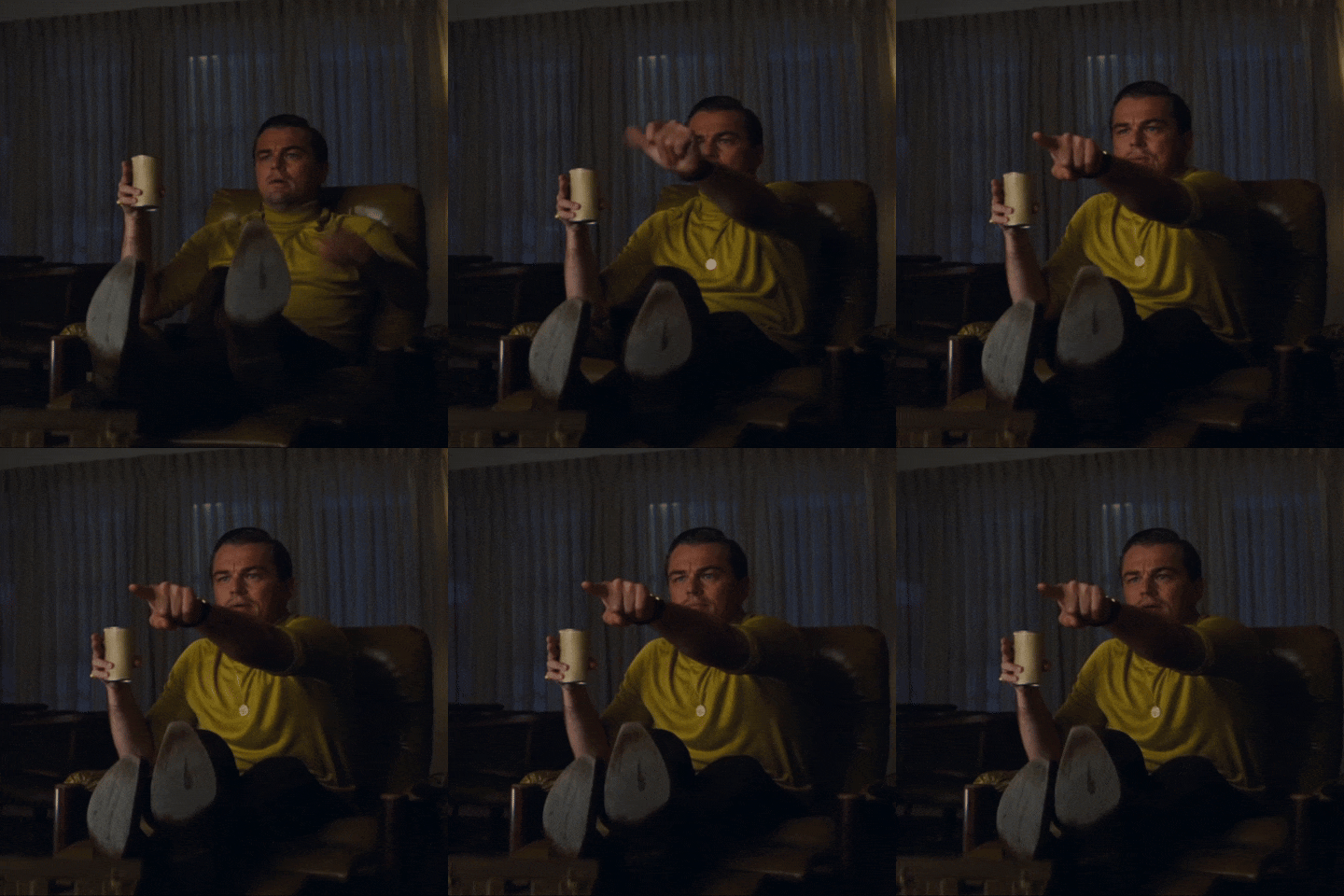
I’ve just finished the section on the AOL-Time Warner merger and had one of those “Aha!” moments that may or may not have looked like the popular Leonardo DiCaprio meme from “Once Upon A Time in Hollywood”. The excerpt was a description of the AOL bosses visiting HBO for the first time:
Shelly Brindle, then a rising executive with HBO’s subscriber marketing group, remembers the first visit from her new AOL bosses. The executives, she says, arrived from Virginia on private jets, sat down at their first big meeting with her team, and asked the HBO staffers to turn over all the subscriber data. The intent, they explained, was to begin comarketing AOL services to existing and former HBO customers. There was an awkward pause. "We were like, um, what subscriber data?" Brindle says."This was after the deal was closed!"
It was left to the HBO staffers to explain that the network didn't deal directly with their customers and that it was the cable companies who collected, retained, and controlled all of the information on HBO subscribers.
The network itself had zilch. "There was nothing we could do to help them, Brindle says. "We didn't have access to the customers. Unfortunately, they didn't realize until after the acquisition that there was really no additive value for either side."
If the dynamics of the story seem familiar, it’s because they’re a fun-house mirror of one of the four trends I’ve been focusing on this quarter: “Media companies have consumer credit cards on file. What happens next?” HBO didn’t have subscriber data or credit cards on file, AOL assumed they did, and a key assumption of the merger – that HBO customers could be easily upsold AOL – was killed (one of many that led to the deal’s reputation as the worst transaction in history). But it’s also a story that left me scratching my head: how did AOL executives buy a cable company without understanding that distributors owned the consumer relationship in 2001?
Key Takeaway
Legacy media management understands DTC business models better than they did in 2001. But there is still both management and investor resistance to better monetizing consumers with credit cards on file.
Total words: 1,400
Total time reading: 6 minutes
I also have been wondering: the marketing and marginal revenue advantages of owning consumer credit card data were an obvious need in 2001… and yet it took legacy media two decades to solve for that need? And they’re still only charging those cards one time?
Many investors — and certainly vocal retail investors with active Twitter accounts — would take this as evidence that current legacy media executives are like the AOL executives, and they simply haven’t done their homework on growing their businesses with direct-to-consumer models. The stock market certainly reflects that story: Warner Bros. Discovery stock fell almost 20% this week and is now down 59% since it debuted in April, and Paramount Global stock fell 18% this week and is down 52% year to date.
But that simply isn’t true: every single legacy media leader betting on a streaming service requires an understanding of DTC streaming by now, especially as heads of public companies with streaming services in the market with millions of subscribers.
Excluding Disney — whose CEO Bob Chapek wants to unite personal data behind its parks and streaming services — no media company or its owner (NBCUniversal is owned by Comcast) has been outlining a DTC future beyond streaming, or built upon a credit card on file, readily accessible for additional charges with the click of a button.
Why?
Roku & Warner Bros. Discovery
Warner Bros. Discovery CEO David Zaslav told investors a growth story last week, but without a mention of credit cards: “we are confident we have the right strategy and are making the structural and strategic changes to successfully achieve our goal of becoming the greatest media and entertainment company in the world capable of generating significantly higher earnings and free cash flow than we are today and creating real long-term sustainable shareholder value”.
Warner Bros. Discovery’s management team may be sitting on 53.5MM credit cards worldwide (and more, if churned out subscribers are included). But their story is an advertising-centric one: its relaunched HBO Max will combine discovery+ and HBO Max, and it will offer a premium, ad-supported experience launched next spring accompanied by an ad-light version of the app. In short, it’s a bold bet that the advertising market comes back in full force in the next 12 months, the demand will be for streaming inventory, and their business model won’t need to find additional means of credit cards for more ARPU.
Contrast that with Roku, which announced:
“new smart home products to build new service revenue streams. This product offering includes cameras and video doorbells with subscription plans that offer users the ability to view cloud recordings of the videos, along with AI-based alerts (e.g., person, package, vehicle, pet). Similar to our TV streaming model, we plan to build scale with our devices and then monetize through smart home services, which we expect to become a very large market.”
They have 65.4MM active accounts, and grew average revenue per user (ARPU) by 10% year-over-year, despite headwinds from slowing demand in the scatter market.
Roku is not exactly an apples-to-apples comparison to legacy media businesses: it is a hardware business that launched a streaming service and now funds original content. But, in Q4 2022 it has a story about how to marginally monetize 65MM+ credit cards on file, and its competition in streaming do not (including Comcast – which is pursuing a Roku-like business with its Xfinity platform – and excluding its more direct competitors Amazon and Apple).
The counterargument
I have written plenty about one obvious explanation as to why we don't hear more about credit cards: there is still $67.63B in spend on linear TV in 2022, according to eMarketer’s most recent estimates. Despite accelerating cord-cutting trends (Comcast has lost more than 10% of its subscribers over the past year), legacy media companies are still incentivized by advertisers to hold upfronts and sell them linear advertising in scatter markets. Connected TV is at $21.16B, less than a third of that figure, and expected to grow to $43.59B in 2026… so it’s not an immediate replacement.
There’s also the fact that despite cord-cutting, there are still 70MM U.S. households or so who have yet to cut the cord from cable, telco and satellite providers, and 14MM who subscribe to virtual MVPDs. Even if declining, that is still guaranteed recurring revenues, whereas streaming offers higher churn rates (as high as 10.4% for Apple TV+ in 2021) and therefore less reliable recurring revenues.
Meaning, they may now have the credit card data of tens of millions of consumers worldwide –- or hundreds of millions, in Disney’s case — 20 years later — but, financially the business still doesn’t need to be disrupted (yet). The marginal ARPU generated from merchandise or any other available line items is too small compared to advertising dollars.
Or, the model does need disruption
In a 2010 New York Times article about the 10th anniversary of the AOL Time Warner merger, there is a doozy of a closing quote from former Time Warner President Richard Parsons:
“The business model sort of collapsed under us, and then finally this cultural matter. As I said, it was beyond my abilities to figure out how to blend the old media and the new media culture. They were like different species, and in fact, they were species that were inherently at war.”
I can't say if those cultures are at “war” within legacy media companies pivoting to streaming — and in many instances, I’m not entirely sure whether these companies still have operational cultures. But millions of credit cards on file seem like obvious progress 20 years later, and therefore it only seems logical that a credit card on file would be a powerful foundation to disrupt legacy media's reliance on linear ad and affiliate revenues.
If management at these companies was describing additional means of charging those cards, would it make a difference with investors?
I don't know, and that's the challenge in this moment. An obvious solution has few takers beyond Disney and Roku (Apple and Amazon have the model built into their DNA). So, any managers being pressed about why they don't do more with credit card data can can all point to Roku and note the stock is down 78% year-over-year, and also to Disney, whose stock is down 36.5% year to date.
Something doesn't add up
So, there’s a disconnect in the marketplace as investors increasingly focus on ARPU: legacy media companies have come a long way and look a lot more like AOL than they did before, and a lot less like Time Warner of 2000. Legacy media management understands DTC business models better now (and certainly does not dismiss them). But there is still both management and investor resistance to an objective opportunity to increase consumer ARPU with credit cards on file.
That doesn't make sense, and there don't seem to be any good, available explanations for this disconnect.
Must-Read Monday AM Articles
The Vibe Shift
*Analyst Benedict Evans outlined “Ways to think about a metaverse”, in part based on the history of how mobile evolved
The 200 vs. The 10 Million
* In closed-door meeting, Elon Musk told 100 top ad execs that he will improve brand safety on Twitter and that he will personally oversee its new video product ($ - paywalled)
Aggregator 2.0 & Bundles
* Netflix wants to be a player in gaming. Can it succeed?
* Amazon is making more ad-free music and podcasts available to Prime members, and here’s why they did it, according to Amazon VP Steve Boom
Sports & Streaming
* The NBA is poised to sell a billion-dollar package of streaming-only games under its next media rights package, sources tell Front Office Sports.
* Overtime Elite, the company that has earned intrigue by launching a basketball league from scratch last year, has signed a media rights deal with Amazon Prime
* The MLS may increase the total number of playoff matches from the current 13 to roughly 30 next year. The objective is to increase its overall inventory of postseason matches in the first year of its new media rights agreement with Apple
Creator Economy, Platforms & Transparency
* YouTube’s ad revenue is declining, but creator economy experts aren’t worried
* Creator burnout is real, and brands need to step up
* Patreon believes it can do video better than YouTube
Original Content & “Genre Wars”
* One future for theatrical releases following Netflix’s release strategy with The Glass Onion
* A string of lay offs and cancellations in the animation industry that leave workers wondering about their future in the industry.
AVOD & Connected TV Marketplace
* How Netflix — and everyone else — learned to love commercials again; but, Shonda Rhimes is among the creators unhappy with Netflix’s mid-video ads, and the service doesn’t work with Apple TV+
* Comcast and Charter Communications have settled on Xumo as the name of their streaming platform joint venture,
* How Pluto TV Is Gaining Market Share
* Fox’s Tubi had a monster quarter in viewing hours and ad revenues
* 5 predictions for the future of CTV, according to experts at Advertising Week New York
Other
* N/A