

[Author’s Note: This essay is free for all subscribers.]
The Ellisons won. Netflix lost more than people seem to realize. Warner Bros. Discovery management will leave with share prices at least 4x greater than where they were 10 months ago.
Acquire IP
I predicted that 2026 will be the “the year of MOAR content”—reflecting the popular internet slang for “humorously or emphatically demanding additional material”—to compete with YouTube.
Netflix’s sales pitch was that acquiring Warner Bros. would “give audiences more of what they love and help define the next century of storytelling.” They could monetize that IP across streaming and gaming. I argued:
The acquisition of Warner Bros. would reduce [Netflix’s] licensing costs and give Netflix the IP resources to produce more content that its data shows audiences love on the services. It would also allow Netflix creatives across the world to imagine more localized versions of DC characters, something analogous to Marvel’s Indian version of Spider-Man (Pavitr Prabhakar) who appeared in Sony’s “Spider-Man: Across The Multiverse” (2023).
Paramount Skydance’s pitch was to become “the most technologically capable media company”. A “truly competitive” version of this company is “a combination of great content working with tech product hand in hand“.
The less obvious rationale is that the Ellisons control both Oracle and Paramount, enabling end-to-end IP control between the studio and its cloud provider. That is a valuable technological defense mechanism as generative AI platforms like Seedance threaten to drive IP value toward zero entirely.
Don’t Lose IP
Netflix needed to bid because WBD’s library—Batman, Harry Potter, HBO’s prestige catalog—represents some of the last remaining premium IP at scale.
In Netflix’s most recent What We Watched report for the first half of 2025, Warner Bros. and HBO IP are strong performers. “Sex and the City: Season 1” was in the top 7.5% of shows with 19.2 million views. Its second season, “Band of Brothers” (25.6 million) and “The Pacific” (20.1 million) were all in the top 14% of shows watched. The rest of the licensed HBO shows fell somewhere in the middle of the tail, around 40% of views.
Netflix has no obvious library alternatives that could perform as well as WBD IP. A bid for WBD was acting in the best interests of shareholders, even in defeat.
Monetizing IP Beyond TV/Film
Warner Bros. Games—home to major studios like TT Games, Rocksteady, and NetherRealm—merited only two mentions in the acquisition pitch deck to investors.
Its most successful title is “Hogwarts Legacy”, released in 2023 and developed by its Avalanche Games studio under its Portkey Games label. To date, sales are 34 million and revenue has crossed the $1 billion mark.
Paramount Skydance’s gaming operation is thin by comparison. Skydance Interactive focuses almost entirely on VR. Major Paramount titles like “Teenage Mutant Ninja Turtles: Mutants Unleashed” and recent “Paw Patrol” games are published through Outright Games, and not an in-house studio.
Management has said little about gaming ambitions beyond the broad promise of combining technology and content.
Licensing IP as Training Data
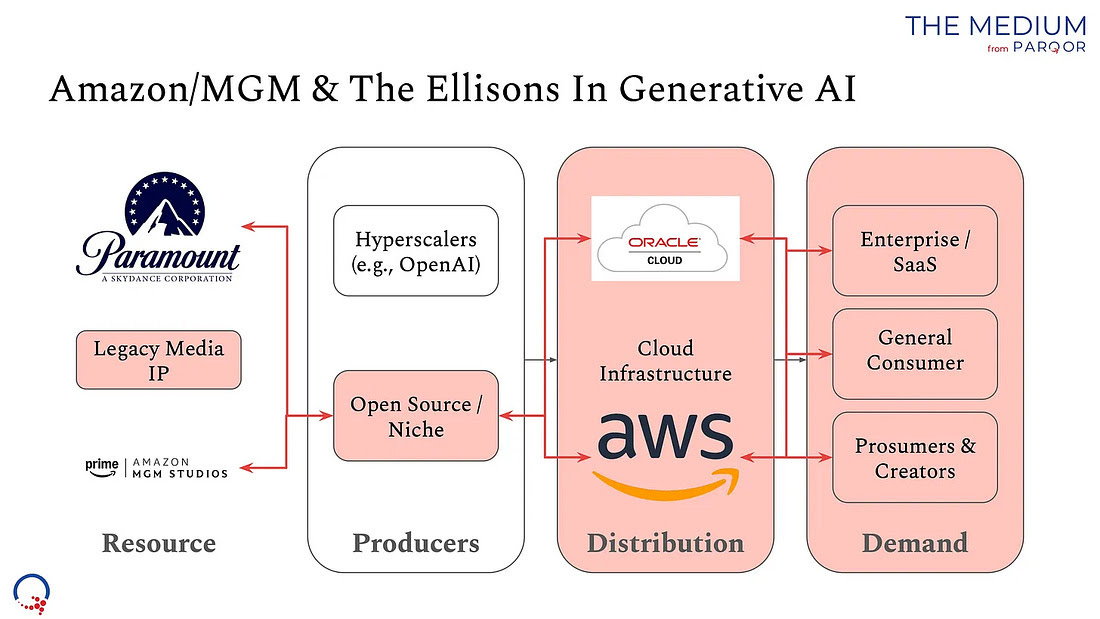
Controlling the cloud is an advantage in the AI era, where protecting IP from piracy will be an existential business. Open source and niche AI platforms enable piracy from Prosumers & Creators (see image above) in ways that are faster, cheaper and better than past forms of piracy.
If the objective is controlling and monetizing all possible use cases with owned IP, proprietary cloud infrastructure and Paramount content backed by Ellison patient capital will enable consumer-facing AI innovation, not just operational efficiency.
Paramount Skydance’s integrated solution with Oracle will allow it to work more easily with the likes of Seedance—to which it recently sent a cease-and-desist letter—and Google’s Veo, or smaller platforms like Showrunner or AiMation.
A New Era for Netflix
I argued that Netflix’s initial agreement with Warner Bros. Discovery may have been “strategic theater that both parties expect to fail.”This outcome would be “brilliant fiduciary duty engineering by both parties”: “WBD locks in the narrative that it pursued maximum value and Netflix locks in the narrative that it fought hard to solve content scarcity.”
Now, having lost the fight to solve for content scarcity, it seems more vulnerable than it ever has. Its next best defensive story about its vulnerable content library is its bets on YouTube creators and Spotify podcasts. Those bring premium podcast content from proven creators. But they do not bring “the architecture that makes video podcasts work on YouTube—the comments, the community, the many-to-many interaction.”
That means they no longer have “a combination of great content working with tech product hand in hand” at a time when the Ellisons are seeking to rethink and rebuild that model using its cloud infrastructure.
That all said, they have bought themselves time—both Warner Bros. Discovery and Paramount Skydance will be locked up in a regulatory review process over the next 10 to 12 months—and a $2.8 billion breakup fee to be paid by Warner Bros. Discovery.
They still need to answer the question of where their business is headed with less content and no games strategy to drive engagement. Video podcasts seem like a tactical fix. What is the strategy?
My guess as to its next big move: A strategic investment from—or partnership with—a cloud infrastructure company to help it defend its IP. The volume of cease-and-desist orders it will need to issue will only increase exponentially. Lawyers are expensive. Cloud solutions are cheaper. Seedance has proven that fans love Netflix IP. Why not use the cloud to enable and monetize more of that engagement—on Netflix’s terms?


