

[Author’s Note: This essay is free for all subscribers.]
There has been an abundance of conflicting market signals over the last few weeks. What does one write about the emergence of generative AI in the middle of a storm of AI Doomerism and oligopolies pantomiming threats to humanity just before their scheduled IPOs—with the twin objectives of achieving those IPOs for their investors and steering the future government regulation of their industry (aka regulatory capture)?
How can I distract you from the public fervor of the “>10%” chance that “AI could kill all humans” within the next decade? The simple (and not so simple) answer is to identify and synthesize a few notable market signals in the digital media and emerging generative AI marketplace.
I will not synthesize those signals into an essay today. There is both a book and an essay about that book to be written that will better accomplish that. For now, a Substack is the best place to summarize those signals individually and connect them piecemeal over time.
I believe the most important story related to generative AI is a Hollywood Reporter story from last week “AI Is Deflating Hollywood’s Microdramas Scene”:
“Not every firm is going the route of My Muse or Inkitt Ironblood, apps that exclusively release AI verticals, often fantasy, period and action stories that would require some serious budgets if they were filmed in live action. But some major players, including DramaBox, DramaWave and FlareFlow, have increasingly been embracing synthetic actors and settings and showering their apps with prompt-generated, sometimes uncanny fare, no human actors required.”
The co-founder of a verticals platform Shortical told the trade that “We all started adopting when Seedance 2.0 came out” in February. This both echoes and counters an argument I made back then:
“Seedance 2.0 is ‘faster, cheaper and better’ at producing Hollywood moments for short-form consumption. It is TikTok for IP pirates. But it is not a tool for AI storytellers. Storytelling with sustained narratives over longer periods of time belongs elsewhere, either on legacy media-owned streamers or in YouTube creator channels.”
Seedance indeed became an engine for producing “faster, cheaper and better” content for short-form consumption. I also predicted:
“Hollywood’s business runs on walls. You cannot stream their movies and shows unless you pay, and you cannot use their characters unless they say yes. AI video tools take those walls down, and Seedance is only the latest one.”
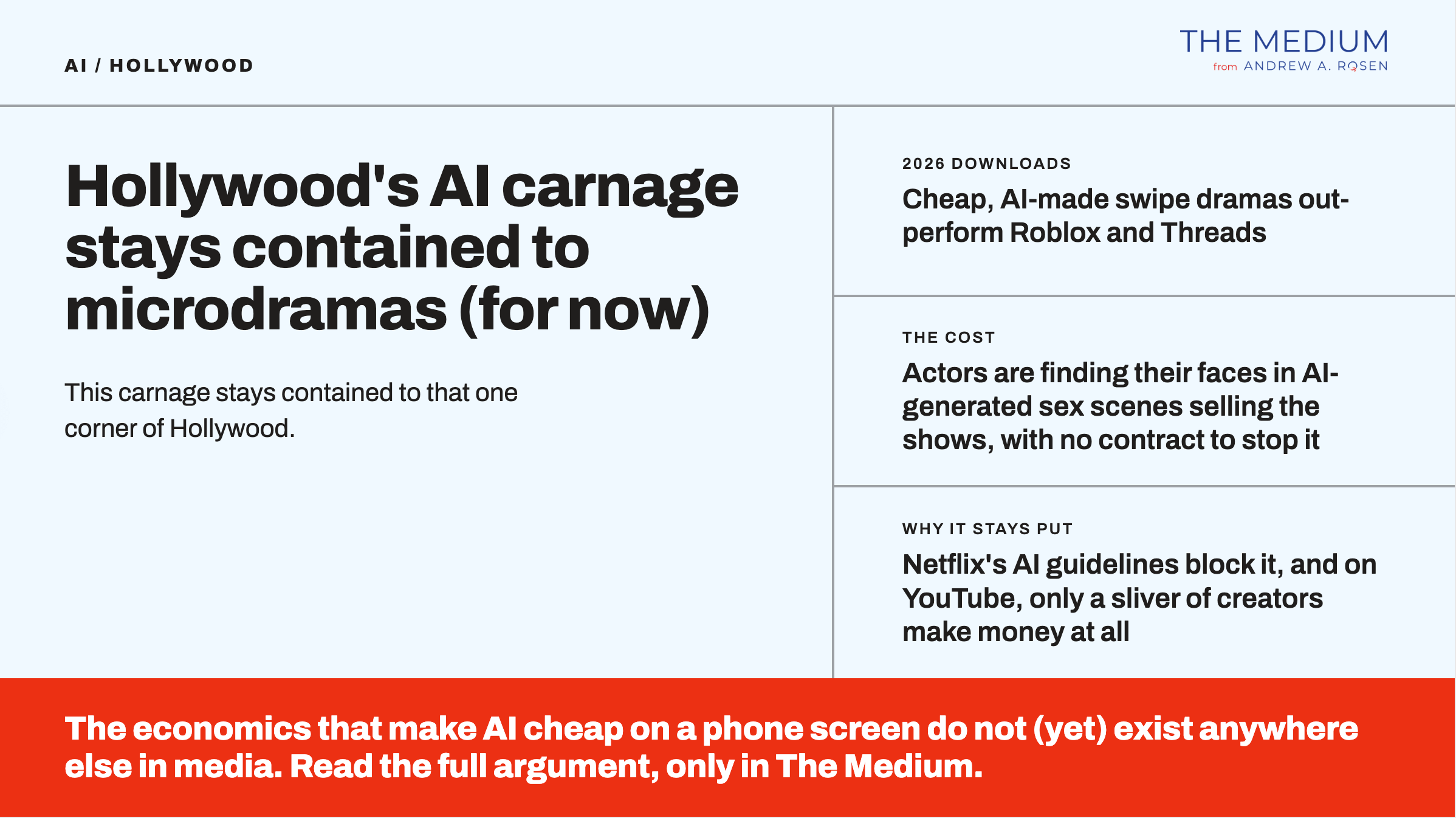
The piece dives into a long list of examples of these walls coming down—“unscrupulous use of the tech on the work of creatives […] on the rise”. Some of these were previously reported by Business Insider: Actors whose “faces are being used in fake AI sex scenes to sell micro dramas” and other actors who are “losing roles to AI knockoffs of themselves”. Also, actors who have managed to secure contractual AI protections are still finding they are vulnerable: “Sometimes, platforms will hire a third-party ad company with which actors don’t have a contract; that company will “‘take many creative liberties that are overtly sexual, rage-baiting, clickbaity’ for advertisements.”
Notable, but Not Precedent
The obvious temptation is to treat the micro-drama marketplace as a warning signal for the rest of Hollywood in the age of generative AI. That is a mistake. Microdramas are a hot content market and consumed at extraordinary scale—see a top 10 microdrama titles from 70k+ titles across 20 apps tracked by media and entertainment consulting firm Owl & Co. below.
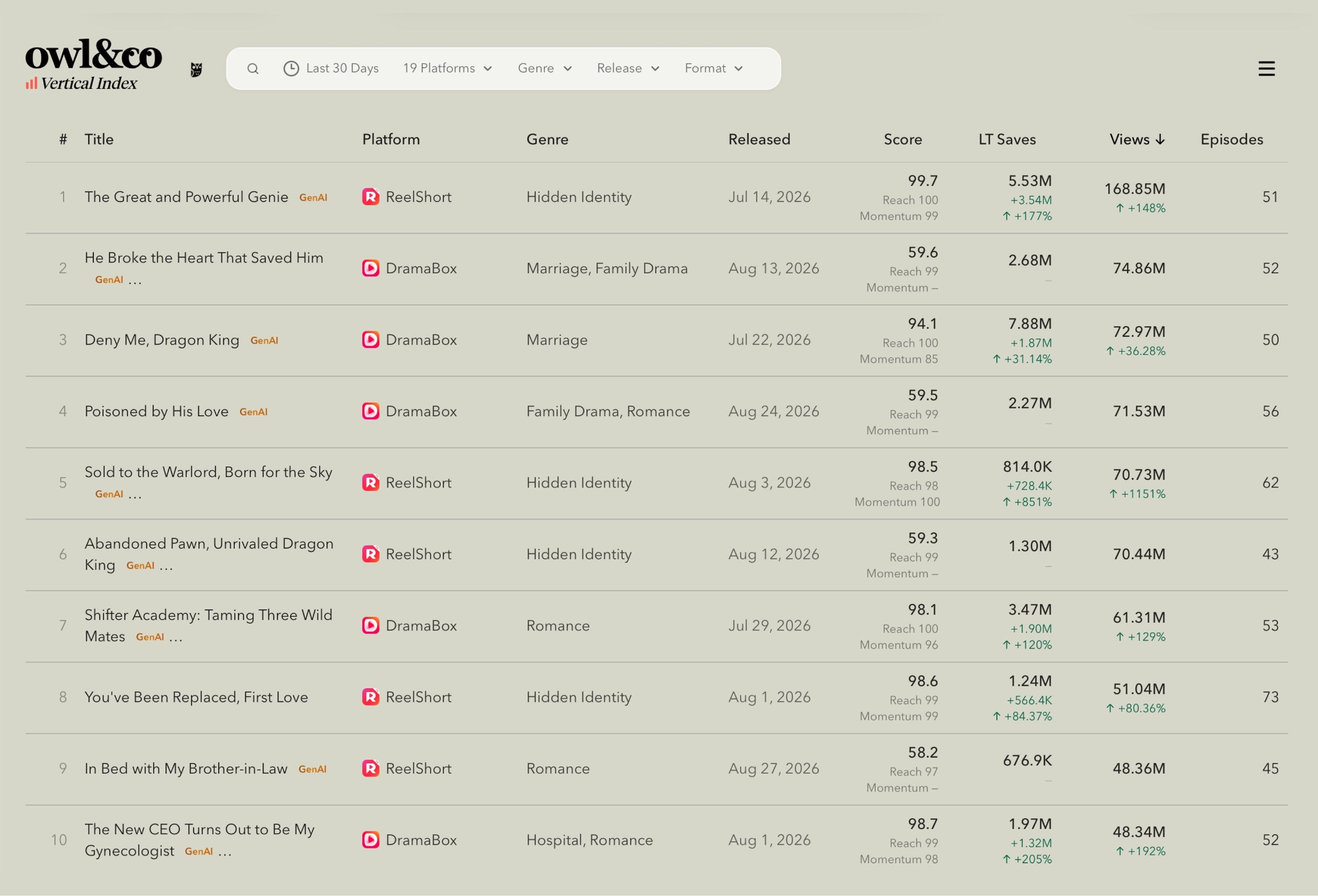
However, it is a market that is limited to distribution on smartphones and tablets and requires the swipe-based interactivity that is only possible on touchscreens. Both the constraints of the medium of touchscreen devices and the power law dynamics of the algorithms demand cheaper economics that favor AI production models.
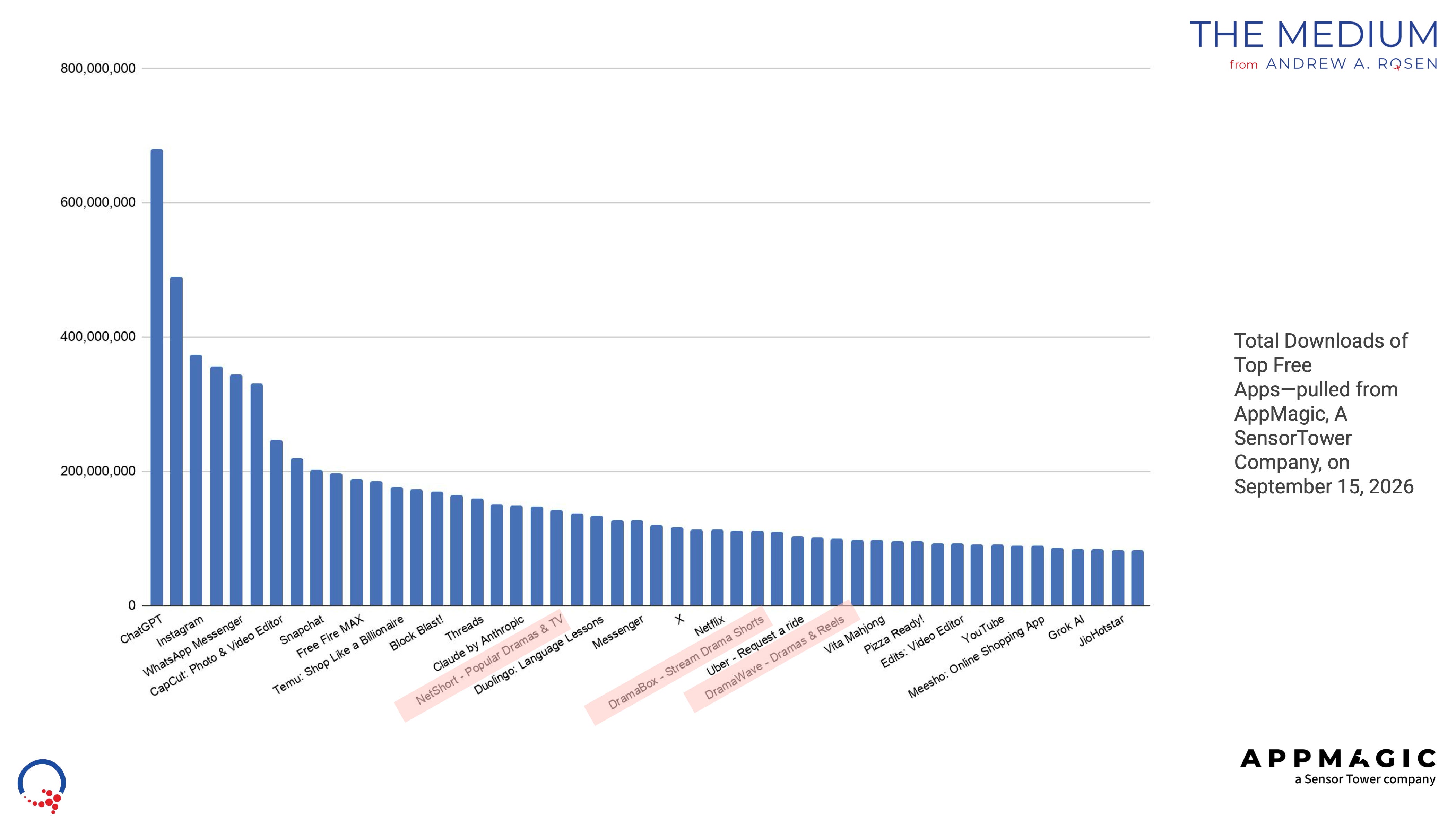
According to data from AppMagic, a SensorTower company, at least five of those 20 apps are in the top 50 most downloaded apps for 2026, averaging over 132 million downloads in 2026, to date. The top microdrama apps outperform Threads from Instagram and the gaming platform Roblox (which also has 132 million daily active users).
Despite that extraordinary scale, something I wrote in February still applies. I argued then that Seedance 2.0 unintentionally limits the market problems of “faster, cheaper, better” to the micro-drama marketplace:
“License original content to Netflix for upfront fees and exposure? That requires surviving Netflix’s strict AI guidelines and producing something entirely original.
Leverage AI production speed for volume on YouTube? Only 4.4% of YouTube’s 67 million creators monetize their content, and that power law intensifies as AI-generated content floods the platform.”
The Information reported that a new AI startup from Jeffrey Katzenberg—the former co-founder of DreamWorks and CEO of DreamWorks Animation—is fundraising for a company that would train its own video models and try to win over filmmakers. He is doing so alongside Bill Peebles, the former Head of Sora at OpenAI, and Sujay Jaswa, the former CFO of Dropbox. They are doing so amidst “serious concerns that AI could inhibit creativity, displace talent and steamroll intellectual property protections”.
The bet is that AI production in Hollywood requires proprietary video models and not larger models like Seedance. Given that Runway already hit a wall with that model—and pivoted to AI-generated short episodic series with Lionsgate IP—it is not clear why they are pursuing this model unless they believe they can scale similarly to Bytedance. That alone is reason to believe that the market problems Hollywood talent are experiencing with AI are limited to the microdrama and gamified video-on-demand (GVOD) marketplace alone.


