
[Author’s Note: Earlier I sent out Hasbro’s (HAS) Q3 2026 Earnings Brief. Netflix’s Q3 earnings call will go out tomorrow morning.
To remind you, I am running the test for subscribers in PARQOR Platinum, the most engaged readers on the list, and subscribers who asked to participate in the test. One brief framed the call from the perspective of a studio IP owner’s licensing team, and the other framed it from a brand licensing team’s perspective.
Subscribers are already sending me enthusiastic feedback. If you would like to learn more or be a part of the test, please respond to this mailing.]
Faced with signs of slowing growth and growing churn in the U.S. and Canada markets in particular, Netflix laid off ~6% of its workforce and fired top executives like Chief Content Officer Bela Bajaria and Chairman of Netflix Films Dan Lin. The company’s withdrawn bid for Warner Bros. was also a bet on content—a successful acquisition would have given Netflix’s algorithm more content to serve subscribers.
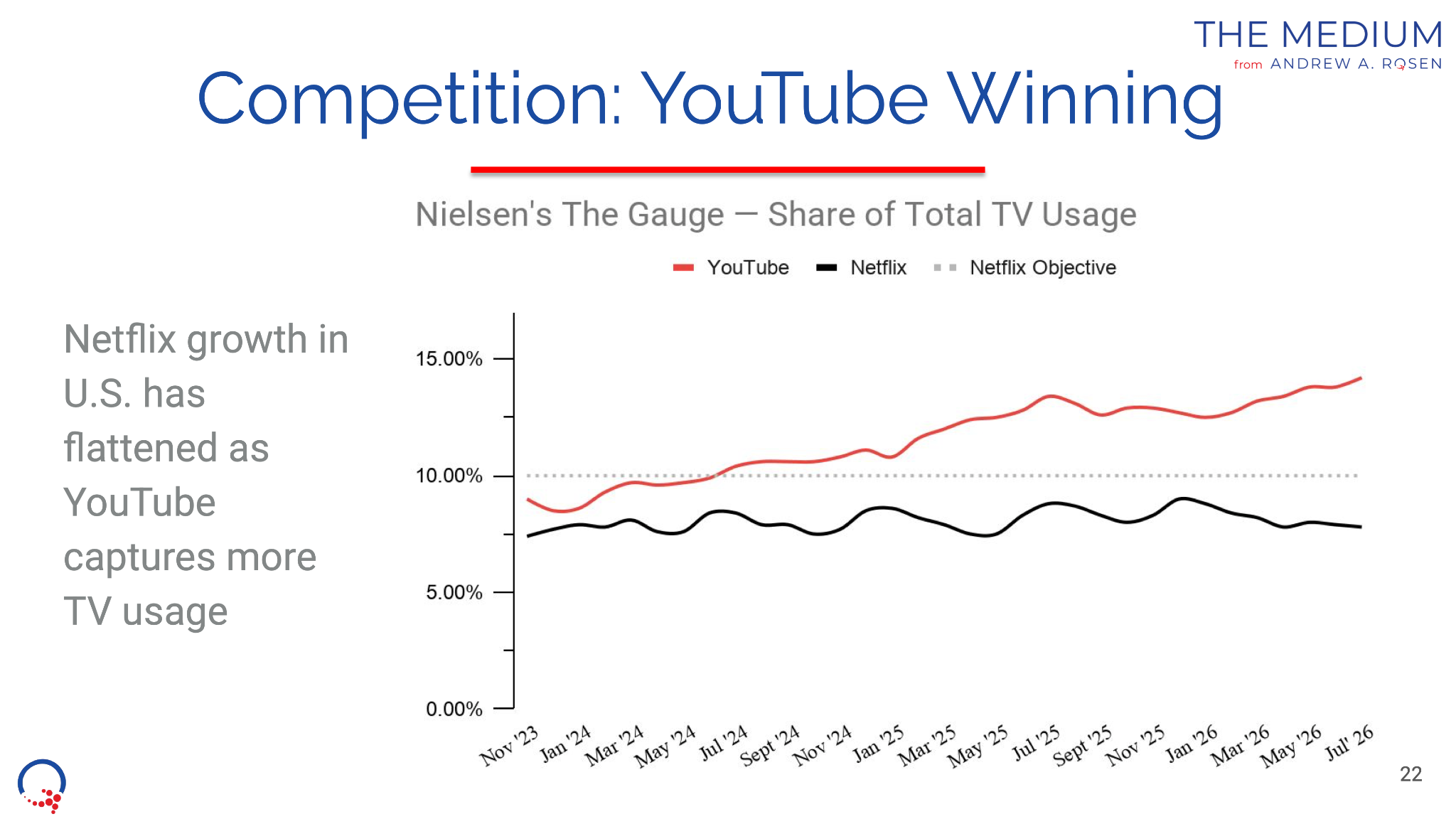
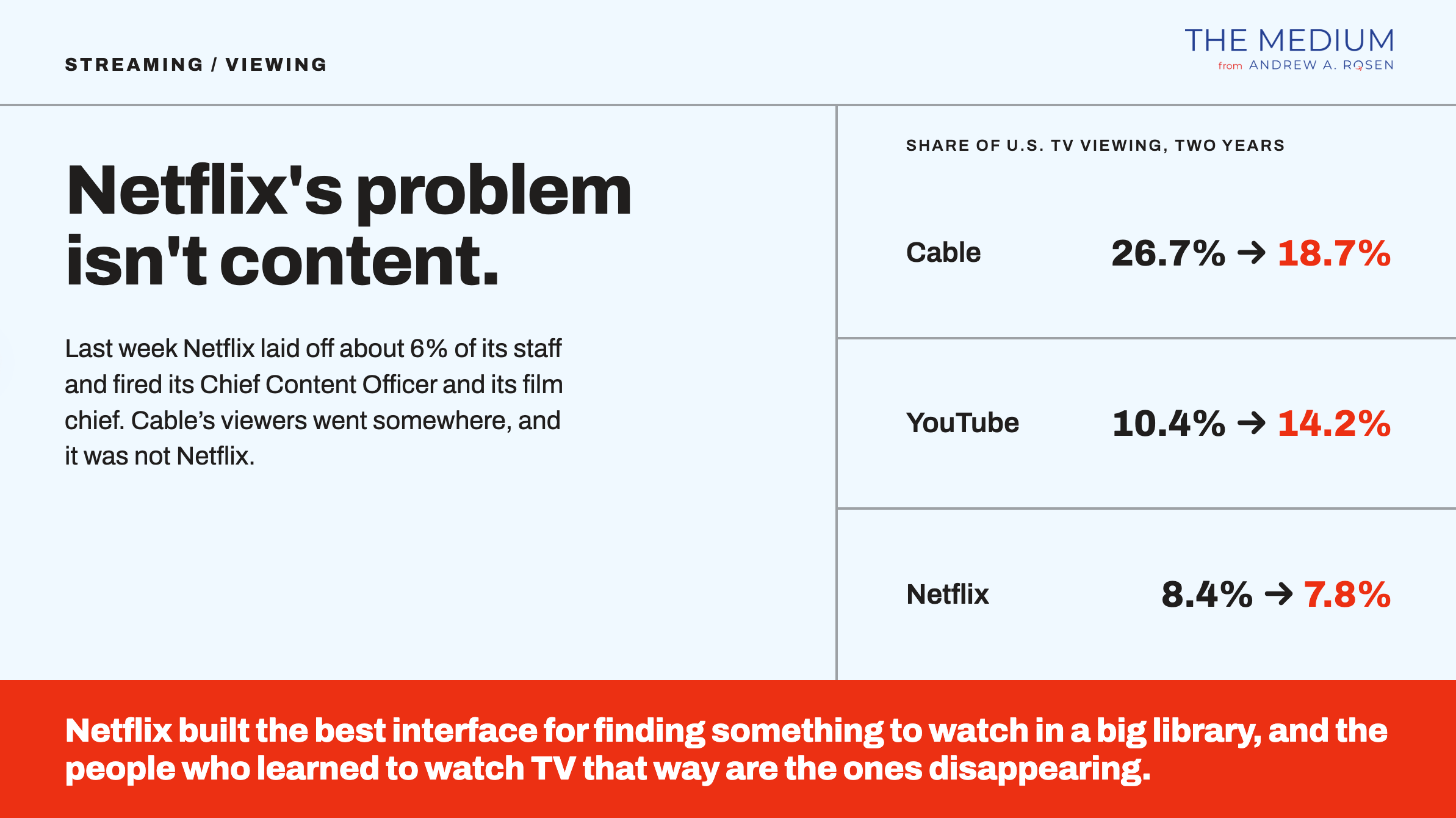
Both signals message the market that the content is the problem. Netflix’s value proposition has been an interface for finding something to watch in a big library—because cable TV guides made that difficult—and at a fraction of the price. It serves the people who learned to watch TV that way. That group is shrinking. Cable fell from 26.7% of total TV consumption in July 2024 to 18.7% in July 2026, a 30% decline, according to Nielsen’s The Gauge. Data from research firm MoffettNathanson shows that pay-TV homes fell 10.5% over the same period, from 68.76 million to 61.51 million.
YouTube’s share of television viewing over those two years has grown 36.5%, increasing from 10.4% in July 2024 to 14.2% in July 2026. Netflix has lost its share, dropping from 8.4% of consumption in July 2024 to 7.8% of consumption in July 2026.
I wrote about why Netflix does not feel any urgency to change its interface or technology in January, where I quoted an argument by Craig Hepburn—a Perplexity Fellow and the former Chief Digital Officer of both Art Basel and UEFA: “The entire field of user experience design has essentially been compensation for machine stupidity.”
This read suggests that the problem Netflix solved for cable is no longer the relevant problem with U.S. consumers.
Past essays related to today’s analysis: