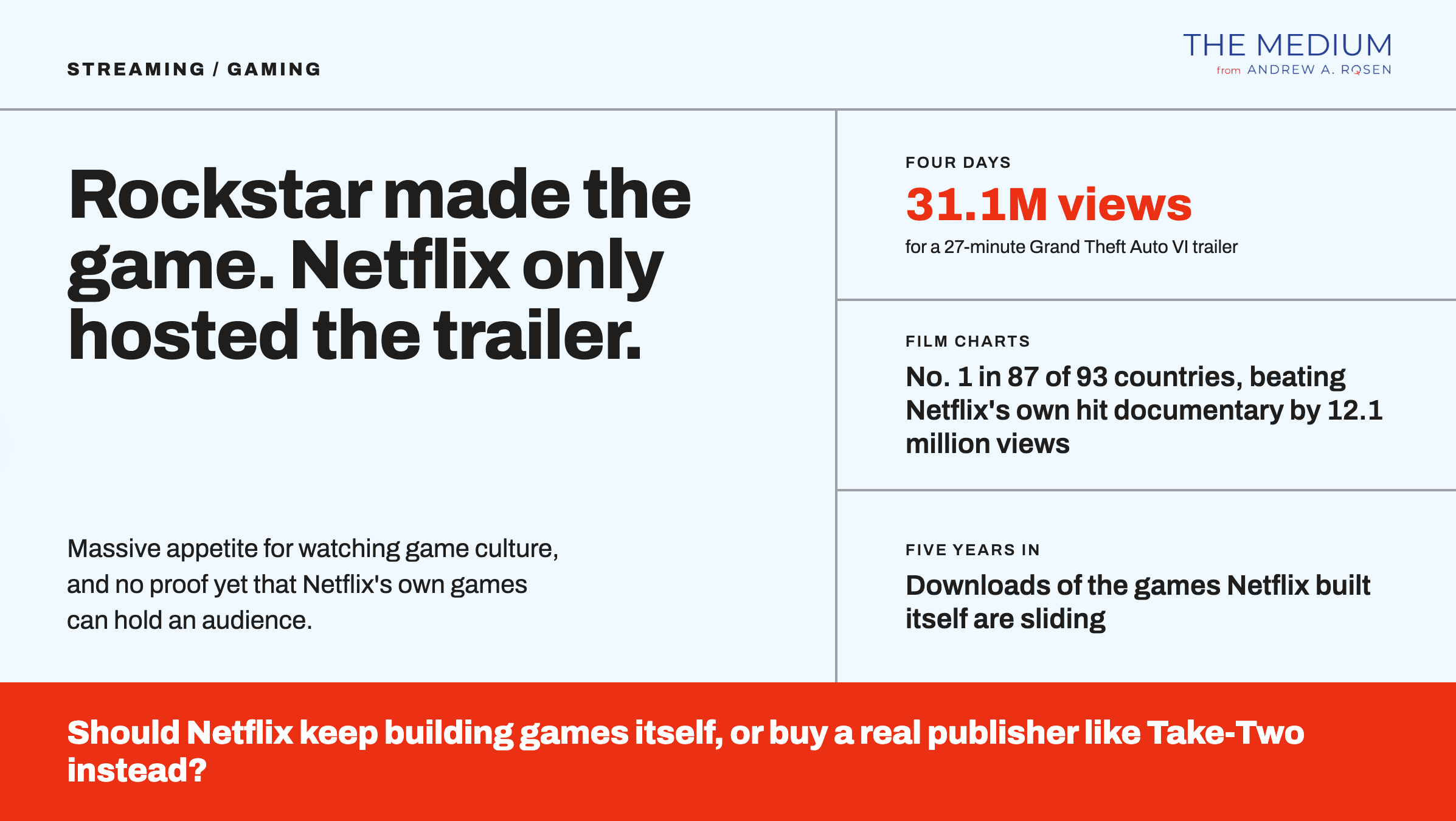
“Grand Theft Auto VI: An Extended Look”—a 27-minute preview of Rockstar Games’ upcoming game “Grand Theft Auto VI”—pulled 31.1 million views on Netflix between August 28 and August 31 last month. It topped the English-language film list in 87 of 93 countries that Netflix tracks globally for that week. It also outperformed the Netflix movie “The Whisper Man” by just under 8 million views and the Netflix documentary show “Death of the Pastor’s Wife” by 12.1 million views.
Rockstar Games gave this title to Netflix for a six-hour exclusive before it was also released on YouTube, where that version has aggregated 26 million views over the last 11 days. It is worth noting that Netflix defines a view as the total hours viewed for a title divided by its runtime, meaning one household watching a program twice would be counted only once. Whereas On YouTube, a view is counted as soon as any video starts to play.
This was a hit for Netflix and Rockstar Games. It marks a significant leap in Netflix’s gaming ambitions, which were launched five years ago when it hired former EA executive Mike Verdu to build the foundation of its games strategy.
My favorite detail of that pivot is that it was announced soon after Netflix’s $200 million bet on comic book IP—a TV series called “Jupiter’s Legacy” from the universe of comic book publisher Millarworld, which it acquired in 2017 for an undisclosed amount—was not renewed for a second season. “Jupiter’s Legacy” was Netflix’s bet that it could compete head-to-head with Disney’s Marvel and Warner Bros.’ DC Comics in comic-book blockbusters. Its cancellation was announced less than a month after its release date.
Effectively, that now-forgotten show and acquisition marked the end of Netflix’s ambitions of becoming the next Disney. Instead, it sent Netflix on a path focused on becoming an interactive mobile and now TV cloud gaming destination. I have argued Netflix has underperformed if not failed in its pursuit of its objective. Others have argued that Netflix has simply failed.
The success of “Grand Theft Auto VI: An Extended Look” suggests Netflix’s audience overlaps with gaming culture more than both I and others have assumed. This presents two questions:
Is it the foundation of a broader gaming strategy suggested by Unity’s announcement in late July of “dedicated Engine support to Netflix Games, making it easier for developers to build and deliver games across Netflix’s multi-platform ecosystem on mobile and TV”?
After EA went private to compete, is Netflix’s listing as a public company a limitation on these ambitions?
The first question is whether Netflix is building a product people want. The second is whether its size and its shareholders will let it pursue these ambitions.