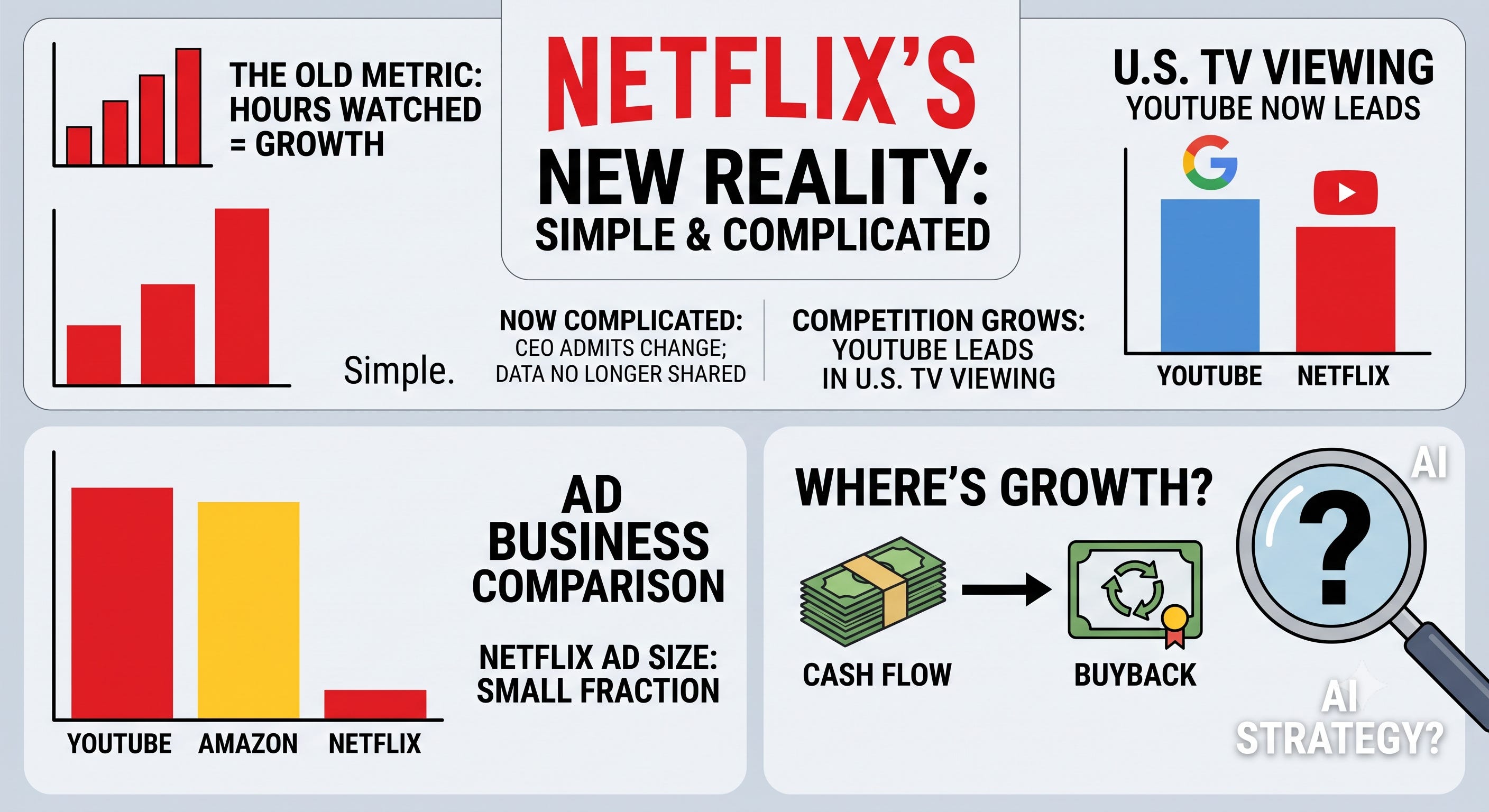
Netflix has long told a story to investors that “Engagement, revenue, profit drives [the] flywheel”. The story of engagement was told through bi-annual “What We Watched” reports. Investors and analysts could do their own work to infer how those reports mapped to Netflix’s quarterly and annual earnings reports. In a model where ~20% of the movie and show titles drive 80% of the viewing, investors and analysts could discern which movies and shows drove engagement over the previous six months.
Co-CEO Greg Peters explained to investors on the earnings why that story has evolved:
“[W]hen I started about 20 years ago, we had one number to describe engagement, hours, just flat hours, no weighting, no adjustments and very similar to how we’ve evolved other metrics in the business. Since then, we’ve gone through about a dozen major iterations of our understanding that.
We get more and more sophisticated because we know, ultimately, it’s combined quality, variety and quantity of engagement that translates into satisfaction and value for members.”
Technology companies like Apple have ditched their vanity metrics when unit sales became disconnected from the actual profit engine, so this pattern is not unusual on its own. But subscription revenue is price times subscriber count—there is no abstraction layer between them the way there is for Apple's unit sales.
Peters’ answer is a wordy concession that Netflix has lost the simplicity of its subscriber and advertising engagement story. In the past, growth was told through subscriber growth. Engagement was told through various reports and Top 10 lists. Its decisions to stop releasing subscriber numbers and to reduce the releases of “What We Watched” to once per year concede that it cannot tell either of these stories anymore.
It does not have an alternative story for investors yet—it relies on a financial story about profit—and they have reacted logically: Its stock price is down 8.4% since the earnings call.
Netflix has long set the market standard for the storytelling of growth in streaming. It is worth asking in the flux that Peters describes: What if they not only do not have a story now, but have lost the story of the media and entertainment marketplace altogether?