Yesterday the Motion Picture Association and ByteDance announced that “they have reached a Memorandum of Understanding (MOU) reflecting a shared framework to maintain strong guardrails on generative AI video and image models like Seedance and Seedream – offered by TikTok, the TikTok USDS Joint Venture, CapCut and Dreamina, among others”. Their goal is to protect intellectual property.
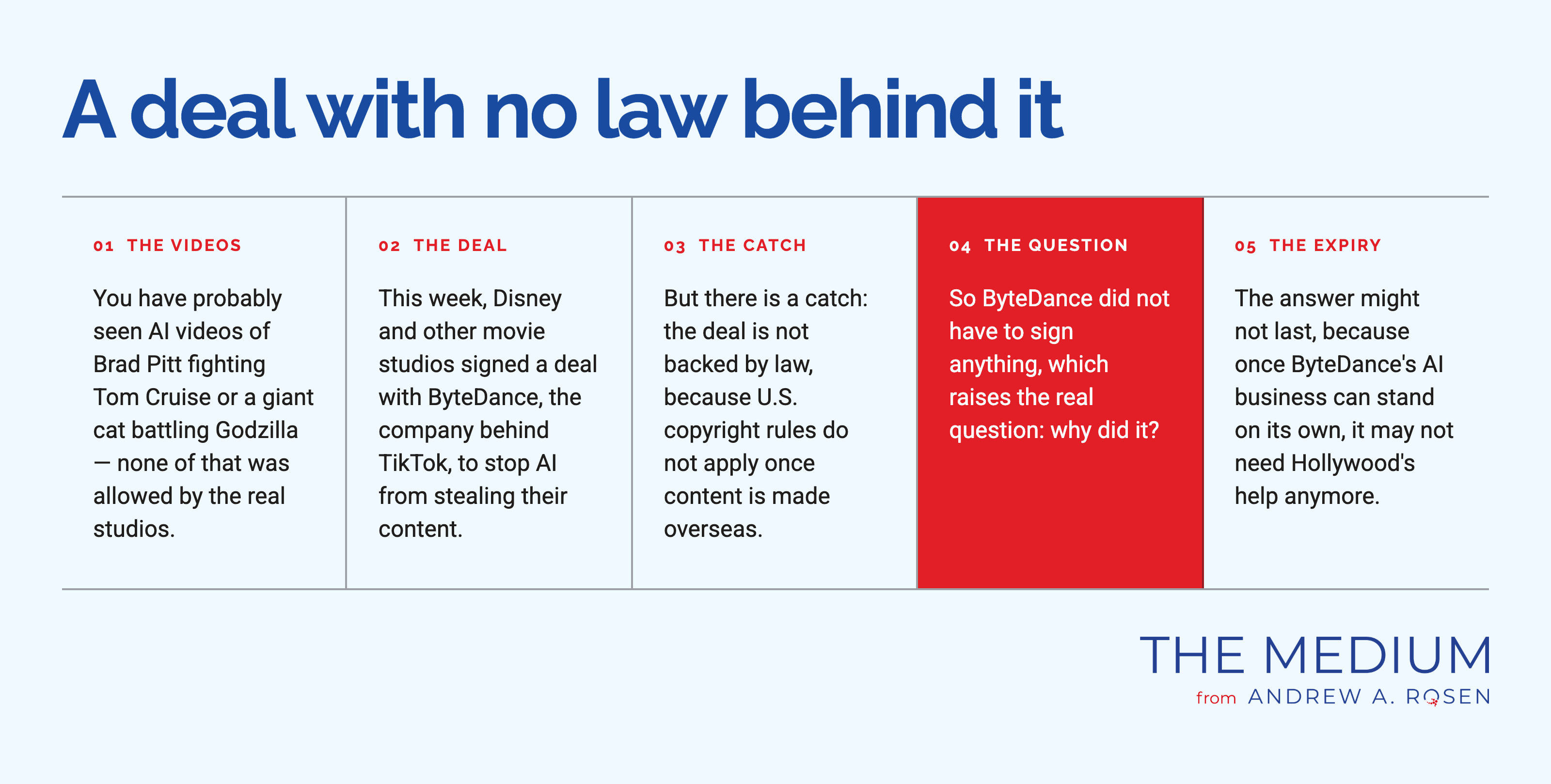
For those who may not be familiar, an MOU is a framework that guides both parties—it is not a binding legal agreement. That is a crucial detail—the best deal that the most powerful rightsholders in entertainment could secure from a Chinese technology conglomerate is a concession that copyright does not apply to AI training and generation.
It also means that everyone has agreed to rules of conduct but not a contract. MPA Chairman and CEO Charles Rivkin labeled these rules “meaningful guardrails on Seedance and Seedream”, and John Rogovin, general counsel of ByteDance, referred to them as “an important framework for continued collaboration as the technology evolves, across a variety of products and platforms.”
As I highlighted back in April, a key problem of studio copyright infringement lawsuits against AI companies overseas is that “U.S. copyright law does not reach conduct that occurred entirely abroad.” Videos generated on servers outside the U.S. are simply not covered by U.S. copyright law—and the 52 infringing videos at issue in the Disney v. Minimax case were created by the studios’ lawyers and not by any U.S.-based creators. This deal confirms that reality—IP protection in the generative AI space is a negotiated set of rules of engagement between studios and popular Chinese AI platforms, but not a legal guarantee.
That problem points to the real question underlying this MOU: if the law could not force ByteDance’s hand, why did it sign?