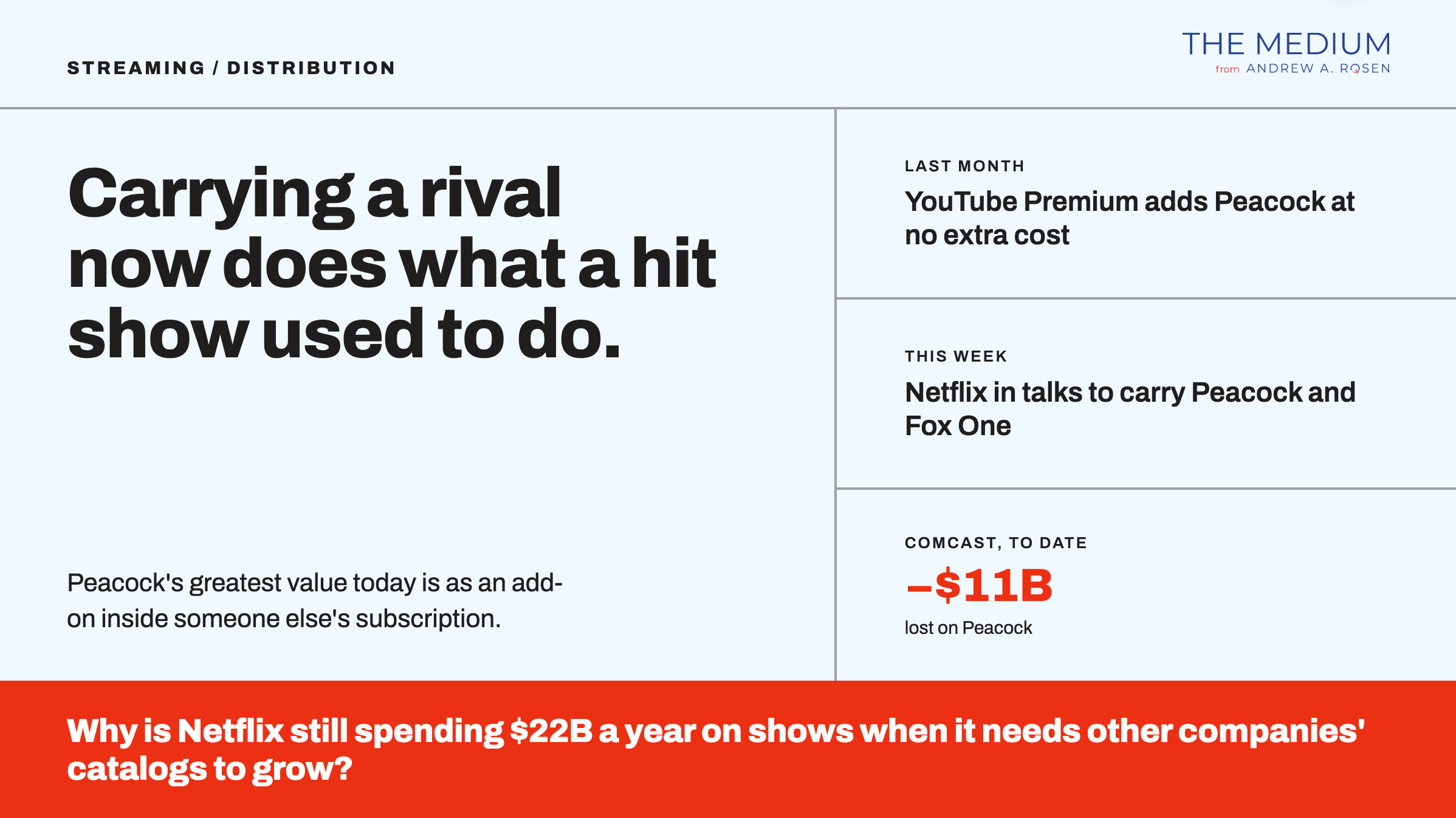
Last month, YouTube Premium announced it will include ad-supported Peacock Premium at no extra cost for eligible U.S. subscribers. In a similar vein, the New York Times reported Netflix has had “recent discussions about making other streaming services available [...] including Peacock and Fox One”.
The fun lens to look at these two announcements is through Netflix’s long-stated objective of 10% of U.S TV consumption (according to Nielsen’s The Gauge). YouTube surpassed the target over two-and-a-half years ago and has soared 40% past it since. Over that same period of time, Netflix has stayed flat and since struggled to reach it.
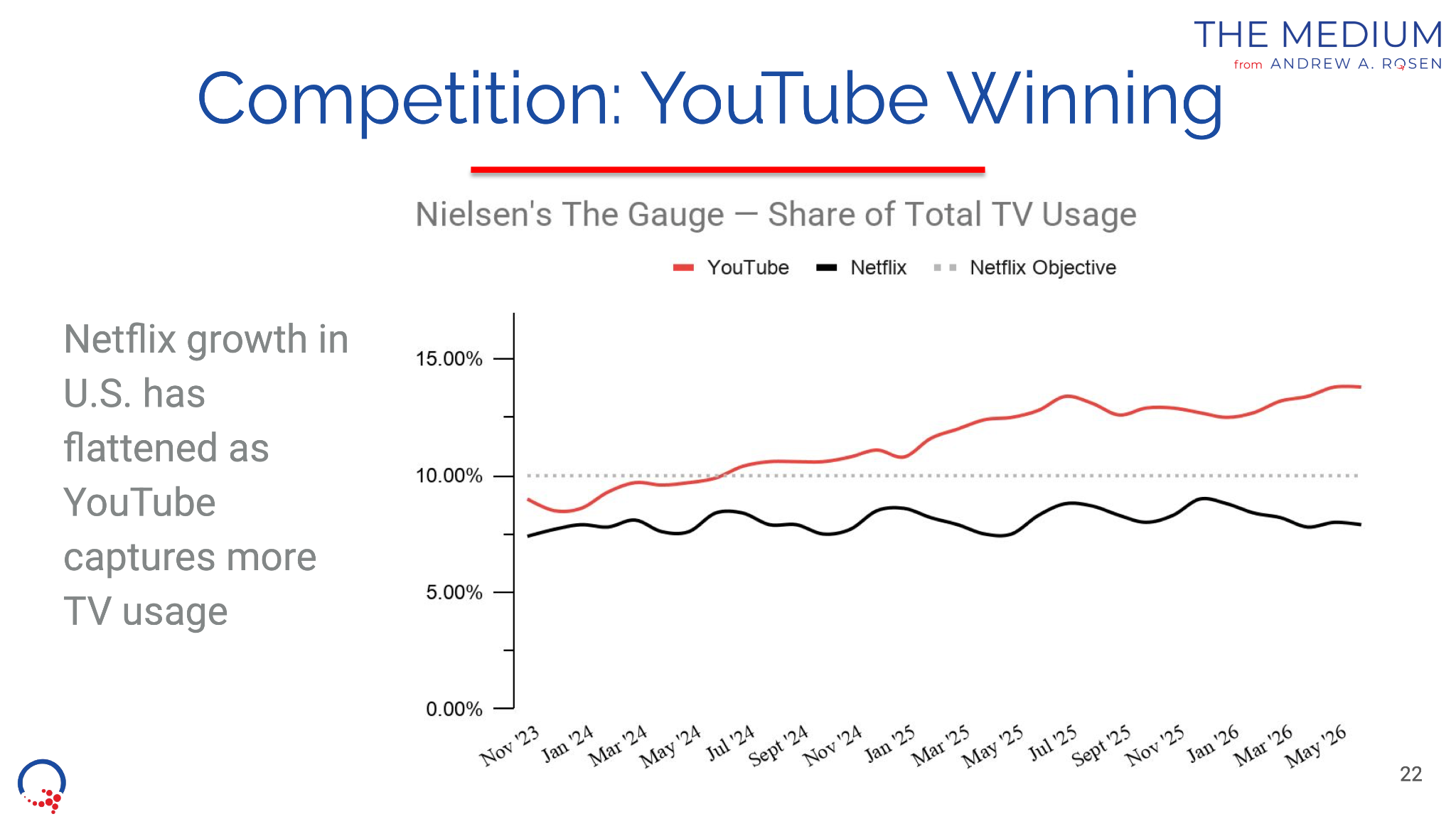
The yet-to-be-met goal tells two stories. There is a YouTube-centric story of its success in connected TV since Nielsen first started sharing the metric in November 2023. That is largely a story of YouTube’s scale and creator economy model reshaping the smart TV and broader TV ecosystem—and generating over $40 billion in advertising revenue and around $20 billion in subscription revenue (from YouTube Music, YouTube Premium, YouTube TV and NFL Sunday Ticket) annually.
There is also a Netflix-centric story about the broader marketplace which has evolved away from subscriber growth and user engagement, and towards advertising growth and ~$11 billion of net income on $45.2 billion in annual revenue. Both share a key detail: What separates these platforms is not how much premium content they make, but what remains of their businesses without it.