

[Author’s Note: This essay is free for all subscribers.]
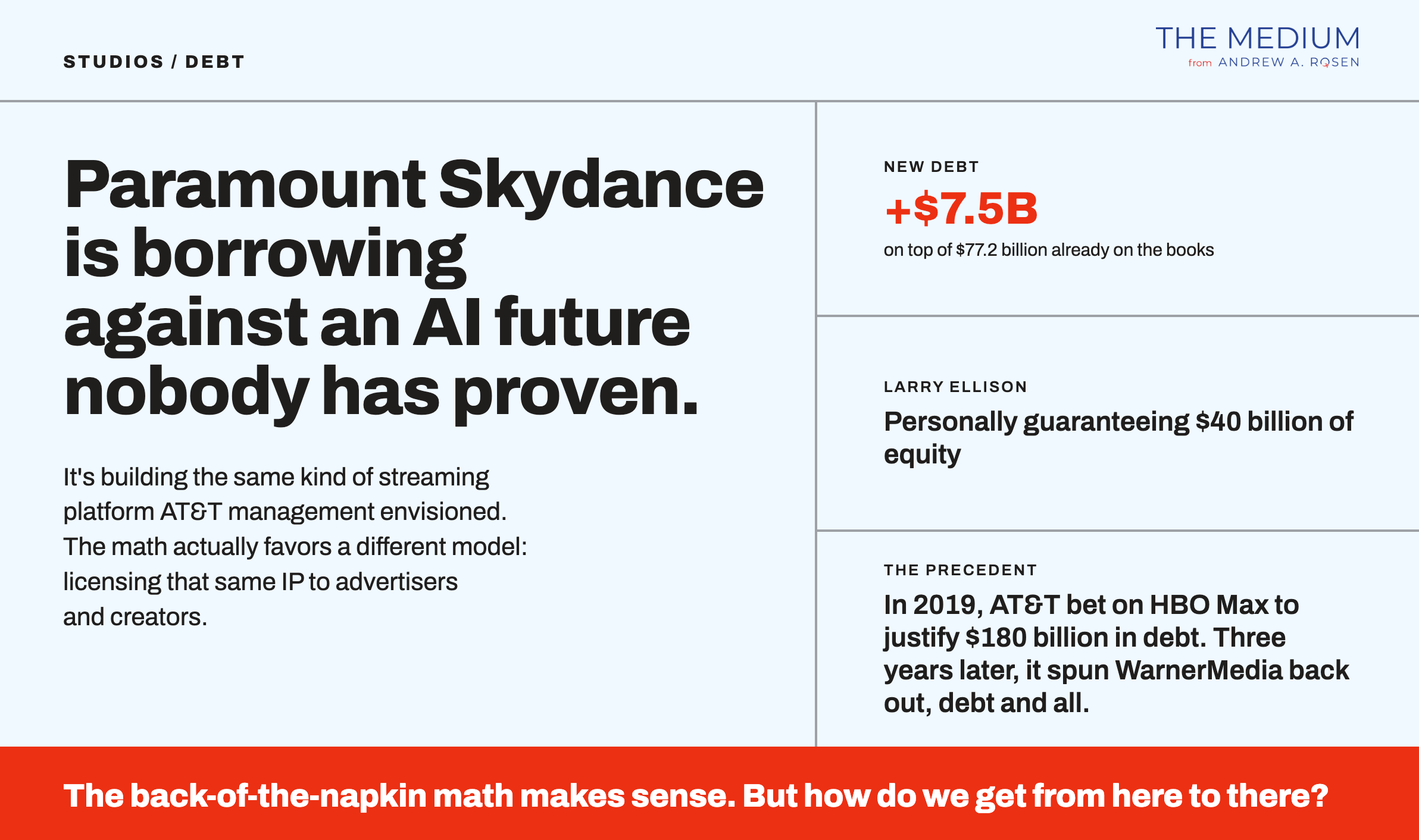
Paramount Skydance announced today that it is launching a syndication to raise $7.5 billion through a proposed senior secured incremental tranche of term “B” loans. Morgan Stanley analysts estimate that by the end of 2026, the combined company’s net debt will be $77.2 billion. This new debt raise will push that total higher, though some of the raise will be used to pay off older debt.
The questions around how post-merger Paramount Skydance plans to pay off $80 billion in debt bring to mind one of my favorite quotes from AT&T management after its acquisition of Time Warner: Former AT&T CFO John Donovan told Fortune Magazine in 2019 that “10 basis points of churn is a billion dollars.” CEO John Stankey made a similar pitch to investors in January 2020: “A reduction of 1 basis point of wireless churn across the base is worth about $100 million to us annually.”
They were both describing their vision of how an exclusive streaming service like HBO Max within AT&T wireless mobile plans would reduce churn and attract new users. They were also assuring investors that despite the additional $23.5 billion debt they took on by acquiring Time Warner in 2018—and the $180 billion in total debt the company was carrying post-merger—there was a path forward to paying down that debt.
Two years later, despite the efforts of WarnerMedia CEO Jason Kilar and his team to improve HBO Max, Stankey threw in the towel and spun off both WarnerMedia and $55 billion of its debt into a surprise merger with Discovery, Inc.
Within the short window when AT&T owned WarnerMedia, Wall Street analysts and industry experts openly wondered how streaming would deliver the level of revenue to service the debt. With the Paramount Skydance-Warner Bros. Discovery merger weeks away from closing, we are hearing similar questions from the marketplace now. The key difference, however, is that Paramount has both an $80 billion debt burden and an equity burden—Oracle founder Larry Ellison has personally guaranteed more than $40 billion of the equity financing for the merger (his son David Ellison is CEO of Paramount Skydance).
Yesterday Semafor reported that Paramount executives “have discussed asking Elon Musk to become part of a syndicate of equity investors” into the post-merger company. The implication is that there exists a marketplace of wealthy individuals who are willing and able to assume some of the risk that Larry Ellison took on personally.
The Math Behind $77.2 Billion in Debt (and Growing)
Morgan Stanley analysts project $6.37 billion in interest payments per year. Paramount Skydance will service that debt in part by more than $6 billion in cost-cutting “(representing 11% of operating expenses) through the consolidation of tech stacks, procurement efficiencies, ‘rationalizing real estate’ — and layoffs in redundant corporate overhead and marketing functions”. Morgan Stanley projects the company should be able to reduce its leverage of net debt to adjusted EBITDA from a ratio of 6-7x at the closing of the deal to 3-4x within three years.
The $6 billion in savings is a one-time step up in EBITDA—Paramount will not find another $6 billion in savings in year four. Meanwhile, linear and affiliate revenue will keep eroding on their own. The ratio falls only as long as that one-time bump outruns the decline. After that, Paramount will need a business that is actually growing.
Streaming alone will not cut it as a solution for growth. The post-merger company had less than $20 billion in combined streaming revenues in 2025 ($8.6 billion from Warner Bros. Discovery and $10.9 billion from Paramount Skydance). 10% margins in those combined businesses will iteratively chip away at the $80 billion in debt.
The closest comparison to AT&T's wireless subscriber base is the affiliate payments Paramount Skydance receives from distributors for its cable channels—though the comparison cuts against the point. AT&T's wireless base was growing in 2018. The cable industry’s consumer base keeps shrinking as cord-cutting continues, even as per-subscriber rates rise to offset the losses. Its will still total nearly $19 billion in annual revenue post-merger. It will also earn $12 billion in advertising revenue per year. With margins of 20% in the WBD linear businesses and 36% margins at Paramount Skydance, these revenues will go further than streaming at chipping away the debt.
But as AT&T already proved, $80 billion is a tall mountain to climb in streaming, and nearly $7 billion in annual payments are a burden.
Growth = Consumption Based IP-Licensing?
My argument in yesterday’s essay was that “without ‘free money’”—the extraordinary profitability of both the cable and DVD business models—Paramount must invent an entirely new marketplace in order to service its debt. I suggested the model most likely to emerge from this merger will be a generative AI model where “Paramount stor[es] IP in the cloud and pricing access to it based on advertiser [and creator] demand”. That model “seems like it could be a highly profitable business” and better than streaming.
I offered this example:
“An advertiser spending $12,000 to license unused or less-used Paramount or Warner Bros. IP [for a campaign[ is spending 10x what a consumer will spend on a cable bundle in a year. For the sake of illustrating this math, assume 1% of Meta advertisers begin licensing IP at $12,000 per year from post-merger Paramount Skydance, that is $1.2 billion in revenue per year from Meta, alone. Compare that to 82+ million Paramount+ subscribers spending less than $100 per year worldwide, and it becomes clear that debt service alone requires a different business model.”
The back-of-the-napkin math makes sense. The size of the advertiser marketplace in the U.S., alone, presents a path to revenue growth. Assuming the pricing model is similar to consumption-based pricing for cloud models—and I assume this because this model most closely aligns with the short durations of advertising campaigns—suggests the model could be highly profitable for Paramount simply because its IP and Warner Bros. IPs are effectively sunk costs. All future approved advertiser and creator use cases will be upside.
There is an obvious counterargument to this example: The math works only if that market exists. Nobody has licensed IP from Paramount or Warner Bros. at that price yet — the $1.2 billion figure describes a market that would have to be built from nothing, not one that already spends this way. If this is going to be built, when will it emerge?
The sense is that cost savings will buy the combined Paramount-Warner Bros. entity some time with debtholders and investors. But as investors become more bearish on Netflix because of its declining engagement metrics, the sense is that—like AT&T’s bet on HBO Max four years ago—management’s financial promises for a new model are not the same as management’s execution of that new model.
Paramount is gunning to build the type of streaming platform that AT&T executives envisioned reducing churn. But the better business model lies in licensing IP to advertisers and creators. Much like AT&T four years ago, the pieces are on the table and the growth opportunity is compelling. The only question is how they plan to get from here to there. Because from my own research, there is not yet a marketplace at scale that shares the vision for this growth opportunity.
It may be four years before we get there. Like AT&T in 2022, the question facing Paramount Skydance will be whether shareholders and management will be willing to see the vision through.


