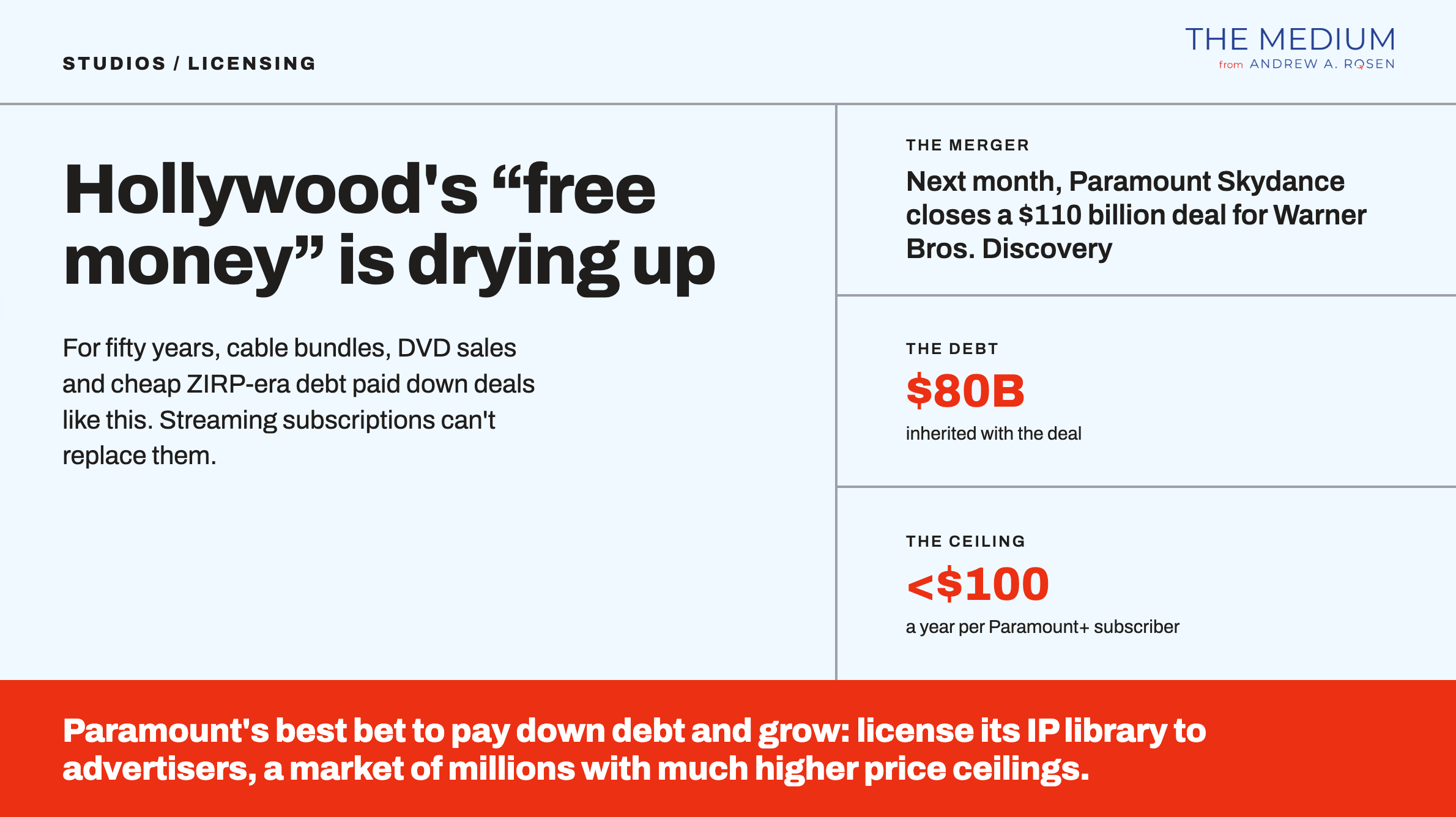
The now-settled lawsuit brought by twelve U.S. state attorneys general to prevent or slow the $110 billion merger of Warner Bros. Discovery with Paramount Skydance was a bad policy. All 12 public officials—and the Writers’ Guild, which also filed suit—evidently forgot the role of “free money” in the entertainment business.
I wrote about “free money” back in 2023—how the extraordinary profitability of the cable bundle has driven financial and creative growth in the cable and movie industries between the 1970s and today. The Acquired podcast recently did an episode on Disney which highlighted how ESPN has generated close to $75 billion of operating profit over the past 30 years, and that profit funded the acquisitions of Pixar and LucasFilm. For a short period of time—from the 1980s until the emergence of streaming in the early 2000s—the extraordinary profitability of the VHS and DVD business padded that financial growth. An interview with actor Matt Damon on the YouTube series “Hot Ones” went viral for highlighting how the decline of DVD sales in the 2000s dramatically reduced the maximum amount of profit any film could make, leaving box-office profits as the only determinant of a film’s success.
I believe that the zero-interest-rate policies (ZIRP) by central banks of the 2010s created a third window of “free money”, enabling media companies and Netflix to take on billions in debt with minimal-to-no interest payments burdening their cash flow statement. But for that policy, AT&T would not have taken on a $23.5 billion debt load—pushing its total debt to over $180 billion—to acquire Time Warner in 2018.
Someone looking at that history, the declining year-over-year revenues from theatrical and cable, and the disappointing profit margins from streaming might reasonably conclude that a new source of “free money” is necessary to both protect and revive the entertainment industry. A good policy would be for the state and federal governments to build incentives towards new infrastructure for “free money”.
A lawsuit does not accomplish—and this lawsuit did not seek to enable—this outcome. It focused solely on the merger’s effects on theater and cable distribution models, and also its impact on the “editorial independence” at CNN and CBS News. The settlement offers toothless solutions to both.
With the uncertainty of the lawsuit now removed, and now that Paramount Skydance can get back to building, the question facing the industry is: What will be the next source of “free money”?