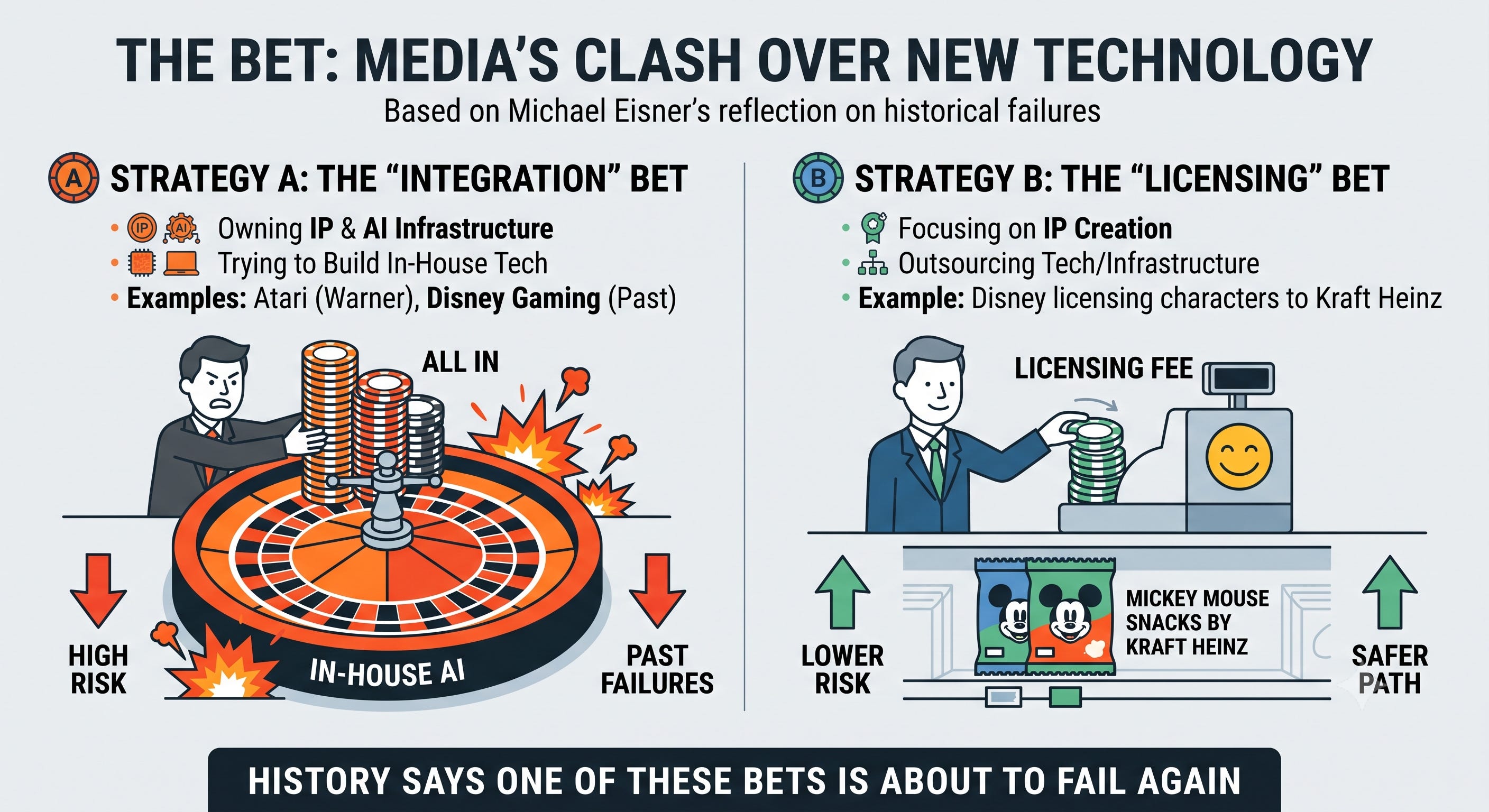
Legacy media companies must rethink how they monetize their libraries of IP in the face of generative AI disruption. Last Thursday’s essay on the Kraft Heinz alliance with Disney offered a potential framework for renting IP to advertise on someone else’s marketing platform.
At The Paley Center last week, former Disney CEO Michael Eisner framed this crossroads as a familiar pattern in Hollywood. Media companies “possess enormously valuable IP”, but also consistently misjudge how or whether to extend it into unfamiliar formats. His talk focused on Hollywood’s long, troubled history with entering the gaming industry: “The problem wasn’t creative, he argued — it was technological illiteracy: gaming ‘was so technologically driven in the beginning, which was not the strong suit of any of us.’”
This problem of technological illiteracy still persists between Hollywood and gaming. A gaming executive told me in 2023 that it is a generational problem: “They aren’t gamers” (something Eisner appears to have indirectly acknowledged).
Eisner did not discuss generative AI, but the new medium is as “technologically driven in the beginning” as gaming was in the 1980s. The emerging technology is rapidly upending traditional processes and business models for content production, distribution and the legal protections for intellectual property. For this reason, it is harder for anyone to identify when to license IP versus when to build.
He did discuss Warner Communications’ failure with Atari—it purchased the video console owner in 1976, and had success until it reacted to competitive pressures from home computers by oversaturing the market with video game titles. That contributed to the video game console market crashing in 1983. Eisner’s point was that because Warner management had no background in gaming, it made product decisions that did not reach sales expectations. Disney had a similar experience with gaming under Eisner’s successor Robert Iger with Disney Interactive Studios, which lost $200 million per year from 2008 to 2012 and had already begun licensing to third-party publishers like Electronic Arts by the time it shut the division down in 2016.