
[Author’s Note: This essay is free for all subscribers.]
Yesterday’s multi-year strategic alliance between Kraft Heinz Company and The Walt Disney Company—which “spans foodservice, media, events and more”—seems straightforward.
Kraft Heinz will be the exclusive provider of cream cheese, some condiments and macaroni and cheese at Disney’s North American parks and resorts, and on the Disney Cruise Line. It will be able to use Disney’s characters and stories across 10 of the food company’s brands, including Heinz, Philadelphia and Kraft Mac & Cheese.
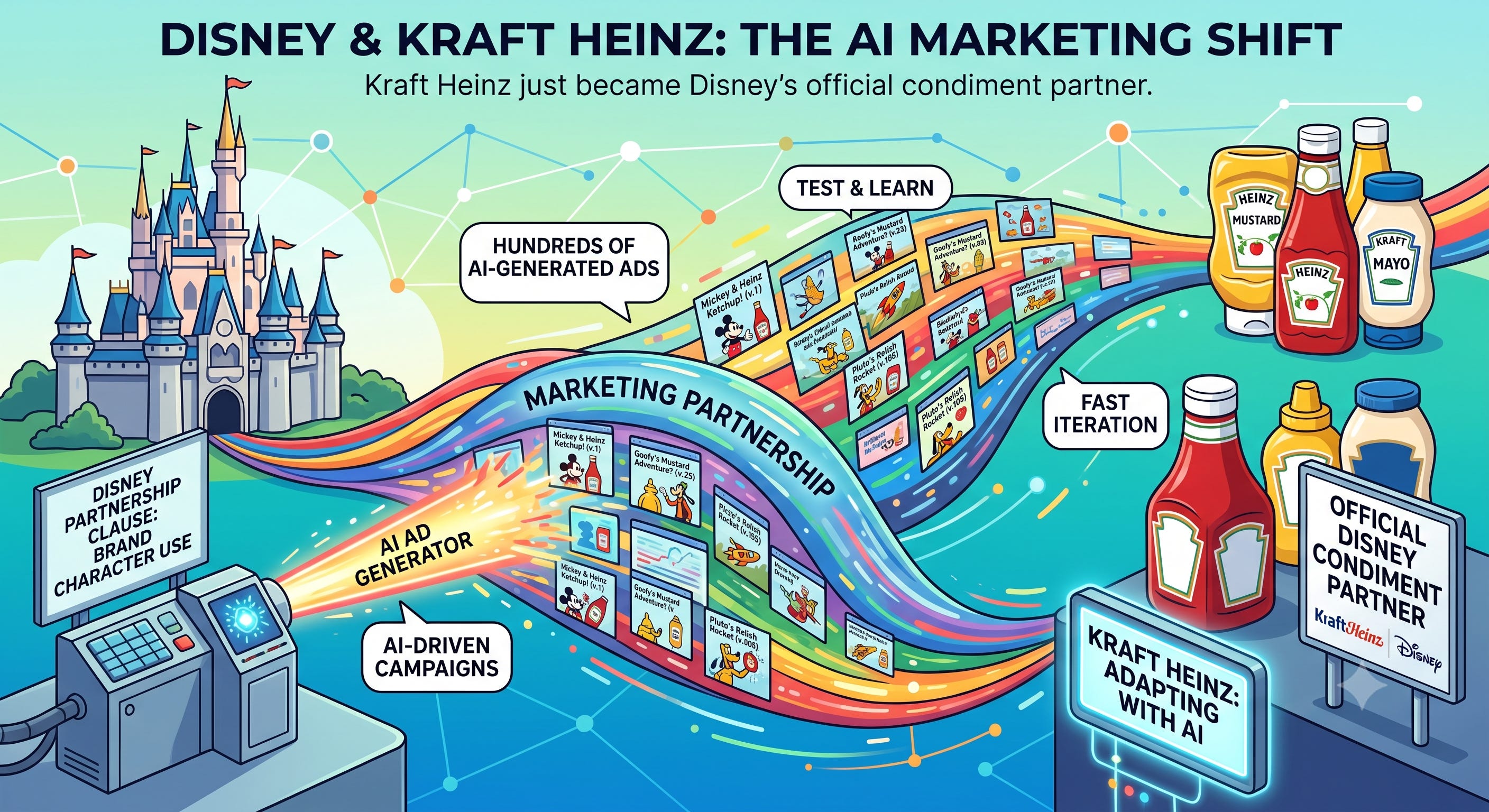
As for the “more”, this deal also “unlocks opportunities for integrated marketing campaigns, digital content and brand-led marketing campaigns across Disney’s media platforms.” It is not core to the deal, but as phrased, it opens the door to experimentation in the marketing space.
These two elements of the deal mirror two recent themes.
First, the licensing of Disney’s characters and stories echoes the “INVERSION” strategy being touted by People, Inc. Chairman Barry Diller—a bet on products and services “birthed out” of its “enormous reservoir of content”. Diller aims to own the branded products instead of licensing, but the business logic is effectively the same: Brand equity from popular IP with existing fan bases translates into product demand.
Unlike People, Inc., Disney is able to find win-win scenarios with giant CPG companies like Heinz because of its extraordinary theme parks business model ($10 billion in operating income in 2025) and broader fan bases for its IP. By comparison, People, Inc. has much less leverage.
Second, the integrated marketing deal heads in the direction of where I believe generative AI advertising is headed.
In April, I wrote an essay about how Nielsen’s The Gauge is “broken” and how “the traditional media value chain—produce content, attract audiences, sell advertising against those audiences, measure with Nielsen—is collapsing at each node.”
I cited an essay from Secret Level founder Jason Zada. It argued that brands are now learning to develop original IP, put it in front of an audience, learn in real time and iterate, the same way a tech company ships and improves a product, rather than betting everything on one expensive, slow-moving campaign.
Kraft Heinz is partially doing that in this deal, but is renting Disney’s IP and audience to “learn in real time and iterate”. Zada adds, “The fear of the big swing gets a lot smaller when you can take fifty fast swings first, each one more informed than the last.”
I also argued in April that Netflix’s ad inventory is increasingly worth more than its streaming content. The same logic applies here. “Integrated marketing campaigns, digital content and brand-led marketing campaigns across Disney’s media platforms” enable Kraft Heinz to take many “fast swings” within Disney’s ecosystem and with Disney’s customers.
The upside for Disney is that it reaps the benefits from the licensing deal—We do not know the terms of the deal, particularly whether the licensing revenues are tiered based on success parameters. The downside really depends on the generative AI and branding savvy of Kraft Heinz.
I wrote in May that “All roads of the [conversion] funnel lead to a sale. The economics are obvious to all parties, production cost savings from generative AI are real and brands have every incentive to adopt.” So if Kraft Heinz has generative AI and branding savvy, we will see these ads within the next year. If it doesn’t, that will confirm this is a traditional licensing deal from risk-averse executives, and reveal just how far behind these two giant companies are in the AI marketplace.
On its surface, the deal seems quite traditional. But it will be worth keeping an eye on what the two companies do together around marketing.
Disney’s deal with Sora—which collapsed when OpenAI abruptly killed it for reasons unrelated to the deal—signaled its openness to third parties creating videos using its characters. It is opening a similar door for Kraft Heinz to do so. We are not far from AI-generated ads pairing Disney characters with Heinz ketchup.