

[Author’s Note: This essay is free for all subscribers.]
Earlier this week I had dinner with a subscriber who suggested I look at Amazon’s announcement last week at “AI on the Lot” through the lens of the pre-Paramount decrees studio system.
In the 1930s and 1940s, the “Big Five” Hollywood studios were vertically integrated across production, distribution and exhibition. An antitrust ruling from the Supreme Court in 1948’s United States v. Paramount Pictures, Inc. forced the studios to sell off their theater chains and also outlawed additional anticompetitive tactics with independent theaters. In 2020, U.S. District Court Judge Analisa Torres ended the decrees in response to the U.S. government’s request to do so. She noted:
“In today’s landscape, although there may be some geographic areas with only a single one-screen theater, most markets have multiple movie theaters with multiple screens simultaneously showing multiple movies from multiple distributors. There also are many other movie distribution platforms, like television, the internet and DVDs, that did not exist in the 1930s and 40s.”
Studios used to control what audiences saw, when they saw it and where—that is no longer true in today’s diverse entertainment marketplace. Past licensing tactics—like block booking, circuit dealing, and resale price maintenance—would be analyzed in modern antitrust law under the rule of reason: “evaluating the specific market facts to determine whether a practice’s anticompetitive harm outweighs its procompetitive benefits.”
The conventional response to Amazon’s announcement is to quote Clayton Christensen’s disruption theory—new technology enables new vertical integration, and integrated players win early markets. The logic behind Torres’ ruling—that the technological constraints around distribution had transformed the market—is Marshall McLuhan’s “the medium is the message” in legalese. Amazon’s announcement at AI on the Lot, Paramount Skydance’s partnership with Oracle and Google’s Veo 3-to-YouTube-Shorts pipeline all suggest that within only six years, the technological constraints around entertainment distribution had changed exponentially again.
Torres’ analysis already seems outdated.
Vertical Integration in AI
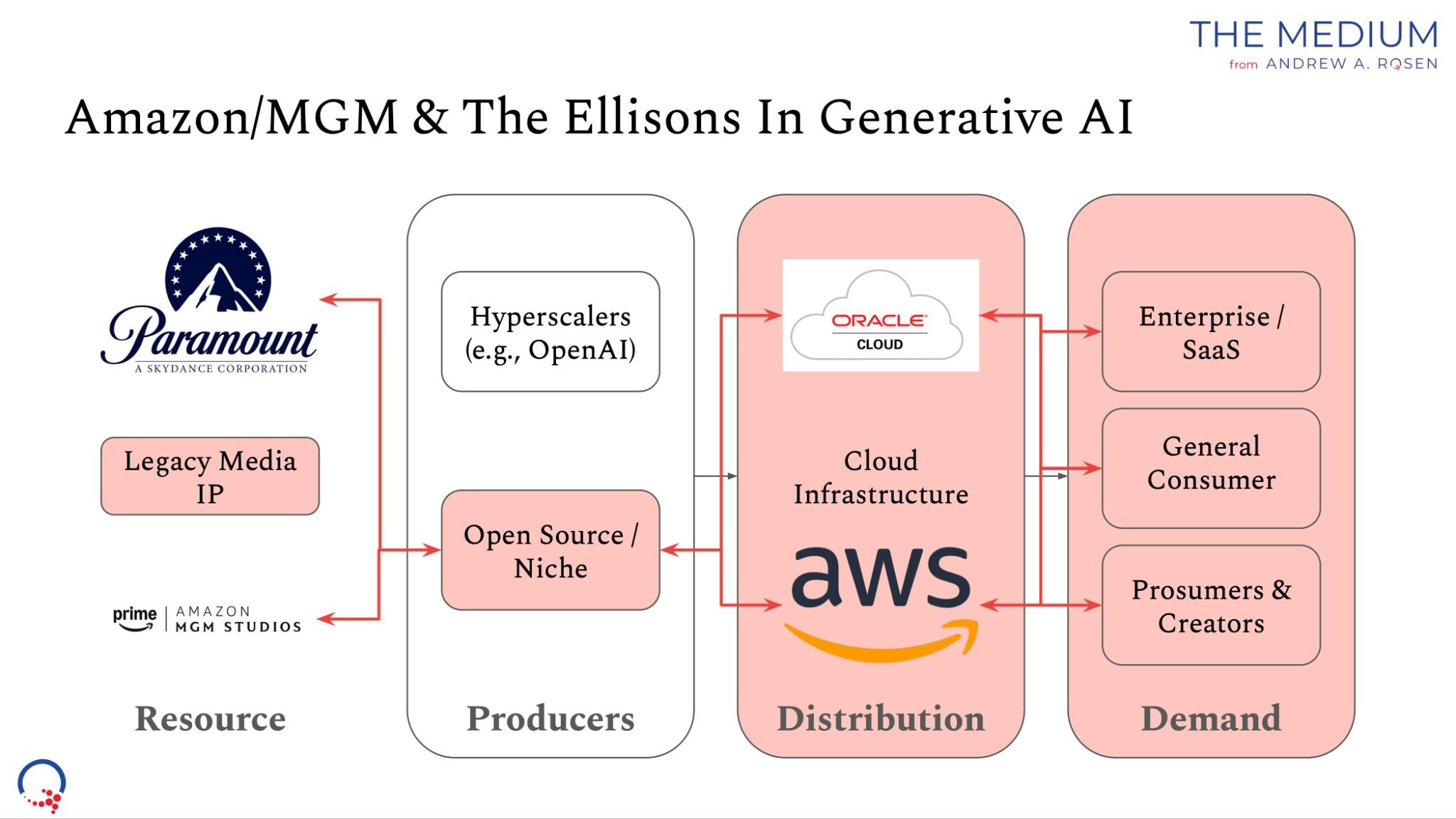
Last December I wrote about the generative AI marketplace (diagram above), where the Ellisons control both content and infrastructure. Amazon enjoys similar vertical integration with MGM Studios and AWS. At AI on the Lot it outlined how its studio, generative AI tools and cloud infrastructure could support animation projects from “people who are leaning into [generative AI] or curious.” There were two other implicit parts to Amazon’s vertical integration pitch: Over 200 million Prime Video subscribers worldwide and “almost 300 million” Fire TV devices “purchased around the world”.
Vertical Integration But No Hardware
Paramount Skydance—via its partnership with Oracle and likely merger with Warner Bros. Discovery—will have similar vertical integration: Paramount and Warner Bros. IP, Oracle’s AI tools, Oracle’s Cloud Infrastructure and distribution via streaming and cable and broadcast networks. However, they will lack the hardware distribution end point.
Vertical Integration But No IP
Google is in a similar position with Gemini (Veo), Google Cloud, YouTube and 300 million active Google TV devices worldwide. Meta has the generative AI tools, proprietary cloud infrastructure, its Family of Apps (Facebook, Instagram, Messenger and WhatsApp) and hardware devices (Meta Quest, Meta Glasses). But both lack the proprietary IP of Paramount Skydance and Amazon’s MGM.
IP and Streaming But No Integration
Netflix owns IP and streaming, but owns no cloud of its own (it runs on AWS) and no hardware (it transferred an internal streaming device project to Roku in 2008 rather than launch it as its own product.). The question is what it will do to remain the dominant global subscription streaming service. It could be the exception that tests the rule, or an example of how full-stack integration is not the only path to market power. There are more emerging market signals it is moving in the direction of generative AI content, suggesting something will have to change.
The New Vertical Integration
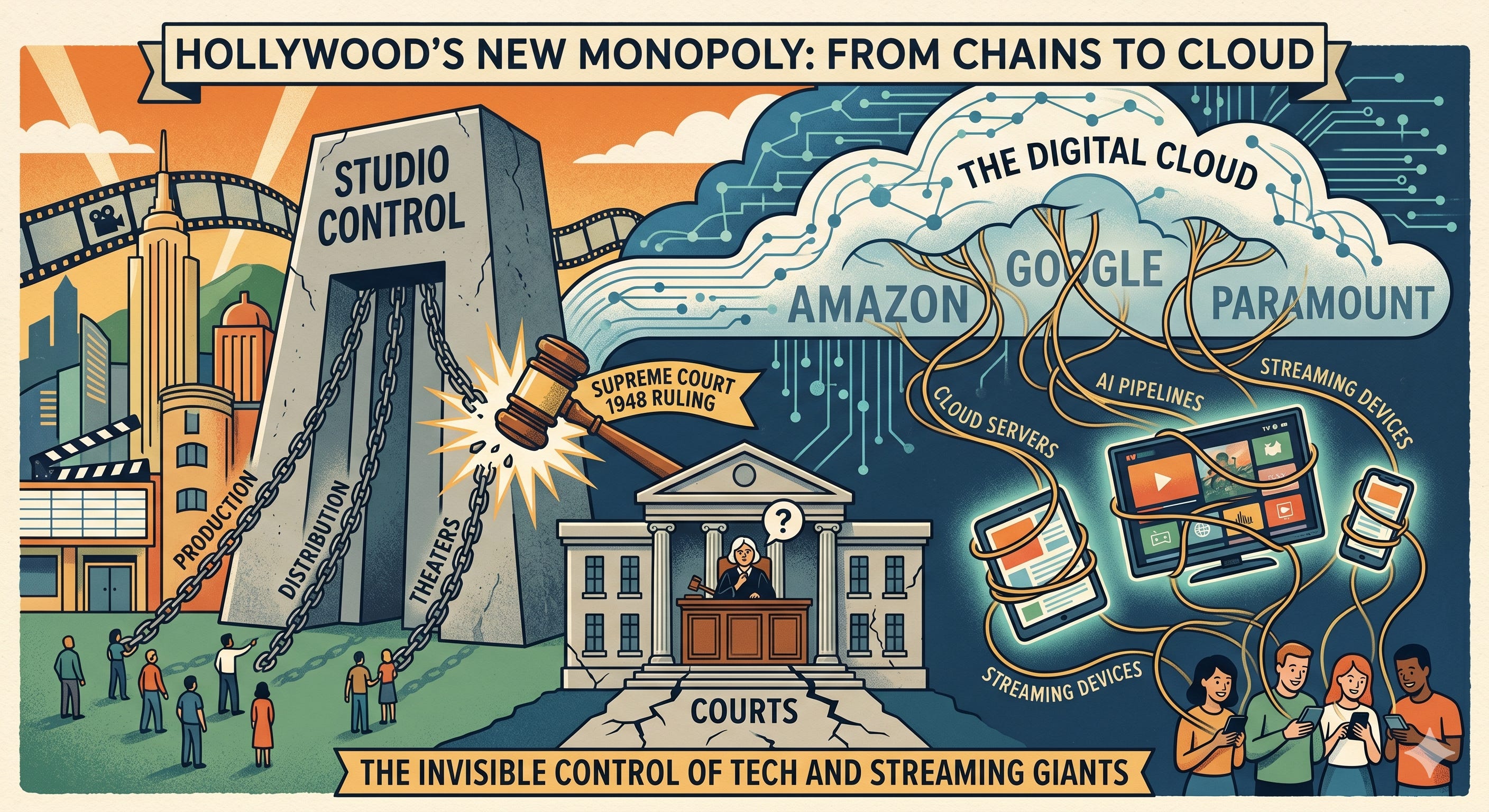
The generative AI marketplace is in the early stages of a new wave of disruption and the key players are in the early stages of new versions of vertical integration. Those that can assemble a full stack will occupy the position the pre-Decrees studios held. Because this new vertical integration will exist across new technologies that are different from traditional theatrical distribution, it is not simply a reconstitution of the old one.
The pre-Paramount Decrees studios controlled what audiences saw, when they saw it and where. The new integrated companies have more far-reaching control—the cloud infrastructure that hosts the training data and the content, the AI pipeline that generates new content with studio IP, the algorithm that selects the content for the user and the device that delivers it. The constraints are mostly invisible, embedded in the medium itself.
Because these models are global, the new vertical integration may be more pervasive than theater ownership ever was. It operates through technological constraints that courts are being forced to understand and IP laws which vary depending on region and/or territory. That also implies that antitrust law will struggle to regulate this.
Studios used to own the theaters. If they did not want your movie on a screen, it did not get on a screen. Now the control sits further back. The companies that own the AI models now decide what can be made in the first place.


