[Author’s Note: Today’s essay is a product of a “dry run” of the briefs test using Hasbro’s Q2 earnings call from July.
To remind you, I am running the test for subscribers in PARQOR Platinum, the most engaged readers on the list, and subscribers who asked to participate in the test. One brief framed the call from the perspective of a studio IP owner’s licensing team, and the other framed it from a brand licensing team’s perspective. The premise is that you are “seeing” developments at the intersection of IP licensing and emerging AI technology from the perspective of the two key players in an IP licensing deal.
Subscribers are already sending me enthusiastic feedback. If you would like to learn more or be a part of the test, please respond to this mailing.]
With the Skydance merger with Warner Bros. Discovery officially closed, the big question on investors’ minds is how it will service its massive ~$80 billion debt. Those questions—plus a release of 471 million stock warrants to Class B shareholders yesterday that dropped the stock price—have dampened investor enthusiasm for the merger. I have argued that the combination of the merger, a partnership with Oracle Cloud Infrastructure and the Ellison family’s control enables a consumer-facing generative AI model:
“Build cloud infrastructure to protect the intellectual property of Paramount Skydance and Warner Bros. Discovery (post-merger, if it happens), and then license it to creators and advertisers. That protection is built into access controls and licensing terms enforced at the platform level.”
To date, I have pointed to some technologies and business models that help explain what this business could look like. However, I have not offered concrete examples that would explain how that model might work in practice.
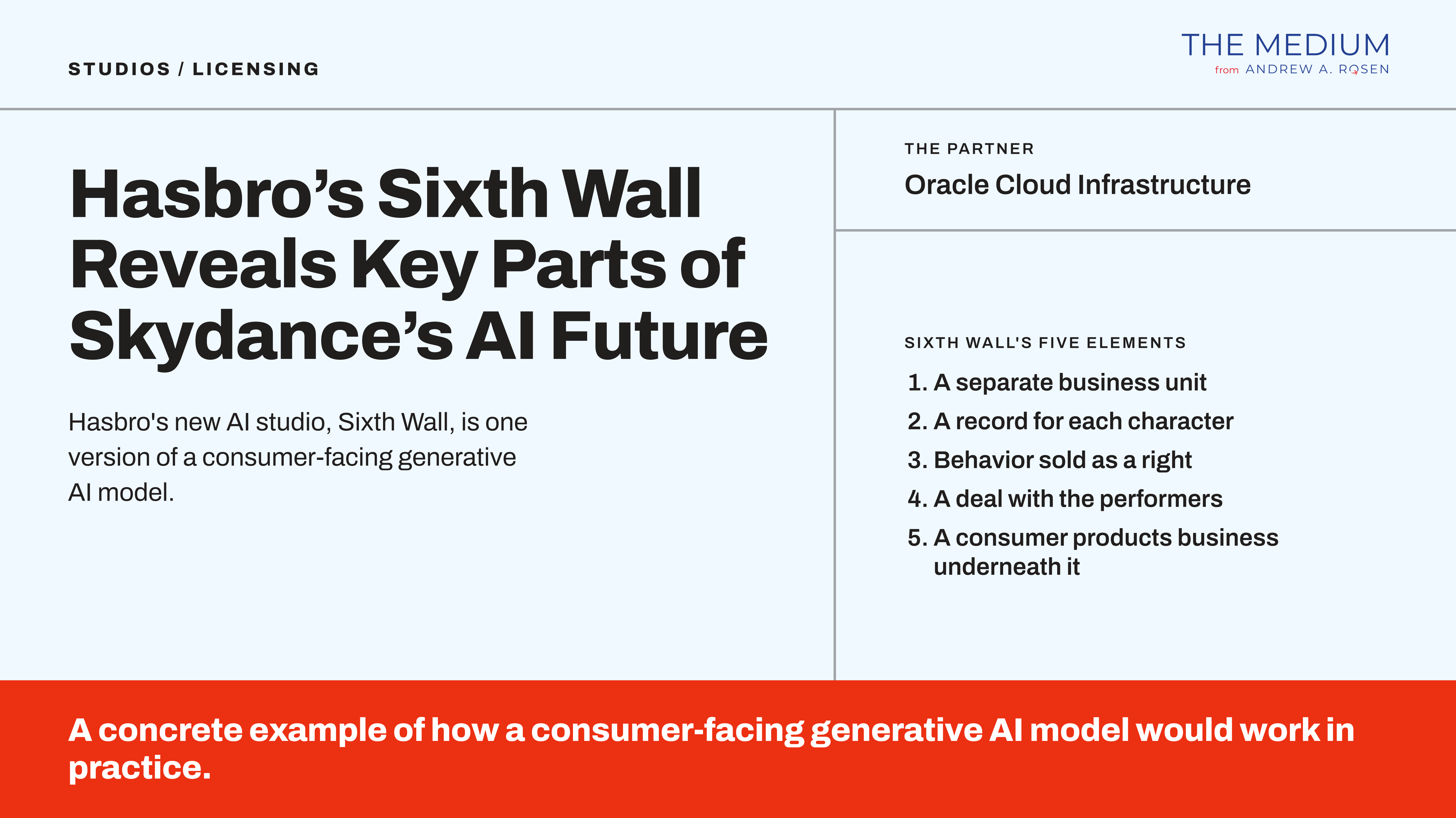
Hasbro is building one version with its new AI studio called Sixth Wall. In June, Hasbro announced: the AI studio “will enable the toy giant’s stable of characters to be deployed by third parties across the new experiences that the technology allows for.” Sixth Wall CEO Roberta Thomson describes the complete offering as “an authorized end-to-end blue check version of the character that a company could license from us.” The company is currently focused on experiences and enterprise use-cases that cater to consumers 13 and older.
We can boil Hasbro’s strategy down to five elements:
A separate business unit
A record for each character
Behavior sold as a right
A deal with the performers
A consumer products business underneath it
The first three are what Skydance and Oracle would need to build. The fourth is harder at their scale. The last one they do not have in place, as I highlighted two weeks ago in “Skydance’s New Co-CEO Moves From Buy Side to Sell Side”