[Author’s Note: An essay I was planning on sending out yesterday—and had been working on since Tuesday—was not working. A market test of a new product no longer made sense as I had structured it. I will give you some backstory because it also provides an overview of my next steps with The Medium.
The core hypothesis driving a growing proportion of my essays, to date, is that the decline of cable and theatrical business models is forcing owners of enormous libraries of IP—especially studios—to find new ways to monetize them. AI is rapidly emerging as a solution for IP monetization for studios, brands and rights holders—but all are risk averse about embracing the technology, especially with questions around copyright law making their way through U.S. courts. Despite fears of AI replacing human creativity in Hollywood, the most promising business model for AI is licensing underused IP to brand-led content creation.
I have been telling people it is 1941 all over again—much like Bulova running the first 10-second advertisement against a broadcast of the Brooklyn Dodgers playing the Philadelphia Phillies at Ebbets Field, brands are emerging in the driver’s seat for the future of IP and the entertainment industry.
This is because they have more business models for monetizing IP than studios, especially as cable and theatrical revenues decline. IP licensing is already a large market and it is growing. Licensed merchandise and services generated $389.8 billion in worldwide retail sales in 2025, up about 5% over 2024, according to Licensing International. Entertainment and characters accounted for $161.8 billion of that. Corporate brands accounted for $98 billion—meaning brands are a quarter of the licensing market as licensors, and that is before AI creates faster and cheaper ways to make content and merchandise around what they license.
The important question now is how this market will play out as AI catalyzes more structural changes. Because it is more a dynamic than a trend, there are many ways it can play out.
Using Claude Code, I have built an agent that writes briefs from quarterly earnings calls for studio and brand executives. Every call produces two briefs from the same transcript, one for each side of the table. An investor reading both sees what one side put on the record and the other left off it.
The briefs apply a game theory lens. Earnings calls are where both sides of a deal speak on the record, under pressure, with lawyers listening and their counterparties taking notes. Written from the studio’s side and the brand’s, each brief shows two parties holding information the other wants, choosing in public what to disclose and what to hold. Tracking those choices across a quarter is how I follow whether companies are adapting as AI shifts the ground beneath them.
The agent reads each call against my hypothesis and drafts the brief. A second pass checks every claim against the source. I choose which calls get covered, read every brief, add my edits and thoughts, and then decide what gets published.
This week’s essay was going to announce a market test of that service and a plan to move over to Beehiiv.
But, then I had second thoughts. The model is closer to equity research than to a Substack or a Beehiiv publication. Equity research is sold by the seat, not by the month, and publishing these anywhere on a subscription list would price them as a newsletter before I know what they are worth.
So, for now, I will start sending the briefs next week exclusively to PARQOR Platinum members and a select group of highly engaged subscribers. If you would like to learn more or be a part of the test, please respond to this mailing.]
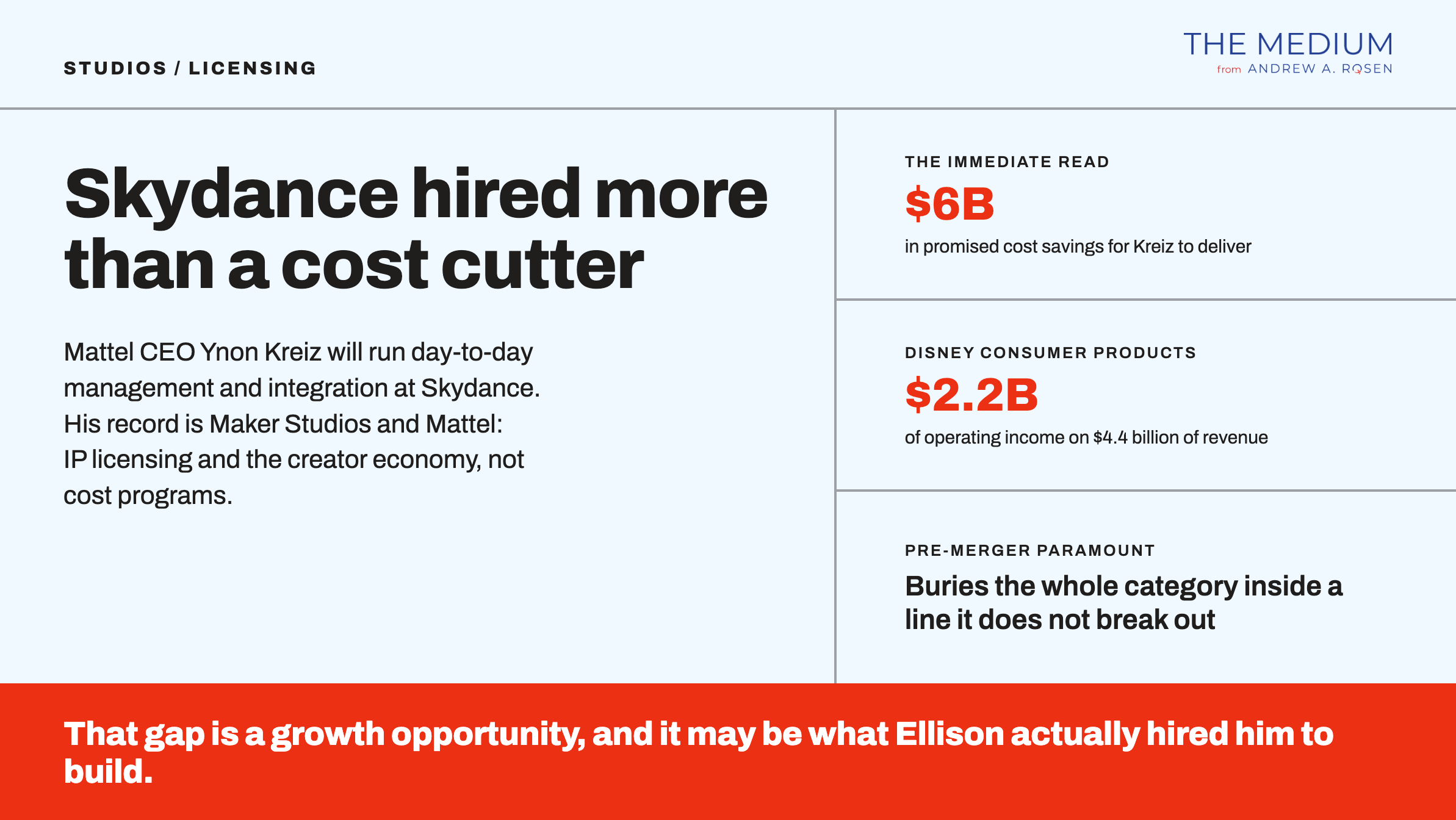
This week, the news broke that Mattel CEO Ynon Kreiz is stepping down and has been tapped as co-CEO of Skydance, the new name of the merged entities of Paramount and Warner Bros. Discovery. Chairman and CEO David Ellison announced Kreiz “will focus on the company’s day-to-day management and integration of the combined businesses.”
Kreiz is effectively the replacement for former President Jeff Shell, who was forced to resign after getting entangled in a legal dispute with a professional gambler.
Ellison’s description of Kreiz’s role has been interpreted as being responsible for overseeing the integration and delivering the $6 billion in promised cost-savings. However, if a media company were to solve for the lack of relevant skillsets in the C-suite for the digital media marketplace in the AI era—a problem that I have long argued was the Achilles heel that hobbled legacy media efforts in streaming—Kreiz’s background brings valuable experiences with creators and IP licensing. They map well to both my hypothesis (in the Author’s Note, above) and a related hypothesis that the partnership of Skydance with Oracle Cloud infrastructure will become the technological foundation for licensing IP to advertisers and creators.
Here is why.