[Author’s Note: This essay is free for all subscribers.]
Last week’s essay on Lionsgate’s deal with Runway concluded:
What does it cost risk-averse executives to truly take on risk? Bollywood’s answer is: far more than they are imagining now.
I had a few conversations and exchanges over the past week that left me thinking my focus on Hollywood is understating the magnitude of this challenge. That if we look at the future of AI in Hollywood from the outside in—like what is happening in Bollywood or through the lens of the Disney v Minimax lawsuit—the industry will never move fast enough to catch up.
The business culture was built to create and support TV and movies for an incredible once-in-a-lifetime profitable business model (cable at 40% EBITDA margins and broadcast at 20%) and a hit-driven model (theatrical at 3% to 6% operating margins) built for passive viewing. Streaming emerged as a medium for interactive viewing. The most successful and profitable once-in-a-lifetime profitable business model has emerged on interactive platforms Netflix (67% EBITDA margins)—but not on YouTube (estimated to have “mediocre” margins), while their legacy media company streaming competition are either losing money or barely breaking even (Disney at 5% operating margins for streaming).
The obvious question for any corporation is where to find additional profits as the cable industry declines and theatrical struggles to recapture COVID-era attendance.
Generative AI enters that equation in two ways: Replacing existing cost-centers like traditional visual effects (VFX) or replacing live productions altogether. The former has been happening in Hollywood since 2023, where ~75% of entertainment industry executives were already using AI to remove, reduce, or consolidate jobs. More recently, Netflix bought Ben Affleck’s AI studio InterPositive “to accelerate the use of artificial intelligence in its filmmaking”.
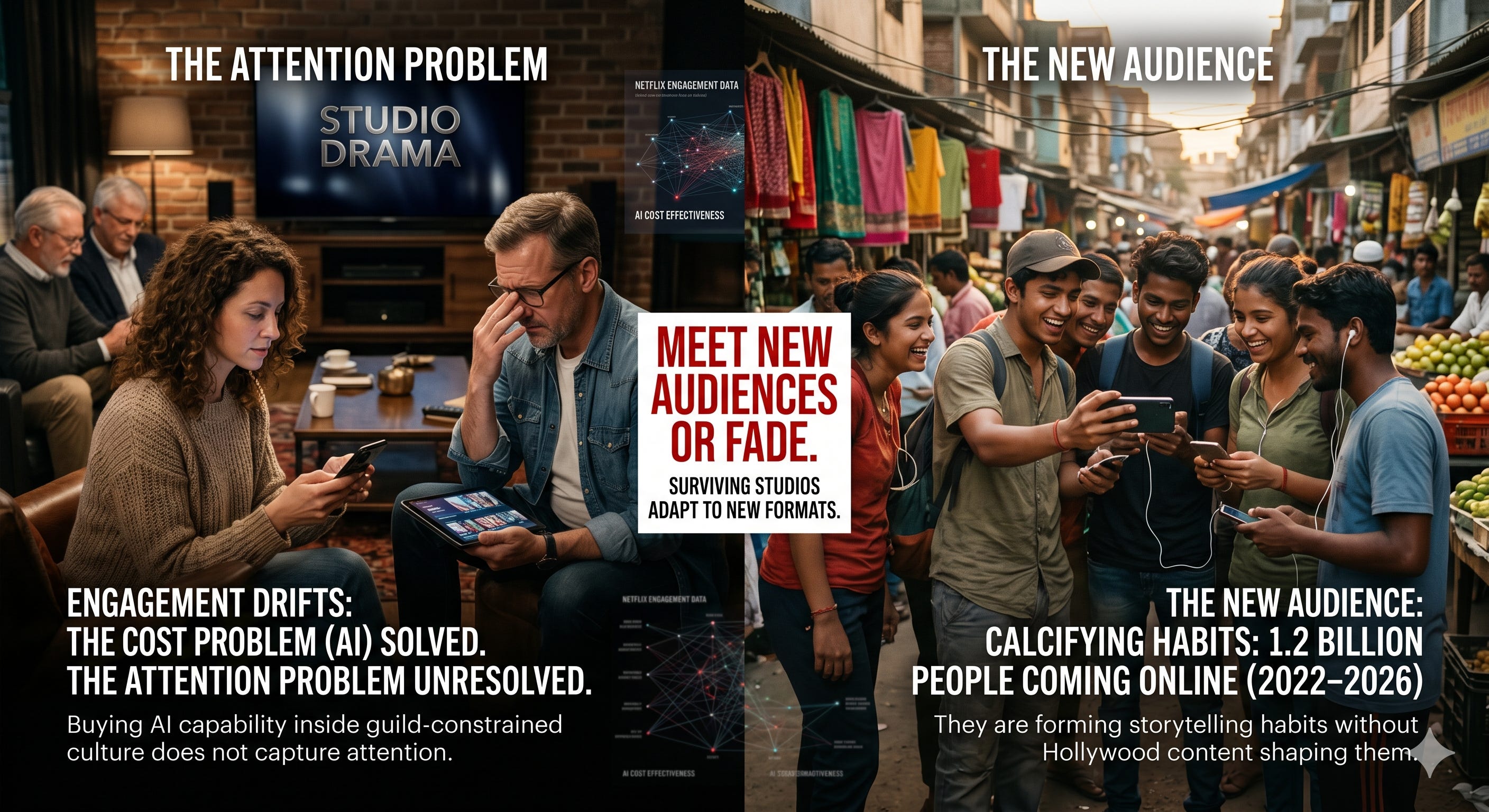
Netflix’s last engagement report is the missing piece that explains the significance of these moves. Its What We Watched in H2 2025 showed total hours viewed in the second half of 2025 increased by only 2 percent. Research firm MoffettNathanson estimates that Netflix’s global user base grew by 10 percent last year, “which translates to an 8 percent decline in daily engagement per subscriber.“
Both that acquisition and the Lionsgate-Runway partnership prove that Hollywood can buy AI capabilities. However, the recent guild negotiations have proven that its core participants will never be unethical or shameless enough to compete with AI studios and corporations from countries like India, China who do not protect copyrighted materials in AI or lean towards embracing AI technology over traditional forms of human creativity. In Singapore, a 2021 Copyright Act explicitly allows commercial AI training on copyrighted content in a way that U.S. and EU law does not.
The owners of studios want and need to find more profitable business models, especially in online media. Rapid subscriber growth normally delivers less engaged consumers—but an 8-point gap between hours growth and subscriber growth suggests something more structural for Netflix—paying subscribers are finding alternative sources of entertainment. A drop in engagement is the opposite of what a platform increasingly relying on ads needs to convey to the marketplace.
As I wrote in March, Netflix now has plenty of competition from both emerging generative AI apps like ChatGPT and Claude, and especially vertical video streaming:
“The challenge for Netflix is not only that this new format is competitive with the 27-year-old incumbent in such a short period of time, but that its weekly and monthly spend suggests consumers value the new format more.”
This is a signal that there is a substitution underway and being accelerated by the 1.2 billion new users who gain access to the internet between 2022 and the end of 2026. Those two signals point to the deeper challenge: Hollywood is moving too slowly, and not relative to Bollywood’s or generative AI’s production costs.
Instead, it is racing against the rapidly evolving attention habits of an audience that has not yet decided what “good enough” means—and is making that decision with less and less Hollywood content in the room. Buying AI capability inside a guild-constrained culture for long-form content seems to be an insufficient solution for rapidly changing audience preferences around storytelling.
From Passive Viewing to Internet Collaborative IP Storytelling Models
What to do instead?
Obvious signs point to vertical video and generative AI as alternative content formats to be embraced as the 1.2 billion increasingly consume storytelling within them. Hollywood studios appear more eager to embrace the former than the latter.
“Internet collaborative IP”—which I wrote about earlier this month—appears to be a more viable solution. It is “IP that is for the people by the people… an interactive story that was built over time that you feel a part of if you were there which makes you want to go and see it and celebrate it because the people made the story.”
The approach marries both the interactivity of online storytelling consumption and the passive consumption of theatrical. It suggests the answer is not for studios to produce long-form content faster or cheaper with AI across televisions and movie theater screens. Instead, it is to rapidly embrace content formats the 1.2 billion are already choosing and to do it before their habits calcify into something Hollywood had no hand in shaping.
To date, we have only seen three movies from YouTubers— “Iron Lung”, “Backrooms” and “Obsession”—emerge and succeed at the box office. That seems likely to grow before any of the guilds shift their embrace of AI. That is because for studios, the corporations that own them and the guilds that have contracts with them, the production budgets can be extraordinarily low (budgets for “Obsession” and “Iron Lung” were both under $1 million) and human creativity can be both protected and thriving.
AS I previously argued in both “Make Ads or Make Stories” and “Bottlenecks and The Greenlight Gap, advertising is the only path where the economics for both creators and distributors make sense in a marketplace where generative AI scales. There is a second solution—one that involves brands, advertising and content partnerships—which I will take up in a future essay.