[Author’s Note: This essay is free for all subscribers.]
Yesterday, IAC announced in an 8-K filed with the SEC that it was rebranding to People, Inc.
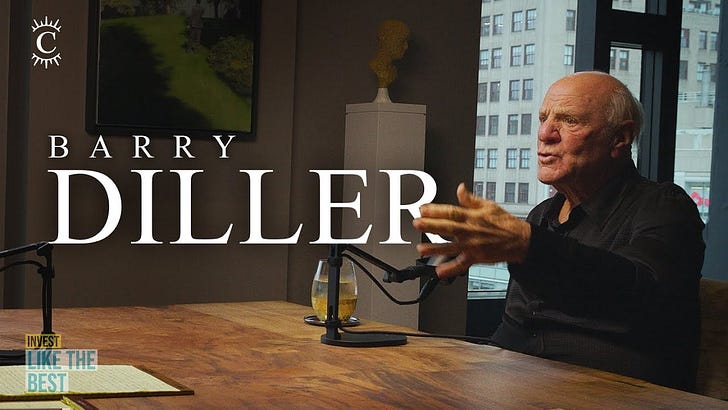
The filing includes a more formalized version of “INVERSION”, which Chairman Barry Diller briefly outlined in a podcast interview with Invest Like The Best last September, and which I wrote about in “Your Favorite Magazine Should Start Making Tequila”.
I wrote that Diller’s concept of INVERSION suggested that “as online commerce has matured, there are more avenues to monetizing this IP via a DTC business or partner with someone looking for new ideas for TV shows.” Diller added on the podcast “If you think about our businesses [through the lens of INVERSION], you succeed and fail, but you’ll come up with hundreds of things to pursue that, if some of them work out, you’ll build a giant company.”
Yesterday Diller defined INVERSION in a letter to shareholders:
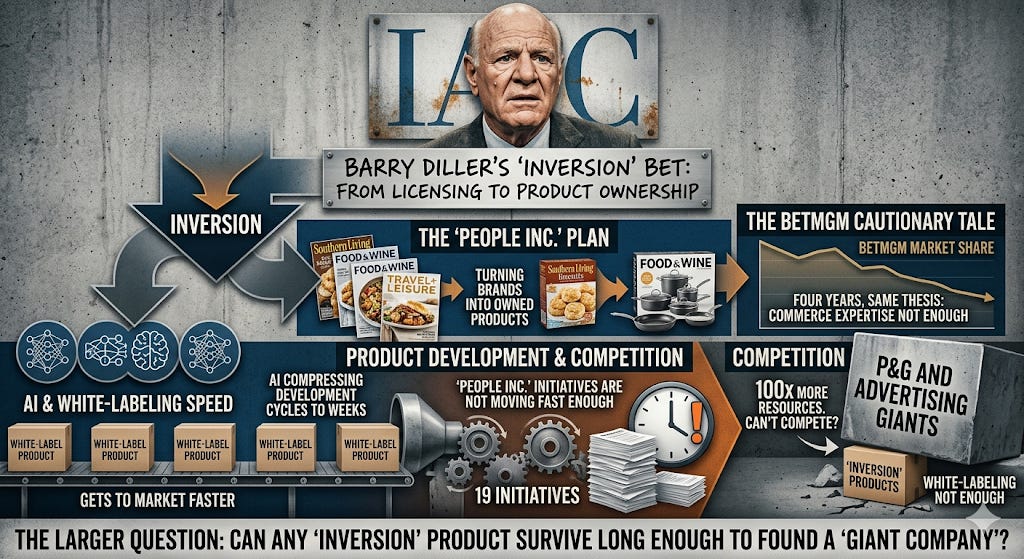
“[It] means taking each of our properties and their intellectual capital and turning them into opportunities to play a direct role in creating new products and services that we own directly, rather than the traditional publishing model of licensing brands. We have literally 19 separate initiatives operating now that are exclusive of the traditional publishing model. I intend for us to be the principal, rather than the licensor, wherever we can in the products and services that will be birthed out of our enormous reservoir of content.”
I wrote then that Diller was betting on its “history and much experience in online commerce” to build this business, the same rationale that he argued positioned it to unlock unusual value from MGM Resorts back in 2020 (it now owns 26% of the company). Notably, Diller writes that “the very hard assets of MGM Resorts” and a “mostly virtual media business” will make up the “corpus of People Incorporated”. Diller sells this as “a perfect hedge in a world that is changing so unpredictively fast.”
The world is changing fast, but INVERSION may not be the right bet on a hedge. I wrote previously that the underperformance of BetMGM relative to its competitors suggests Diller’s and People, Inc.’s keen strategic insights do not always translate to execution. Execution still matters. The generative AI marketplace is already revealing where the limits are.
Disappointing Returns from BetMGM
Diller argues in his letter that the MGM stock “continues to be wildly undervalued.” Back in 2020, Diller’s pitch on MGM was that IAC’s history and experience in online commerce positioned it to unlock unusual value from MGM. That has not happened over the past five years.
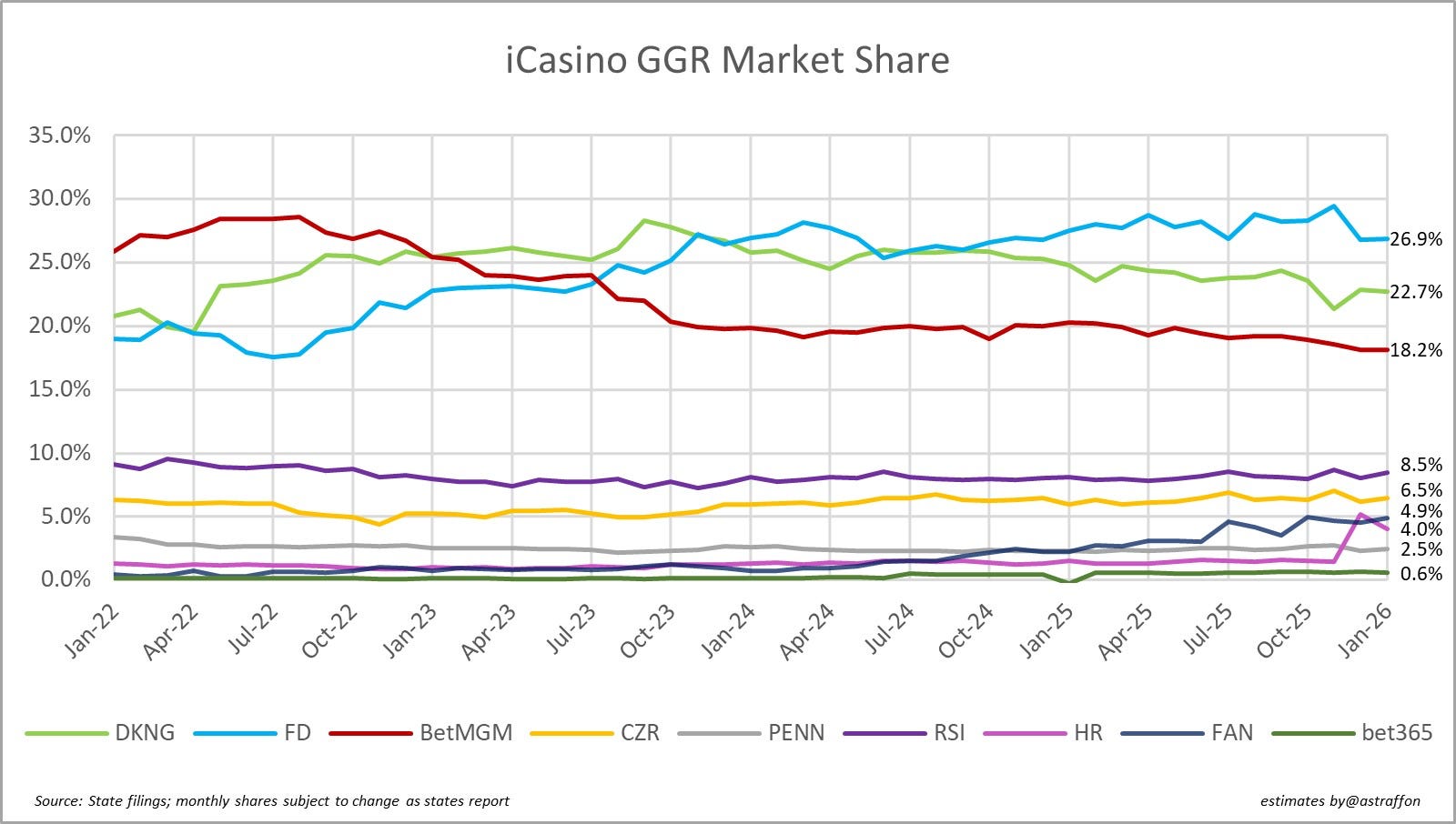
A big reason why is that People, Inc. has not added much obvious value to BetMGM since 2020. As data from iCasino shows (below), BetMGM has actually lost market share over the last four years. Its competitor DraftKings is up ~50% over the same period and FanDuel is effectively flat. MGM’s stock price ($36 today) has underperformed the markets, up 82% since August 2020 compared to 247% for the S&P 500 and 210% for NASDAQ. It is also down 22% from its all-time high of $50.90.
The market has largely soured on the betting market—DraftKings is down 35.4% year-to-date and 30.7% year-over-year. A big part of that is the emergence of prediction platforms like Kalshi and Polymarket, which are quickly capturing market share.
Product Development Requires Faster Speed
In the podcast interview, Diller outlined his vision of People Inc.’s editorial brands—an “incredible gold mine of content, of ideas and of subject areas”—becoming physical products, entertainment properties, and consumer goods.
I have previously written about “faster” being the key variable of the “faster, cheaper, better” maxim in both AI-era content development and product development. For content development, I wrote “‘faster’ is the variable that will change marketplaces more than ‘cheaper’” because that model favors both advertisers and AI storytellers alike.
As for product development, Trevor Sumner—the CEO of i-Genie.ai, an AI consumer insights platform that empowers leading brands and retailers like Bayer, Coca-Cola, Danone, L’Oreal, Unilever, Kenvue and Elida— explained to me last Spring why faster is the key variable in product development with AI:
“We can go from information to true insight to action plan faster than ever before. And I don’t care what industry you’re in, more agile decision making that’s more informed with higher success rates makes a lot of sense.”
People, Inc. is moving in this direction with the “19 separate initiatives” pitched by Diller.
Sumner’s sales pitch suggests that this number is too low. People, Inc. needs to move faster. Sumner was saying last Spring that they can move faster. Beyond Diller’s salesmanship, there is not much evidence yet People, Inc. is in a position to do so.
Adding Infrastructure Is Risky
Earlier this month, I highlighted one big challenge People, Inc. faces in creating new products and services that it owns “directly, rather than the traditional publishing model of licensing brands.” Betting on building, owning and distributing these new products typically requires building infrastructure—supply chain, fulfillment, retail relationships, regulatory expertise— that a digital media company like People, Inc. does not currently own.
A white-labeling strategy similar to the ones YouTube and TikTok creators pursue with manufacturers—like MrBeast’s Feastables chocolate business or Logan Paul’s and KSI’s Prime Hydration beverage—creates a near-instant path to market. This involves hiring a manufacturer to produce a product under the People Inc. brand. Like MrBeast, People Inc. owns the product and the customer relationship. The manufacturer is an invisible partner.
One question for the INVERSION model is which parts People, Inc. and Diller are more likely to own than outsource. Retail relationships are a likely bet—People, Inc. brands like The Spruce and Byrdie have had success with white-label paint, pets and makeup lines. The company has strong relationships with retail advertisers and Diller has a powerful network developed over seven decades.
Those are familiar risks. New unknowns are created by adding retail infrastructure in an era where storytelling creates moments but infrastructure captures value. Agility wins and complex corporate architecture slows companies down in an “unpredictively fast” marketplace—Sumner highlighted last Spring how brands are going to have faster product cycles. In response, Fortune 500 brands like Starbucks, Nike and Burberry are now “dismantling the unnecessary architecture that turned them into shapes too complicated for anyone to hold”, as Code & Theory’s Chief Creative Officer Craig Elimeliah recently wrote.
Infrastructure is not entirely a disadvantage to People, Inc., which is a storytelling business. It has built an in-house, AI ad targeting product called D/Cipher which reduces the technological architecture between advertisers and People’s first-party data. Diller says it will leverage D/Cipher and its first-party data to market those products.
Diller seems to believe that People, Inc.’s brands can result in products that get to market faster and are perceived as “better” because of the brand power of its portfolio of IAC and Meredith Publications. That may not be enough to produce hits when its advertisers are also placing similar bets, and iterating with sophisticated market research models. Advertisers also have more resources—P&G has a $342 billion market capitalization, which is 100x the market capitalization of IAC’s current market cap.
White-labeling, alone, will not be enough to compete.
The Larger Question
On the Q4 2025 earnings call, Diller pitched Southern Living's Southern Tea as a product People Inc. would own and distribute, a Food & Wine chef-driven product line and Travel & Leisure's "own White Lotus."
One question is how fast they can bring these to market and iterate against creators and advertisers pursuing similar strategies. A larger question is whether any INVERSION products can survive long enough to be the foundation of a “giant company”.
Their short-term priority should be speed to market. The good news is that “faster” is very much in the DNA of People, Inc.’s success. CEO Neil Vogel told Fast Company in January 2020: “Our job is to make great content that loads quickly with relevant non-intrusive advertising.”
Now the rebranded company’s job is to curate new brands for white-label partners who can produce and iterate quickly to deliver product to People, Inc. audiences. The other path is too slow and too expensive. That suggests their ultimate challenge will be whether they can come up with enough ideas to compete with their advertisers.