A core argument of my essays from the past few months is that a studio will need to partner with a cloud provider to protect its intellectual property (IP).
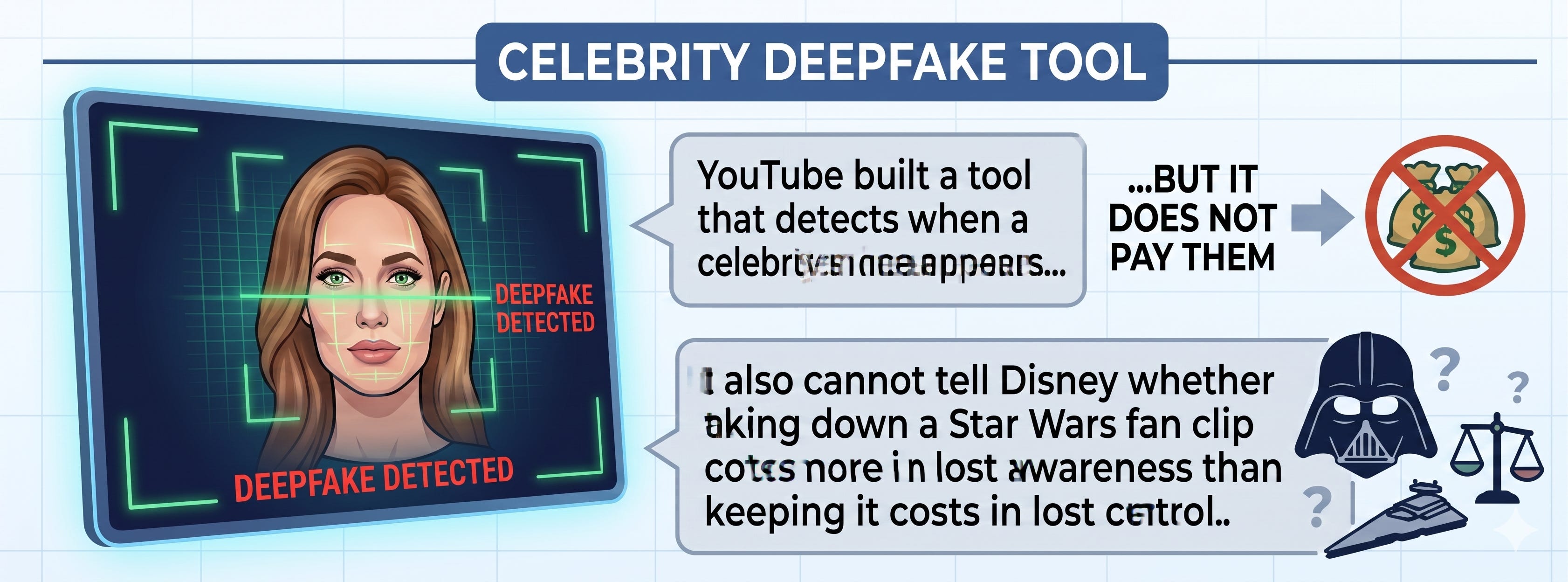
Google-owned YouTube recently announced an alternative path to that outcome: A deepfake detection tool for creators which it opened up to politicians and journalists last month, and expanded to actors, athletes, creators and musicians last week. Anyone “at high risk of having their likeness abused” can sign up to identify and request removal of deepfakes on its platform, whether or not they have a YouTube account.
The model is the “same concept” as its Content ID system to identify copyrighted content uploaded to its servers. Effectively, a celebrity, creator or public figure is uploading their likeness into Google’s cloud infrastructure, where AI learns to identify—but not produce—those likenesses across all content on the platform. That is an enforcement mechanism that operates at both the cloud-level—where the likenesses are identified—and the platform-level—where the videos with violations are either flagged or removed. This mechanism is “air-gapped”: constrained within the cloud and isolated from other models and the broader internet.
That is a double-edged sword. Likenesses can be protected independent of studios, which are slow to partner with cloud companies. However, unlike content ID—where music rightsholders are paid a portion of ad revenue where use of their music was identified—celebrities are not being compensated when their likeness is flagged. They and/or their management team must request the removal manually.
But that request for removal “does not guarantee that YouTube will pull the video”, as its community guidelines allow for “a number of cases like parody and satire” to remain on the platform.
These are operational costs. The deeper problems are structural.