

[Author’s Note: This essay is free for all subscribers.]
Today, Josh D’Amaro officially takes the reins as Disney’s CEO. There are many takes on Bob Iger’s legacy. Here is one I have not seen.
Iger’s expensive bet on streaming and expensive $71B acquisition of 21st Century Fox left a giant database of Disney + 21st Century Fox content at the heart of Walt Disney’s famed flywheel. That decision is playing out in the reorganization under Disney Entertainment announced on Monday. Streaming, games and digital entertainment now directly report into Dana Walden, Disney’s new President and Chief Creative Officer.
Substantively, this move means that two different databases now drive Disney’s business—one sits in Entertainment under Walden, and the other sits in Experiences under D’Amaro’s successor, Thomas Mazloum.1
Iger’s unintended legacy is that the Entertainment database now sits at the heart of the flywheel. But the appointment of Walden—a longtime TV executive with strong ties to Hollywood’s creative community—is intended to signal that human creativity still sits at the heart of Disney’s flywheel. The long-held belief is that “creativity will drive the profits”, as former CEO Michael Eisner posted on X upon D’Amaro’s appointment.
An Inherent Contradiction
This conflict beneath the reorg reflects an inherent contradiction within their pivot to streaming. As I wrote last month, “streaming is, at its core, a database business.” In streaming, content delivered by Netflix serves technical problems like retention curves, churn reduction and ARPU optimization. It serves the distribution software and the core metrics that drive the economics of that software.
Former CEO Bob Chapek understood this dynamic. Before his ouster, he told investors that the customer relationship—not content—is the engine for direct-to-consumer businesses. Theme parks were Disney’s “original direct-to-consumer business” and streaming was “our newest direct-to-consumer business.” Disney’s future lay in a data-driven model operating across the two databases. The closest analogue was Amazon Prime, putting customer satisfaction first and content second. But that operates upon one giant customer database.
This reorg explicitly refuses to acknowledge those synergies. At the very least, it implies those synergies are secondary to political control over each database. Synergies are a negotiation, not a central corporate priority.
From a financial perspective, the Experiences database is more important to the flywheel—it drove 57% of operating income ($10 billion of $17.6 billion) in FY 2025. But, given the corporate adage “creativity will drive the profits”, the Entertainment database is more important.
So which database is at the heart of the flywheel? If it is actually both, no one has spelled out how that will work.
In a black box world, there is one database to rule them all. In the notoriously ugly internal politics of Disney, the CEO who envisioned the single database is out via a putsch. The new generation of leaders is being territorial around their databases.
It is not clear what lies at the heart of the flywheel now. All we know is that it is not creativity alone driving it anymore.
Iger’s “Monolith”
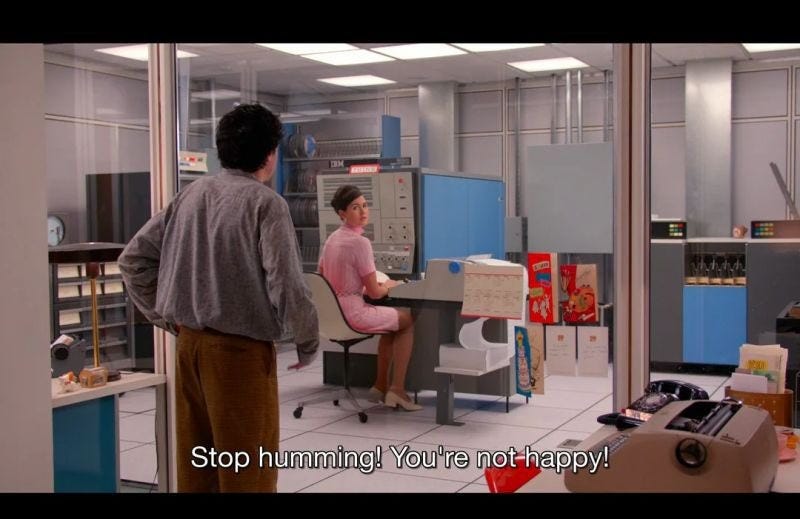
In season 7 of AMC’s hit show “Mad Men”—Episode 4: “The Monolith”— Sterling, Cooper & Partners’ (SC&P) acquire a room-sized IBM System/360 mainframe computer. It is placed in a room that SC&P’s creatives had used as a lobby. The presence of the computer and its loud humming drives one of the creatives—Michael Ginsberg—to have a mental breakdown and the rest of the creative team to resent it.
Iger’s legacy is a “monolith” of a database at the heart of where human creativity once resided. It does not “hum” because its databases of content are stored across Amazon Web Services (AWS) servers. No creatives were impacted by the installation of Iger’s “monolith”.
But it does pose an existential challenge to human creativity at Disney. The deeper challenge presented by Iger’s “monolith”—one reflected in the reorg—is that it embodies a fundamentally different corporate relationship with the consumer. The most successful flywheel models in digital media put customer satisfaction first and content second. Disney’s Experiences division already operates this way.
This reorganization leaves Disney with organizational, procedural and technological ambiguities around what drives the flywheel after creativity has been supplanted by a database.
D’Amaro’s appointment suggests that Experiences—once a beneficiary of creativity at the center of the flywheel—will now drive the flywheel itself. This reorg leaves each division’s role in the famed flywheel ambiguous. Perhaps it is D’Amaro’s objective to resolve those conflicts. But his former Parks boss Chapek sought to do the same, and he was ousted.
That leaves D’Amaro, like Chapek, starting his new job in tricky political territory with internal stakeholders and external shareholders.
“Antibodies in the System”
I argued in February that “Chapek was right about the business and wrong about the politics.” He misread Hollywood and he misread the willingness of Disney’s corporate culture to embrace the culture change catalyzed by Iger’s bold pivot into streaming. He learned there are “antibodies in the system”—a phrase I read in the book “Unit X” about the Pentagon’s attempts to accelerate the U.S. military’s adoption of Silicon Valley innovations.
In the book, “antibodies” describes Pentagon bureaucrats and congressional staffers who were slow to cooperate, prioritizing their own privileges and entrenched processes, and working to block or kill the progress of the Pentagon’s “Unit X” program.
Iger wrote in his autobiography “The Ride of A Lifetime” that he believed Disney would not have been able to pivot to streaming and survive the acceleration of cord-cutting trends without a realignment of managerial incentives—effectively, fighting the antibodies. That pivot to Disney+ required those managers to focus on the “new thing” instead of the businesses at which they had been successful, to date. It required “the purposeful erosion and disruption of their businesses” and the incentives offered needed to match the assumption of that risk.
Despite all that work, “antibodies” in Disney’s system later took down Chapek.
D’Amaro needs to simplify the role of the database in Disney’s flywheel. The new reality is that creativity has become a commodity in Disney’s distribution model. Marginal value from creativity must be extracted elsewhere across the flywheel. It is operationally and technologically more complex and inefficient to pursue that model across multiple databases.
In the Attention Wars, the consumer has fundamentally more power over Disney than they ever had when Walt Disney was alive. They now navigate exponentially more digital and real-world alternatives for their money, time and attention.
Bet on D’Amaro
My bet is that D’Amaro will figure it out. He has to. But the past is precedent and it will not be pretty. My guess is that at some point over the next 12 months, D’Amaro will rip the band-aid off Iger’s legacy and start building anew.
That means:
Unify the two databases under a single customer-data architecture,
Subordinate content decisions to retention metrics; and,
Streamline the fiefdoms of Entertainment and Experiences.
Last November, I wrote that Disney management “believes it can have market leverage at the consumer-facing level. But, in the emerging marketplace, IP only has value to consumers when there is leverage at the cloud level.”
The market’s message is that Disney collectively needs to honor and listen to the “monolith” now at the center of its Entertainment division. That means a strategic investment from a cloud company to wall off Disney’s IP at the infrastructure level and charge AI models for training access.
Licensing alone will not drive the flywheel. Infrastructure ownership will.
Past essays related to today’s analysis:




Arguably its Sports division owns a third database for ESPN’s streaming app. But the ESPN app relies so heavily on the bundles with Disney+ and Hulu—Iger told investors last November that 80% of subscribers opted for the “Trio Bundle,” which also includes Disney+ and Hulu—that the database is effectively owned by the Entertainment division.