[Author’s Note: This essay is free for all subscribers.
Author’s Note #2: There were a few copy errors in the mailing which have since been fixed.]
In its FY Q3 earnings call, Disney sounded like a company that finally understands the “inherent contradiction within their pivot to streaming”. Back in March, I argued former Disney CEO Robert Iger’s legacy from an aggressive, multibillion dollar pivot into streaming is “a database at the heart of where human creativity once resided.” Direct-to-consumer software models live and die by their databases of consumer data.
Disney Experiences division is a DTC business driven by a database. Its Entertainment division was not—affiliates (broadcast and cable) and theatrical distribution are passive consumption models—until Disney’s pivot to streaming. After that, Disney Entertainment became a messy hybrid of two passive consumption, profitable businesses in secular decline and an interactive, increasingly profitable (12.9% in Q3, up from 6.6% in 2025) growth business in streaming.
For these reasons and more, I argued in March that new CEO Josh D’Amaro must:
“simplify the role of the database in Disney’s flywheel. The new reality is that creativity has become a commodity in Disney’s distribution model. Marginal value from creativity must be extracted elsewhere across the flywheel. It is operationally and technologically more complex and inefficient to pursue that model across multiple databases.”
Disney management addressed this new reality with three announcements:
Data unification
A move of consumer products from the Experiences to the Entertainment division, and
A content-sharing partnership with TikTok
Data Unification
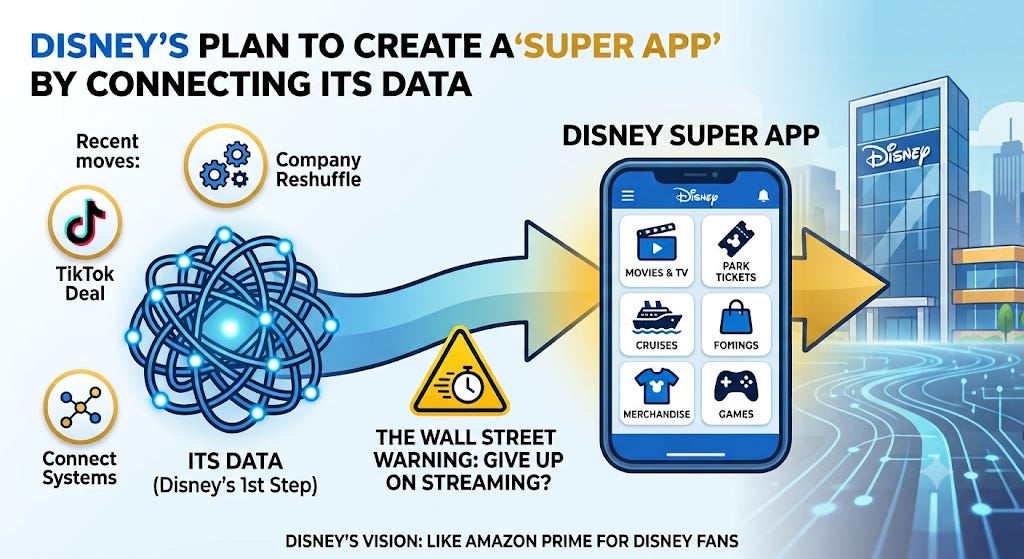
On the call D’Amaro outlined the company’s path to data unification. He acknowledged that Disney’s multiple acquisitions under Iger had created “disparate data sets that sometimes don’t talk to each other.” To fix that, Disney is “unifying” its consumer data “across the entire company so that we can serve our fans better and then drive lifetime value.”
D’Amaro needs this data foundation for a more ambitious bet he shared back in March: turning Disney+ into a “super app” folding streaming together with theme-park tickets, cruise bookings, games and merchandise into one hub. Bloomberg reported in July that the concept remains an early internal idea, with no concrete build underway.
D'Amaro echoed a sales pitch former CEO Bob Chapek had made years earlier when he said: “There are very few companies in the world with the breadth and richness of data that Disney has across parks and streaming and studios and consumer products.” Chapek saw that overlap as the basis for Disney become a DTC company at its core and an opportunity for a “Disney Prime”-type service.
That all said, D’Amaro also acknowledged in an answer to another question that “There’s still work to be done on unifying the tech stacks between the legacy standalone services, as well as on integrating what have historically been disparate data sets.”
Effectively, he was conceding that Disney had done more work to impress investors than to build the platform that could deliver the promises it was making to those same investors. The super app is a preview of why data unification matters beyond customer service. It is the precondition for a product Disney has not built yet but envisions as table stakes to compete with Netflix and Amazon. Even if it is now headed in the right direction, it has a long way to go.
Consumer Products
Disney announced the day before its earnings call that “Disney Consumer Products will shift the majority of its businesses from Experience over to the Entertainment division, sitting within the Studios.” In its letter to shareholders, management said the move “shift will have strategic and operational benefits by bringing the monetization of our IP through consumer products closer to the studios that create that IP.” It added the move “will better reflect the returns our Entertainment segment is generating from the content it produces and make our Entertainment segment more comparable to peer reporting methodologies.”
A memo from Thomas Mazloum—chairman of Disney Experiences—and Alan Bergman—chairman of Disney Entertainment Studios—explained that the objective of the move is to create “cohesion” across the entire Disney ecosystem “from the very beginning” and extend the relevance of its franchises “for generations.”
Consumer products is a profitable business, generating $560 million in operating income on $1.1 billion in revenue in FY Q3. Nothing in Disney’s portfolio has the same 40% margins at the same scale of revenue as cable had. Combining consumer products into Entertainment boosts operating income by 30% from 11% to 14.3%.
It is also worth considering this move in light of the recent deal with Kraft-Heinz, which “unlocks opportunities for integrated marketing campaigns, digital content and brand-led marketing campaigns across Disney’s media platforms.” The implication is the move makes it easier for the content side to execute this part of the deal. The framing of “majority of its businesses” suggests that the division responsible for the Kraft-Heinz products related to the various Parks and Cruises will remain in Experiences and oversee that part of the deal.
It is reasonable to assume this will be a new model going forward.
Content Sharing with TikTok
Disney announced a pilot with TikTok to “bring an expansive collection of thoughtfully curated Disney-centric fan-created content from TikTok to the Disney+ app.” As part of that pilot, “TikTok will offer their creators access to assets related to hundreds of films and series from Disney’s vast library of enduring franchises and beloved IP.” When the pilot launches, “short-form videos from participating creators who opt-in to the program will live on both TikTok and in Verts on Disney+ and feature characters and stories from across Disney’s brands including Pixar, Marvel, Star Wars, FX and more.”
Disney has found an alternative solution to the sudden collapse of its planned Sora pilot alongside its $1 billion investment in OpenAI. This deal was unthinkable at the beginning of 2025, if not heresy to suggest it at Disney 20 years ago.
As D’Amaro explained on the call, the experiment has a clear DTC rationale. First, it helps with awareness and engagement for Disney+: “It’s important for us as The Disney Company to be out there with the fans, making sure that they’re seeing us, they’re engaging with us.” It also helps with retention: offering native TikTok content on Disney+ will create “a more complete experience on Disney+, and it’s a stickier app. People stay around for longer.”
But, “Work To Be Done”
We can see the pieces in place for the new models that are emerging in the post-cable media marketplace. In moving consumer products to Entertainment, Disney has positioned its IP for brands as both advertisers seeking to create content with its IP and licensors seeking to build merchandise with Disney IP. In partnering with TikTok, it is building creator-led entry points into the Disney flywheel.
These are promising opportunities. That said, the key takeaway from the call is that data unification is a necessary condition for these moves to truly succeed. Streaming’s margin gains came from data streaming already owned, and Disney has not shared the extent to which they came from unification with other divisions. The TikTok and consumer products announcements require exactly that kind of cross-division and cross-platform connection to succeed—which D’Amaro says is still incomplete. The TikTok deal will not work if Disney cannot connect a viewer’s TikTok engagement back to their Disney+ profile to know whether it is actually driving retention. Nor will it work if valuable data from that engagement is not actionable across Disney because there is still “work to be done”.
The consumer products move will mean little if the disconnects between databases interfere with the performance of brands’ ad and merchandise campaigns. The slower and/or more problematic data unification is within Disney, the less progress these deals will make for the company despite its obvious business logic and promise.
That suggests that even if the consumer products move makes it easier for Disney to pursue generative AI ad marketing deals with Kraft-Heinz and other advertisers that use its characters, D’Amaro is acknowledging there is still “work to be done” on “unifying the tech stacks” and “integrating disparate data sets”.
He may be intentionally understating the challenge here, given how much of the reorg's logic depends on investors believing the unification story on its face. Disney is well behind where it should be technologically. That was the case that Wells Fargo analyst Steven Cahall made last month when he suggested that Disney should exit the streaming video business. Even with a deal like the one it made with TikTok, Disney is not positioned to compete effectively with high-volume streaming platforms such as Netflix and YouTube. He also questioned whether Disney releases content frequently enough to control subscriber churn and support long-term margins.
Data unification could help to alleviate those problems and create new business problems. But D’Amaro’s explanation suggested there are operational, cultural and technological disconnects across Disney’s data silos. It may be too far behind the speed of the market’s evolution to truly solve this issue.
Cahall’s arguments suggest Disney has insufficient technological resources to compete. I have suggested it also lacks the technological resources to protect its IP and therefore needs a cloud company as a strategic investor.
The real risk D’Amaro revealed is that its data still does not offer a complete picture of which of its ambitious new initiatives will earn their keep.