[Author’s Note: The first week of the test produced eight briefs from 11 earnings calls.
This week will have 10 earnings calls—six of them will be across Thursday and Friday. That may mean I schedule sending one or two on Saturday to even out the distribution and not overwhelm readers’ inboxes.
To remind you, I am running the test for subscribers in PARQOR Platinum, the most engaged readers on the list, and subscribers who asked to participate in the test. One brief framed the call from the perspective of a studio IP owner’s licensing team, and the other framed it from a brand licensing team’s perspective.
Subscribers are already sending me enthusiastic feedback. If you would like to learn more or be a part of the test, please respond to this mailing.]
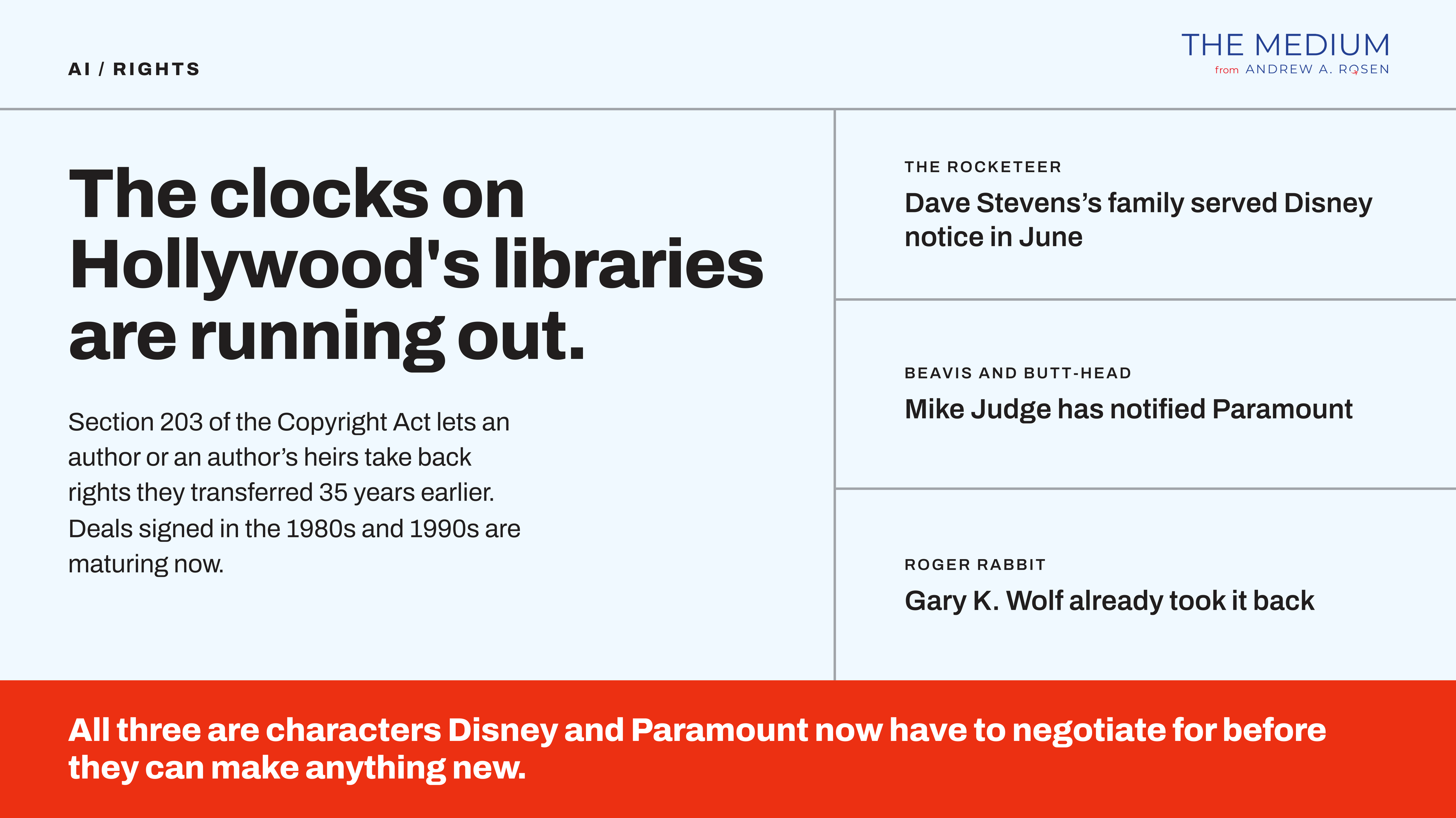
Section 203 of the U.S. Copyright Act lets an author or an author’s heirs take back rights they transferred 35 years earlier. It is now playing out in a few cases where the heirs to an author’s estate are invoking Section 203 to take the rights to properties like The Rocketeer (owned by Disney), and Beavis and Butt-Head (owned by Paramount)—creator Mike Judge recently notified Paramount of his intent to exercise termination rights over the characters he originated in 1992 shorts, with a potential reversion window opening around 2027.
The Rocketeer was created by Dave Stevens in 1982 as a nostalgic homage to 1930s pulp serial heroes. This past June, The Rocketeer Trust—run by Stevens’s family—served a Notice of Termination on Walt Disney Pictures and several of its subsidiaries and licensees. The filing targets six copyright registrations and sets June 12, 2028 as the effective termination date. Section 203 says the reverting rights “become vested on the date the notice of termination has been served,” so the family’s claim on them was locked in this past June, two years before it takes effect.
Disney will be allowed to continue exploiting the 1991 film. Section 203 says a derivative work prepared before termination “may continue to be utilized under the terms of the grant”—on the original deal’s economics, including whatever royalty it agreed to when it licensed the IP. The same clause says the privilege “does not extend to the preparation after the termination of other derivative works.” So, generating new images of the character from that film—which generative AI models are built to do—looks like the preparation of a new derivative work, which would put it outside what Disney keeps.
That safety is narrower than it sounds. Termination moves the copyright and nothing else. The statute “affects only those rights covered by the grants that arise under this title, and in no way affects rights arising under any other Federal, State, or foreign laws.” Disney keeps the Rocketeer name and logo, and it keeps every right outside the United States.
These moves by Judge and Stevens’s family reflect emerging cracks in the libraries of studios like Paramount and Disney How many characters in those libraries are vulnerable to a termination notice is an open question—no studio discloses how much of its catalog came in from individual authors after 1978.
For any executive planning to license IP through generative AI models—like Hasbro’s Sixth Wall studio is doing—the safest material to license for generation will be the material a studio made itself. Section 203 does not reach works made for hire, and a studio’s own productions are works made for hire with the studio as author.
The riskiest material will be the IP it acquires or licenses from creators like Judge and Stevens. As we have seen with the success of Bluey on Disney+ and third-party IP like Super Mario Bros. on Netflix, the IP with the deepest fandom is often the material a studio licenses in.