
[Author’s Note: This essay is free for all subscribers.]
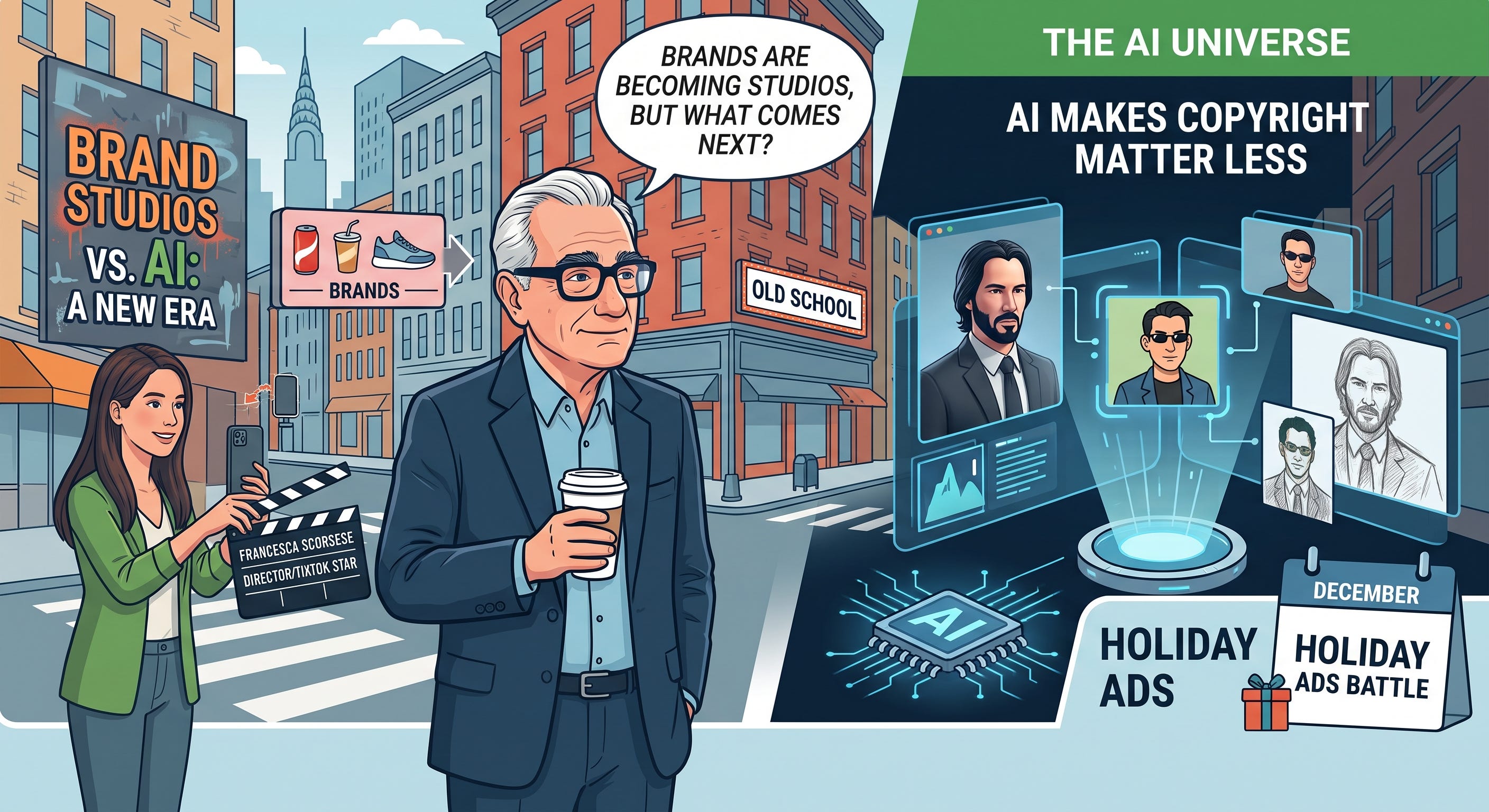
On July 22, Lavazza released a digital short directed by Francesca Scorsese which follows her father—famous director Martin Scorsese—through New York while he drinks espresso. It is one example of brands importing the operating skillset of a studio and running it inside a marketing budget.
The Hollywood Reporter’s recent cover story, ”The Pillsbury Doughboy Is Coming for Hollywood” details a wave of productions like it—a Prada short directed by Barry Jenkins, a scripted series from Albertsons and Procter & Gamble—and frames brands as “keeping an ailing industry afloat.” But it also presents brands as outsiders stepping into a market with declining opportunities for talent and building studios to create content with that same talent.
This complicates the argument made recently by activist hedge fund Anson Funds to Lionsgate management that third parties will license or even buy libraries of existing IP from studios like Lionsgate. I have previously argued that advertisers are the optimal licensing partners for this IP, especially in an era of generative AI: “Advertisers can license ‘five or six IPs’ from the major studios while figuring out the ‘big swings’ through many ‘little swings’ in the background.”
The story suggests, instead, that brands now prefer to build their own IP and implies some additional challenges for brands as third party customers for licensing.
It also suggests the demand for libraries of IP from brands is not as strong as my past essays argued. This is because brands who might license IP from Lionsgate and other studios are choosing to build new IP by funding original content instead. In April, I predicted brands would “build their own entertainment infrastructure” and shift dollars away from “the traditional advertising value chain altogether.”
Last month I flagged two risks in a world where brands license IP from studios for generative AI campaigns. First, advertisers will only license if IP can still be kept excludable—meaning the owner can prevent creators and advertisers who do not pay for access from using the IP—and be enforced outside the walls of the IP holder’s cloud ecosystem. For example, an advertiser licensing “Teenage Mutant Ninja Turtles” from Paramount Skydance will want Oracle to watermark every output so misuse of authorized content can be traced though not enforced.
It is worth noting watermarking would do nothing to stop a separate, unauthorized model trained on the same characters and hosted on other platforms. If exclusivity cannot be enforced, the thing a studio is actually selling—premium IP with the right to exclude everyone else—becomes unenforceable by default. That presents a bigger, more existential question of whether IP ownership still functions as a business model once any well-resourced actor can train a separate model on the same characters. That is a key reason why studios reacted so strongly to Seedance 2.0’s release in February.
Otherwise, brands will be forced to build their own IP. The precedent of Gulf+Western owning Paramount Pictures suggests they could buy a studio, too.
A second risk is that audiences must care about the IP enough to engage and pursue a direct relationship with authentic, high-quality representations of the IP from a brand. WME head of entertainment marketing Liz Walaszczyk told The Hollywood Reporter that brands now “have more of an opportunity now to be more targeted in terms of the audiences that they’re trying to reach”. Kraft-Heinz CMO Todd Kaplan added that the guiding “philosophy” is how to “create organic conversations that are really opt-in from consumers and things that people want to share with their friends.”
Kraft-Heinz is currently betting on Disney IP to revive sales of iconic brands like HEINZ, Philadelphia and Kraft Mac & Cheese. If third-party IP cannot accomplish these goals, there will be more reasons to build original IP than to license it.
A Marketplace Before Generative AI
Today, brands are opting to build. The question is when, if ever, license or buy enters into that calculus.
I argued the Kraft-Heinz deal reflects two different futures for how generative AI can enter the fold. If Kraft-Heinz “has generative AI and branding savvy” and Disney agrees to use cases of its IP similar to its failed deal with OpenAI's Sora, we will see these ads within the next year. If either falls through, it will reveal how risk-averse, and how far behind, these two giant companies are in the AI marketplace
This leaves an open question the Hollywood Reporter article does not answer: Are brands building because they do not want licensed IP, or because the licensing market is not yet liquid enough to serve them? The distinction matters. If it is the latter, Anson’s licensing thesis for Lionsgate is too early and has obstacles to manifest.
The signal to watch is whether a brand licenses a major franchise character for a generative AI advertising campaign within the next two quarters, especially with the holiday season approaching. If that deal does not happen, the answer is the first one: brands do not need licensed IP, regardless of how liquid the market becomes.
It may be simpler for a brand to buy a studio on the cheap, or build its own with the tools of a new medium.


