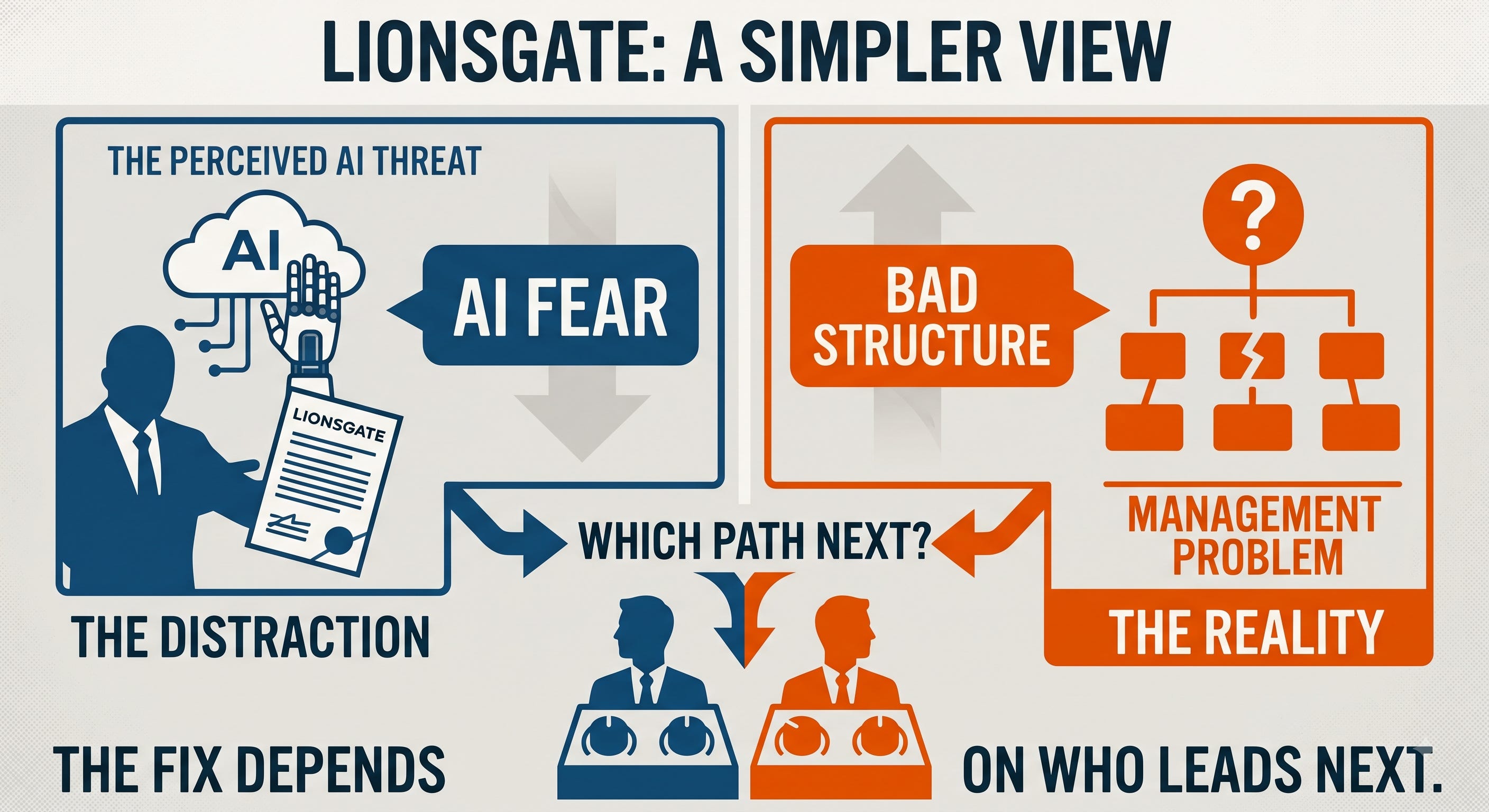
Yesterday Semafor reported that activist fund Anson Funds recently wrote to Lionsgate management, arguing the studio should respond to the threat of AI disruption by selling itself. The July letter argues that “Lionsgate’s stock has reacted sharply—and negatively—to the release of new AI video models, including Sora and Seedance, which we believe reflects a default market assumption that a studio is more likely to be an AI casualty than an AI beneficiary.”
The letter posits that Lionsgate could “enjoy a premium as the owner of thousands of films, given the IP licensing that could come from that library.” Management has “struggled to define that to investors.”
Semafor appears to be the only external media party to read the letter—it is not sharing the full letter, only the core logic of the Anson Funds’ arguments. That said, this logic echoes something I argued back in June about Lionsgate’s equity investment in Runway, the video generative AI company:
“Lionsgate and Runway seem to be taking the traditional studio approach to AI. It is a studio that thinks short-form AI content and new IP with a hot AI platform counts as risk-taking. That contrasts with the Bollywood ecosystem where the entire production model is being reimagined and restructured.”
Anson’s logic is similar but narrower: Regardless of what may be happening in Bollywood or elsewhere, emerging models like Sora and Seedance present the traditional production model with a new calculus of build, license or buy.
Anson’s argument is that licensing is the best path ahead to unlocking shareholder value. The firm understands that there are limits to building in the new calculus of build, license or buy. But Anson does not appear to grasp the emerging “first principles” of the calculus of license or buy.
Who can Lionsgate sell to? Who can they license to? And how will it license it? There are limits to what a standalone production company can do in this marketplace—much less than a relative behemoth like Disney or NBCUniversal.