[Author’s Note: This essay is free for all subscribers.]
Recent conversations with people in Hollywood point to a shift in mentality towards AI from both studios and guilds. Some highlighted the upcoming IPOs for OpenAI and Anthropic as making AI seem less abstract and more an inevitable reality. Some pointed to few, if any, signs of vitriol between studios and guilds in the current negotiations. All suggested that various mindsets of fear and resistance I heard in conversations as recently as six months ago were disappearing.
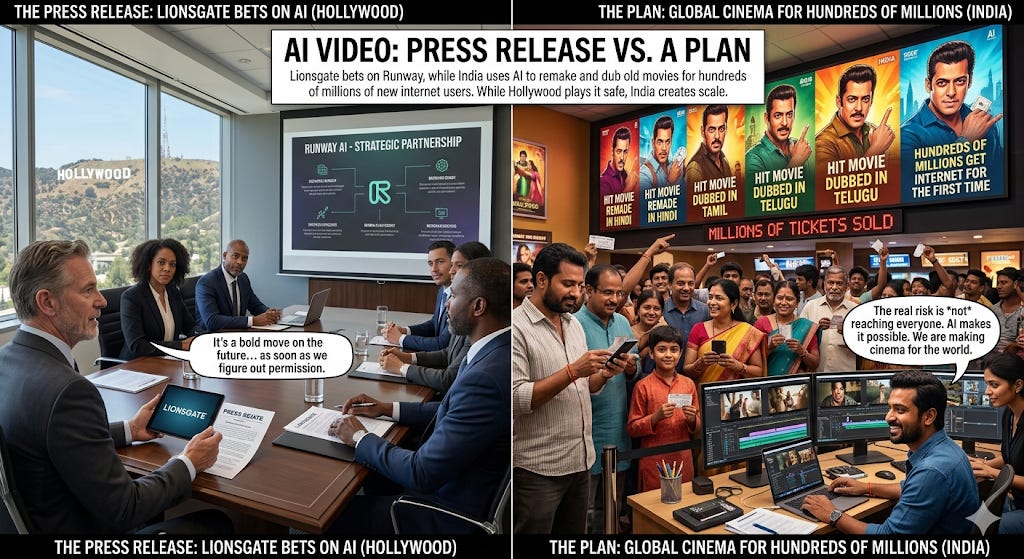
Similar signals of a thaw, if not a vibe shift, have emerged in the past few days. Lionsgate announced yesterday it is taking an equity stake in Runway, the generative AI video company. It expands on a partnership launched in 2024. The deal includes using Lionsgate’ existing catalogue of intellectual property for an AI short-form series and starting a new development program to create new intellectual property using AI.
I previously wrote about Runway’s partnership with Lionsgate last year and then again in February about the range of “unforeseen complications” that emerged: The “limited capabilities that come from using just Runway’s AI model” and “copyright concerns over Lionsgate’s own library and the potential ancillary rights of actors”.
This deal seems to solve for both: Short-form series appears to be a business opportunity that avoids the challenges encountered incorporating Runway into pre-production. New IP obviates the thorny questions around copyright and compensating rightsholders of old IP (in theory).
Risk-Taking
This deal is emerging both against the contrasting backdrops of the guild negotiations and Bollywood’s aggressive embrace of AI. Through the lens of the former, it reads like aggressive and possibly transgressive risk-taking —the possible use of existing franchises and characters will create inevitable exposure to public-backlash around labor, likeness, authorship and intellectual property. It will also be subject to the final version of SAG-AFTRA’s 12 basic ground rules for the use of digital replicas in its tentative agreement with AMPTP.
Through the lens of the constraint-free “Wild West” of Bollywood, the deal seems like a half-measure. A smaller, traditional studio is embracing AI for short-form content and new IP, only. The partnership is built to aggressively use AI to push new movies into theaters, revise old ones or create movies based on public domain IP like mythology or The Bible.
Disney Precedent
In some ways the Lionsgate-Runway deal echoes Disney’s abruptly-cancelled deal with OpenAI. Last December, Disney and OpenAI announced a surprise three-year licensing agreement: Disney would license 200+ characters to OpenAI’s Sora platform, invest $1 billion and become a “major customer” of OpenAI’s APIs “to build new products, tools, and experiences” Depending on who you asked, that deal was perceived as Disney taking a significant risk, or as I argued, securing the optics of a significant risk but really investing in operational cost efficiencies. Now that the deal is dead, Disney never got to answer that question.
Runway recently raised $315 million in Series E funding at a $5.3 billion valuation to “pre-train the next generation of world models and bring them to new products and industries.” Lionsgate is sending a similar message to shareholders that Disney did: Whatever the perceived costs or risks of AI may be to the creative industry, shareholders will see inevitable financial upside from a legacy media company hitching its wagon to a fast-growing AI platform.
But Is This Enough Risk?
The Eros recut of a 2013 hit movie “Raanjhanaa” proved that Both theatergoers and 958 million active internet users in India are increasingly forming their entertainment expectations around AI-generated content. Hollywood and Bollywood compete for the same customers on the same digital platforms. A creator at the Artist & The Machine Summit framed it best: Asia and Africa are leveraging AI to change the scale and speed at which content is being produced and monetized. With hundreds of millions more arriving online across Africa and other territories getting internet access for the first time, this means a conservative solution that works for the Hollywood ecosystem will struggle to compete globally.
More risk must be assumed by a Lionsgate and Runway partnership to produce content faster and cheaper in order to compete in a global marketplace. Monday’s essay suggested that the model also needs to be “internet collaborative IP”, which is “IP that is for the people by the people essentially. It is an interactive story that was built over time that you feel a part of if you were there which makes you want to go and see it and celebrate it because the people made the story.”
That model is the antithesis of a studio model. It is more like a creator model. It captures the human creative collective that has built Hollywood. It is also its antithesis—audience input eliminates the need for a team of “expert” creatives driving the creative. That makes the model cheaper.
Instead, Lionsgate and Runway seem to be taking the traditional studio approach to AI. It is a studio that thinks short-form AI content and new IP with a hot AI platform counts as risk-taking. That contrasts with the Bollywood ecosystem where the entire production model is being reimagined and restructured.
This raises a difficult question: What does it cost risk-averse executives to truly take on risk? Bollywood’s answer is: far more than they are imagining now.