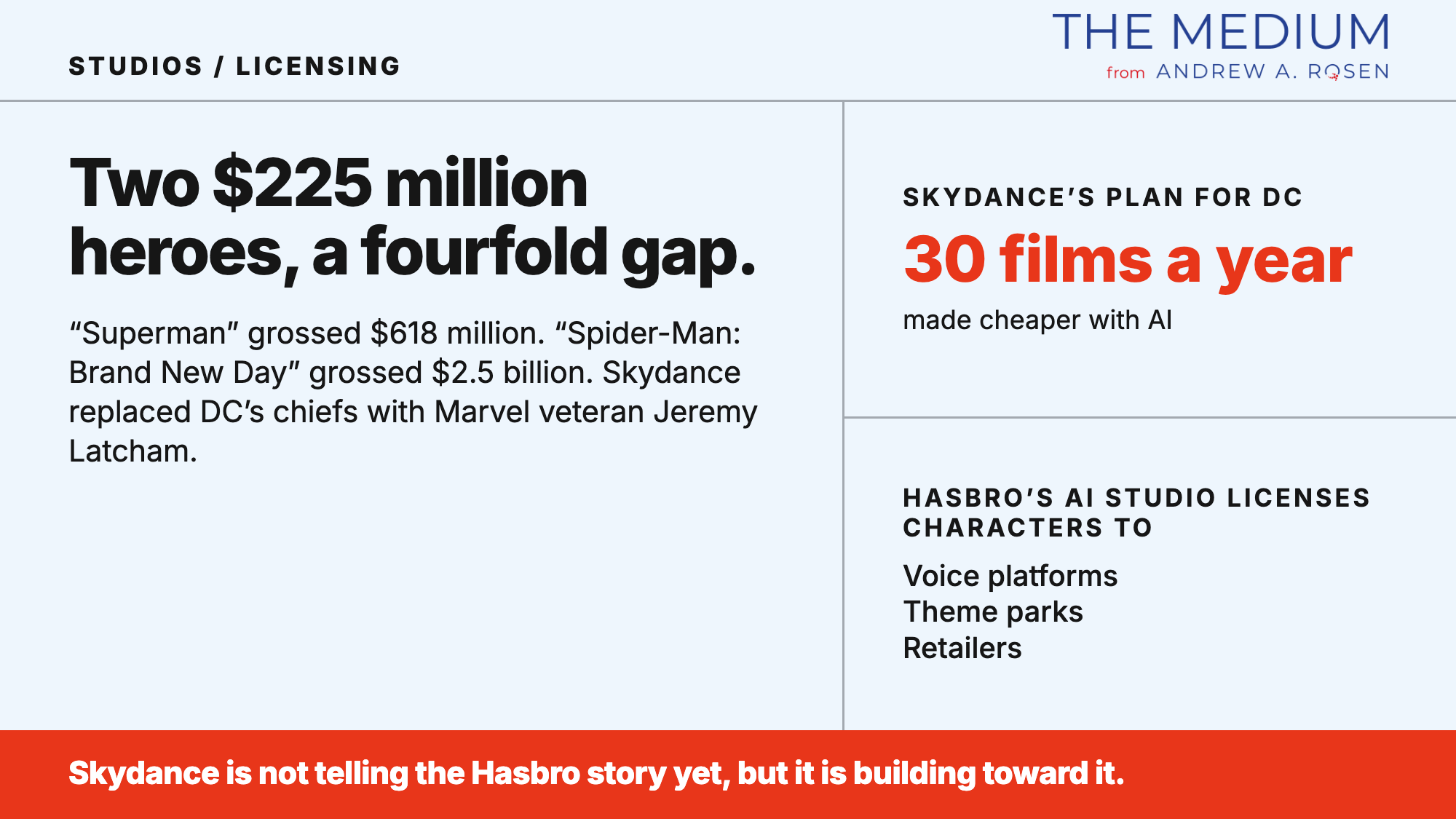
“Superman” and “Spider-Man: Brand New Day” each cost $225 million to make. “Superman” grossed $618 million. Sony’s “Spider-Man: Brand New Day” grossed $2.5 billion—four times as much.
This week Skydance announced it had fired DC Studios co-chiefs James Gunn and Peter Safran and replaced them with Marvel Studios veteran Jeremy Latcham as president and chief creative officer. The question now is what Skydance management will do with “an incredible treasure trove of superhero storytelling.”
DC Studios’ bets under Gunn and Safran had successes. In movies, “Clayface”—a horror movie about a villain from the DC Comics universe—recently grossed $109 million on a $44 million budget. On TV, “The Penguin” did well and “Lanterns” averaged above 12 million viewers per episode in the U.S. and nearly 19 million internationally.
Skydance has already given part of the answer. It promises at least 30 films per year in the face of declining theatrical revenues—down about 23% from 2019—while finding cost-efficiencies via AI. As I argued in December’s “Why MOAR Content Alone Won’t Save Legacy Media,” more films made more cheaply with AI are still more content.
Skydance CFO Dennis Cinelli told investors on Monday that management expects to have a $200 million headwind to adjusted EBITDA in Q4 from “the continued underperformance of the Warner Bros. film slate.” Gunn’s bet on “Supergirl” recently flopped with $126 million globally against a $170 million budget.
The open question is how Skydance plans to monetize DC IP via television and streaming. Pay TV is down to 50% of U.S. households, and streaming is seeing slowing growth—at 7% year-over-year compared to 12% in 2024 (Antenna Research). HBO’s “Peacemaker” and “Lanterns” are perfect examples of its challenges in TV and streaming. The second season of “Peacemaker”—starring the WWE crossover Hollywood star John Cena—had mixed responses from audiences after a hit first season and “Lanterns,” despite its success, generated as much fan backlash for its creative decisions as positive buzz.
The precedents Skydance inherits with DC Studios reflect the key challenge in this market moment. Online, every fan can not only argue for their own version of a character but generate their own versions—and I have highlighted how Star Wars fans are doing this . A hit has to speak to that fandom, and if not, compete with that fandom. Monoculture at scale is still possible—“Spider-Man: Brand New Day” not only survived but exceeded expectations. Elsewhere, the value of IP to audiences is beginning to fragment—Gunn’s bet on the horror genre with “Clayface” successfully captured a subset of DC Comics fans at scale.
Skydance is betting on 30 movies per year and using AI to make the production process cheaper. But the optimal model has long been monetizing that IP across multiple channels of a larger business—TV, streaming, consumer products. With pay TV in decline and streaming flattening, Skydance’s challenge with DC Studios is twofold:
Serving various fanbases
Finding new avenues for monetizing IP