Two unusual data points emerged from the streaming marketplace of the last two weeks:
11.8% price growth in streaming subscription prices over the last year against 3.9% for cable and satellite and broader inflation (3.84 percent annually since 2019);
Data from research firm Luminate showed that hiatuses of streaming originals that last more than 1.5 years cost hit shows a fifth to well over half their audience upon return.
Also, a data point from Bank of America in April that “about 44% of 2,000 Americans surveyed by Bank of America plan to keep their streaming subscription slate as-is, while another 44% plan to either cancel or downgrade one or more subscriptions.” Lurking in the background is YouTube’s growing dominance of U.S. television viewing (14.2% in July, according to Nielsen’s The Gauge).
There is an obvious story in this data about the supply side in streaming: The economics do not work at their current scale, so prices need to increase. There is also a story about consumer demand for streaming. Consumers not only are price sensitive to the economics of Hollywood content on streaming but also do not value the production model as much.
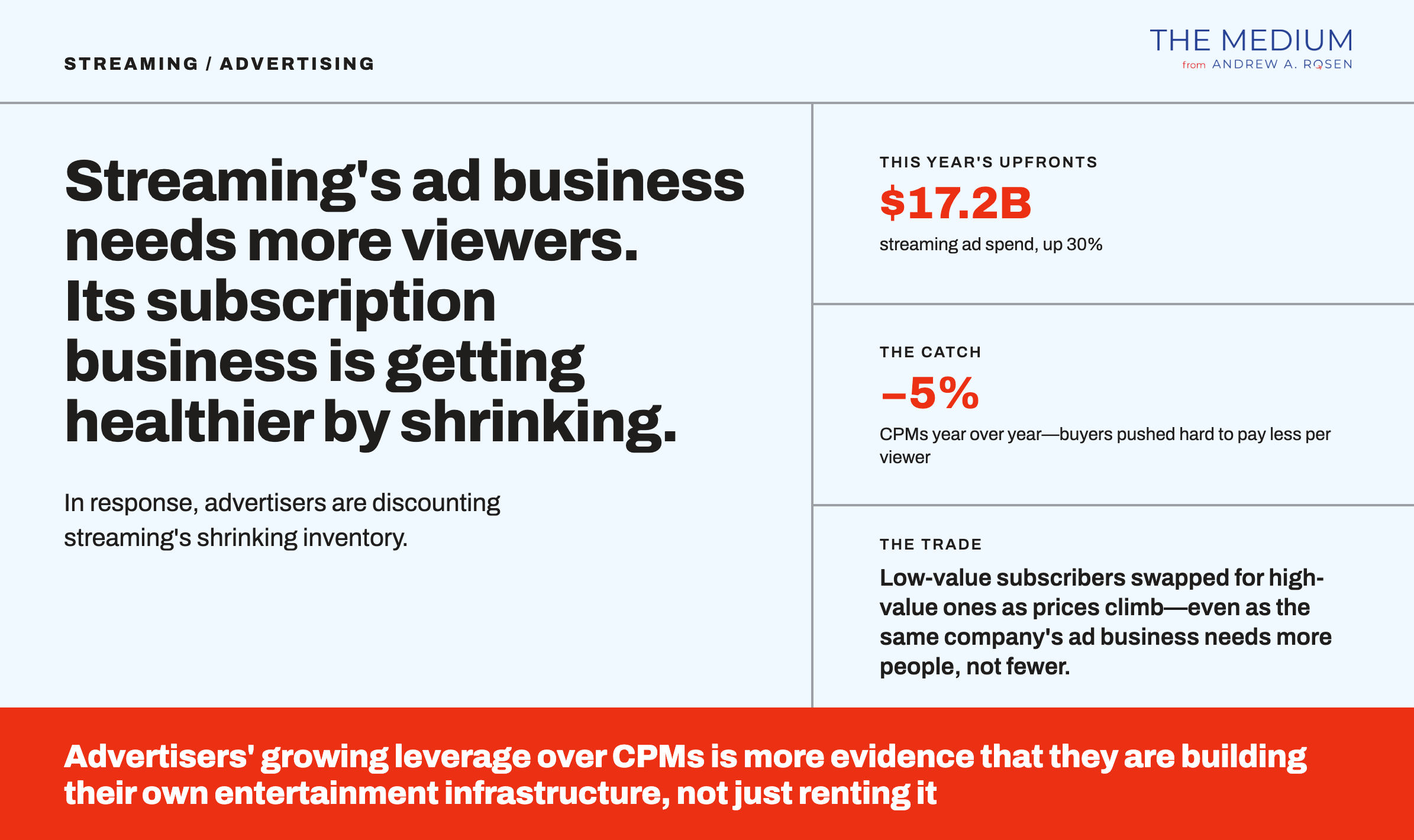
That presents a problem for the advertising-supported models: They require more scale to compete and attract advertising dollars; but in streaming, price increases are a tactic for combating lost revenues from churn at the risk of growth. The best evidence of this problem is almost every streamer (excluding NBCUniversal’s Peacock and Paramount+), has stopped reporting total subscribers since relying more heavily on price increases.
Streaming’s subscription business can get healthier by getting smaller and pickier—forcing out lower value customers while earning more from higher value, more loyal customers. However, its advertising business requires more people and not fewer. Both moves are happening inside the same subscriber base at the same time.
These echo a problem I argued back in April: “The traditional media value chain—produce content, attract audiences, sell advertising against those audiences, measure with Nielsen—is collapsing at each node.” In that argument I also highlighted how that problem opens the door for generative AI on both the production and advertising sides, but really on the latter.
These data points suggest that this is a problem of scale that generative AI not only cannot solve, but price hikes also undermine.